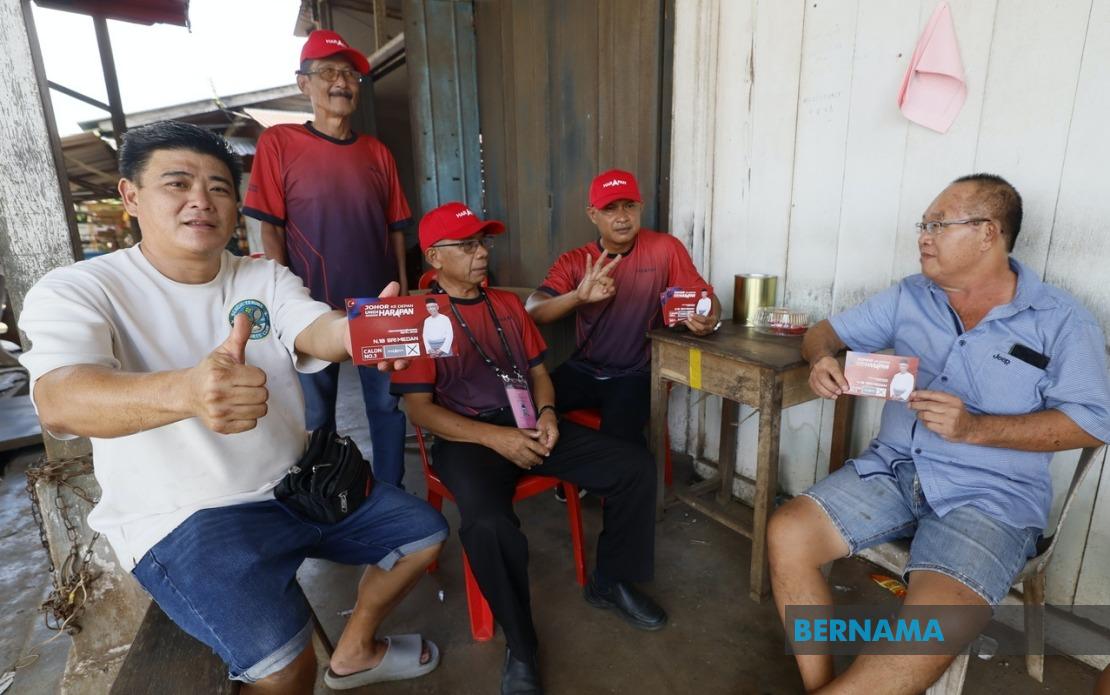
Former mathematics teacher Hishamudin Misrin Ishak, the Pakatan Harapan candidate contesting for the Sri Medan seat in the upcoming 16th Johor State Election, is pursuing a community-centred campaign strategy that places resident concerns at the forefront of his political engagement. Known affectionately as "Cikgu Misrin" among constituents, his walkabouts across Pekan Kangkar Senangar and other parts of the constituency have been marked by his attentiveness to local grievances, setting a tone for his candidacy that emphasises direct dialogue over grand pronouncements.
One of the most pressing issues affecting Sri Medan voters is the persistent flooding that has disrupted lives and livelihoods for years. Hishamudin has made tackling this environmental challenge a centrepiece of his campaign platform, signalling that infrastructure remediation will be among his first priorities should he secure the seat. His commitment to addressing long-standing flood problems reflects a recognition that environmental resilience directly impacts public confidence and constituency development—an increasingly important consideration as climate-related disasters become more frequent across Malaysia.
Beyond flood mitigation, Hishamudin's campaign platform extends to balanced territorial development. He has articulated a vision of equitable infrastructure allocation across urban, semi-urban, and rural zones within Sri Medan, recognising that disparities in public amenities and services often drive voter discontent in constituencies with mixed settlement patterns. This territorial equity approach acknowledges that a comprehensive development strategy must address the needs of fringe communities often overlooked by state-level planning initiatives.
Education and youth employment constitute another pillar of his proposed governance agenda. Hishamudin has committed to organising Technical and Vocational Education and Training (TVET) programmes and digital literacy initiatives designed to prevent young constituents from falling behind in an increasingly technology-dependent economy. This focus on skills development reflects broader Southeast Asian concerns about youth unemployment and workforce misalignment with emerging sectoral demands, particularly in rural and semi-urban areas where vocational pathways remain underdeveloped.
Small and medium enterprises form the economic backbone of most Malaysian constituencies, and Hishamudin has pledged to intensify support for SME expansion beyond local market constraints. His proposed interventions include facilitating market access broadening and reducing dependency on purely domestic consumer bases—crucial elements for entrepreneurs seeking to scale operations or access regional and international opportunities. This approach acknowledges that grassroots economic empowerment depends not merely on capital provision but on systemic barriers to market participation.
Hishamudin's personal background as a village head positions him as an administrative bridge between residents and state government apparatus. His experience in managing welfare matters and local development issues provides operational credibility often lacking in candidates without prior governance exposure. He has explicitly framed this experience as evidence of his ability to navigate bureaucratic channels effectively while maintaining accessibility to ordinary constituents, a balance frequently difficult to achieve in larger political structures.
Critically, Hishamudin has articulated a commitment to serving all residents irrespective of their political allegiances or voting patterns. This principled stance reflects an understanding that effective constituency management requires impartial provision of public services and facilities, a distinction he emphasises through his "work first, talk later" philosophy. In a political environment where partisan loyalty often dictates service allocation, this promise to transcend factional boundaries represents a significant rhetorical positioning.
Contesting in Sri Medan presents a formidable challenge for Hishamudin, as the constituency has traditionally favoured Barisan Nasional candidates. His opponent, incumbent Datuk Zulkurnain Kamisan, holds the advantages of incumbency and established organisational machinery, while Perikatan Nasional's Ahmad Rosdi Bahari represents a third electoral force in a fragmented opposition landscape. Despite these structural disadvantages, Hishamudin has reported encouraging voter reception during the early campaign phase, suggesting that his outsider status as a new candidate and relatively fresh face may resonate with constituents fatigued by established political cycles.
The campaign has entered its third day as of late June, with polling scheduled for July 11 and early voting on July 7. The compression of the campaign timeframe means candidates must rapidly build voter recognition and establish clear policy differentiation—a particular challenge for PH in a traditionally stronghold BN constituency. Hishamudin's emphasis on constituent accessibility and practical governance rather than ideological rhetoric may represent a strategic calculation that local voters are more responsive to promises of effective service delivery than broader political narratives.
His determination to persist in campaigning despite Sri Medan's historical BN dominance reflects confidence in demographic shifts or changing voter preferences within the constituency. Younger voters, particularly those graduating into the job market or establishing families, may be responsive to his TVET and SME support messaging, while environmental consciousness around flooding may have shifted traditional voting patterns. The extent to which Hishamudin can convert grassroots engagement into actual electoral support will become apparent on polling day, but his campaign already illustrates how opposition candidates in difficult terrain attempt to build competitive positions through localised, issues-focused strategies rather than reliance on broader partisan waves.

