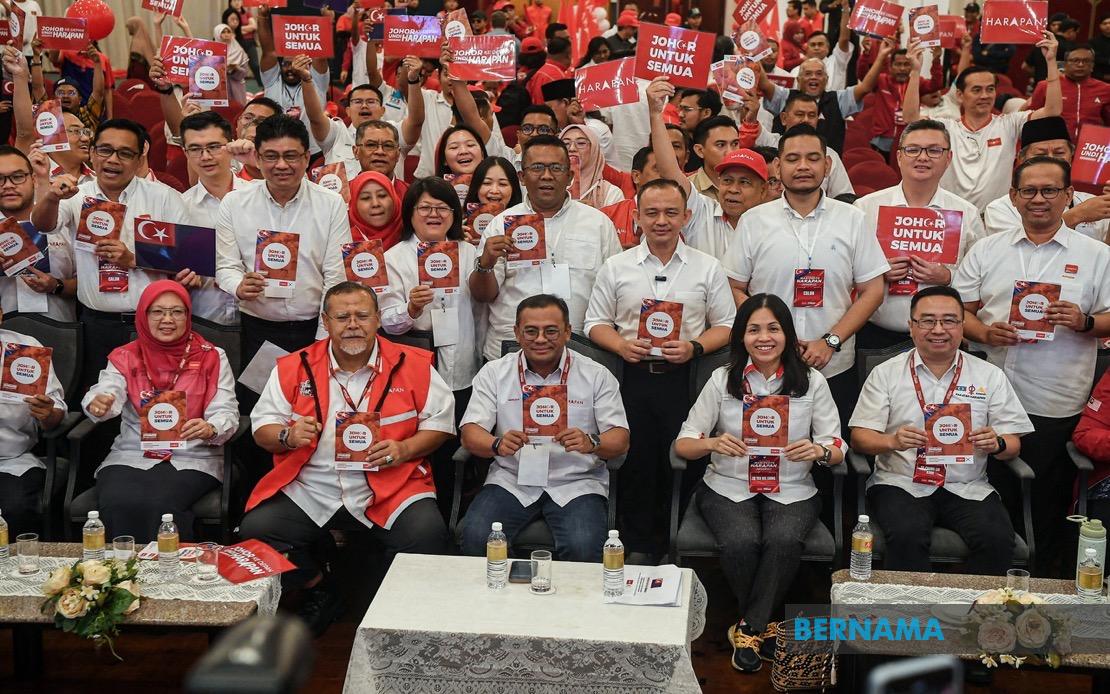
Pakatan Harapan has launched its manifesto for the 16th Johor state election under the banner 'Johor Untuk Semua' (Johor For All), with party leaders insisting the document represents genuine commitments rooted in observable community needs and economic realities rather than hollow campaign promises. Johor DAP chairman Teo Nie Ching, who also serves as Deputy Communications Minister, articulated this distinction at the launch event in Johor Bahru on July 3, arguing that the platform's comprehensiveness and specificity differentiate it from typical election rhetoric.
The manifesto encompasses ten principal pledges designed to appeal across demographic lines, from young professionals seeking economic opportunity to parents prioritising their children's welfare. These initiatives reflect coalition strategists' assessment of voter priorities in Malaysia's southernmost state, where economic concerns and quality-of-life issues consistently dominate public discourse. By framing the platform as attentive to distinct demographic segments—youth, mothers, and children—the coalition positions itself as having conducted genuine consultation rather than imposing a top-down agenda.
Education emerges as a cornerstone priority within the manifesto framework. This emphasis reflects broader Malaysian concerns about schooling quality, teacher shortages, and curriculum adequacy across the country. For Johor specifically, education policy carries outsized significance given the state's demographic composition and its role as an economic hub drawing talent from across Southeast Asia. The coalition's decision to foreground educational advancement suggests party strategists view this sector as both vulnerable to public criticism and responsive to targeted investment.
Another flagship commitment addresses the persistent congestion at Malaysia-Singapore border crossings, with PH pledging to reduce waiting times by fifty percent. This objective holds profound implications for Johor's economy and residents' daily lived experience. The Johor-Singapore border represents one of Asia's busiest land crossings, with hundreds of thousands of commuters, traders, and travellers transiting daily. Chronic delays impose measurable costs on commerce, worker productivity, and quality of life. Teo's confidence in achieving this target hinges explicitly on effective coordination with the federal Home Ministry, acknowledging that such improvements require sustained bureaucratic cooperation across government levels.
The proposed Johor Health Scheme constitutes perhaps the manifesto's most ambitious social commitment. This health initiative signals the coalition's recognition that healthcare accessibility and affordability remain pressing concerns for ordinary Malaysians. By specifically invoking Selangor's parallel health scheme as an operational model, PH strategists attempt to ground their proposal in demonstrated feasibility rather than untested theory. Selangor's experience becomes a persuasive reference point, suggesting that proven mechanisms can transfer across state contexts. This approach proves particularly valuable for voters harbouring scepticism about ambitious campaign promises, as it provides concrete evidence of viability.
First-time homebuyer assistance represents another substantial pledge within the platform. Malaysia's property market has become increasingly unaffordable for young adults entering the housing market, particularly in high-growth areas like Johor. Deposit assistance mechanisms directly address a documented barrier preventing home ownership among millennials and younger workers. This commitment resonates particularly strongly in Johor, where rapid urban development and foreign investment have driven property prices upward across major centres including Johor Bahru, Iskandar Puteri, and surrounding municipalities.
The manifesto allocation of a RM500 million fund dedicated to youth development demonstrates substantial financial commitment to a demographic group central to coalition electoral calculus. Young voters represent an increasingly conscious electorate capable of mobilising rapidly through digital platforms, making their engagement strategically crucial. This dedicated fund allows PH to demonstrate concrete resource commitment rather than rhetorical flourishes, addressing a generation facing employment precarity, limited wage growth, and housing unaffordability.
Teo's assertion that the manifesto reflects genuine deliverability rather than aspirational fantasy carries particular weight given her ministerial position. As Deputy Communications Minister, her credibility depends partly on the coalition's ability to honour stated commitments. Her confidence that initiatives can materialise provided federal government cooperation introduces a crucial caveat, however. This conditional framing acknowledges political reality—that state-level governments in Malaysia operate within constitutional constraints requiring federal coordination for certain policy domains. By explicitly noting the Home Ministry's role in border reduction efforts, Teo demonstrates understanding of Malaysia's federal structure while also pre-emptively addressing potential failure modes.
The timing of this manifesto launch carries strategic significance. Scheduled for the 16th Johor state election, with voting on July 11 and early voting on July 7, the coalition presses its case at a juncture when voter attention peaks. The compressed campaign window intensifies pressure on all contenders to crystallise their messages and differentiate their positions clearly. For PH, emphasising practical specificity rather than soaring promises attempts to exploit perceived advantages in detail-oriented governance thinking.
Johor's particular political importance cannot be overstated. As Malaysia's largest state by population and a crucial economic engine, political shifts in Johor reverberate across national politics. The state's diverse demographic composition—encompassing urban professionals, manufacturing workers, agricultural communities, and cross-border commuters—requires coalition platforms addressing heterogeneous interests. PH's ten-point platform attempts this balancing act through targeted offerings to distinct constituencies.
The coalition's invocation of "Bangsa Johor" (Johor people) in Teo's remarks reflects emerging identity politics within Malaysian electoral contests. By positioning the manifesto as specifically calibrated to Johor's unique circumstances and inhabitants, rather than merely applying national policies uniformly, PH taps into emerging regional consciousness. This localist framing, increasingly visible across Malaysian politics, acknowledges that voters increasingly evaluate candidates and platforms through state-specific lenses.
Critical observers will note that comprehensive manifestos inevitably raise implementation questions. The coalition's ability to realise these commitments depends on securing sufficient legislative seats, securing adequate budgeting, maintaining federal cooperation, and sustaining political will across the five-year electoral cycle. Voter scepticism about campaign promises reflects hard experience with previous unfulfilled pledges. PH's particular challenge involves converting stated good intentions into measurable policy outcomes within tight fiscal and administrative constraints characterising Malaysian subnational governance.

