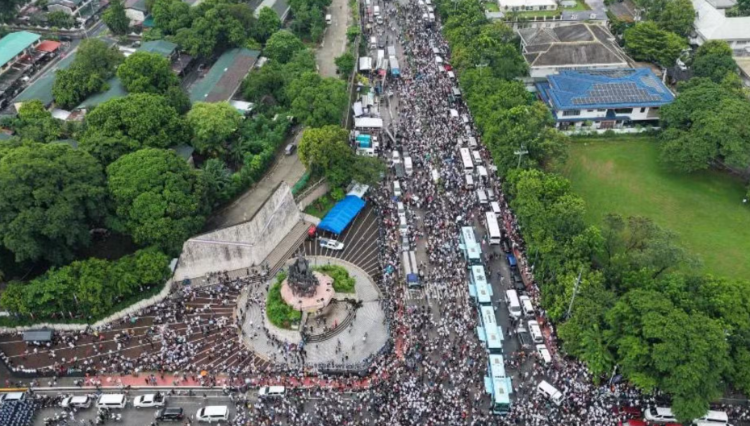
The Philippine capital descended into gridlock on Tuesday as members of the Iglesia Ni Cristo, one of the nation's most influential religious organisations, flooded the streets of Manila to demonstrate against the imminent prosecution of a prominent church member. The massive mobilisation brought traffic across the sprawling metropolitan area to a near standstill, with only public transport lanes remaining passable during peak commute hours. The timing and scale of the demonstration reflected the church's determination to signal its political clout at a particularly sensitive moment in the country's turbulent political landscape.
At the centre of the controversy stands Senator Rodante Marcoleta, whose dual identity as both an INC member and a staunch supporter of impeached Vice President Sara Duterte has thrust him into the crosshairs of anti-corruption enforcement. Government ombudsman Jesus Remulla announced the previous day that Marcoleta would face graft charges stemming from his alleged failure to disclose 75 million pesos in unspent election campaign funds. The disclosure failure, seemingly technical in nature, carries significant implications for the broader political drama unfolding in the country.
The timing of Marcoleta's legal troubles could hardly be more consequential. Sara Duterte's impeachment trial is scheduled to commence on July 6, and Marcoleta is widely expected to vote against conviction. In the upper chamber's 24-member composition, prosecutors require 16 votes to secure a guilty verdict that would remove Duterte from the vice presidency and permanently disqualify her from electoral office. Marcoleta's likely opposition to conviction makes him a potentially decisive figure in proceedings that will reshape Philippine political dynamics for years to come.
Church spokesperson Edwil Zabala framed the demonstration as a demand for impartial justice, rejecting what he characterised as selective prosecution. Speaking through a Facebook video message, Zabala declared that the INC would persist in seeking accountability regardless of whether authorities proceeded with Marcoleta's imprisonment. The rhetoric employed—emphasising the concept of selective justice as fundamentally unjust—reflected the church's positioning of its senator as a victim of politically motivated persecution rather than as someone facing legitimate scrutiny of potential wrongdoing.
Police estimates suggested the crowd had reached approximately 8,000 demonstrators by mid-morning, with expectations that numbers would swell considerably as the day progressed. The sheer mobilisation capacity demonstrated by the INC underscores its evolution from a purely religious institution into a formidable political force capable of assembling massive crowds at relatively short notice. This capability has made the organisation a coveted ally for politicians seeking to demonstrate grassroots support, particularly during periods of political instability.
The INC's recent activism reflects a broader pattern of leveraging its membership base for political purposes. In November, the church orchestrated a massive rally estimated to attract hundreds of thousands of participants, ostensibly to demand accountability regarding a sprawling flood control project scandal. Many speakers at that earlier gathering had shifted blame toward President Ferdinand Marcos, suggesting the church's willingness to orchestrate demonstrations that serve multiple political agendas simultaneously. Just two months prior, in January 2025, the INC had organised another substantial rally opposing Duterte's initial impeachment—proceedings that the Supreme Court subsequently reversed.
The convergence of these factors reveals a complex political ecosystem where religious institutions wield considerable electoral and street-mobilisation power. Duterte's spectacular rupture with former ally Marcos has fundamentally altered the political terrain, and the INC appears to have positioned itself as a key institutional backer of the Duterte faction during this realignment. Marcoleta's prosecution thus represents far more than a routine graft investigation; it constitutes a potential test of whether anti-corruption mechanisms can operate independently of factional interests.
Marcoleta's legal predicament sits within a broader pattern of legal jeopardy facing Duterte loyalists across multiple branches of government. Senator Jose Estrada, another prominent Duterte supporter, faced charges related to the same flood control corruption scandal that had triggered widespread public outrage. More dramatically, Senator Ronald Dela Rosa had fled to evade arrest on an International Criminal Court warrant connected to his operational role in the drug war orchestrated by Duterte's father, former president Rodrigo Duterte. These cascading legal challenges suggest either a systematic anti-corruption campaign or, as Duterte allies contend, a coordinated vendetta against the previous administration's officials.
The impeachment proceedings against Duterte herself represent perhaps the most significant constitutional crisis to engulf the Philippines since her father's presidency ended decades ago. Duterte's public falling-out with Marcos has fractured the political alliance that had enabled her electoral victory, exposing her to judicial accountability that likely would not have materialised under more harmonious political conditions. The Senate trial beginning July 6 will essentially determine whether the nation's constitutional impeachment machinery can function as an independent check on executive power or whether factional alignments continue to determine outcomes.
President Marcos's decision to cancel a planned engagement with international media representatives demonstrated the seriousness with which government officials viewed the street mobilisation. While the cancellation was ostensibly to monitor the developing situation, it also reflected the sensitivity surrounding public demonstrations that explicitly challenge government action, particularly when they involve constituencies as organised as the Iglesia Ni Cristo. The gesture conveyed recognition that large-scale religious institutional mobilisation merits executive attention.
For observers across Southeast Asia, the INC rally illuminates the enduring challenge facing developing democracies in balancing anti-corruption enforcement against the influence of powerful organised groups. Religious institutions command loyalty rooted in spiritual commitment, which translates into political organising capacity that secular political parties often struggle to match. This dynamic creates structural incentives for anti-corruption efforts to appear selective or factionally motivated, even when prosecutors act with genuine intent to pursue wrongdoing impartially. Marcoleta's case will likely determine whether Philippine institutions can navigate this tension successfully.

