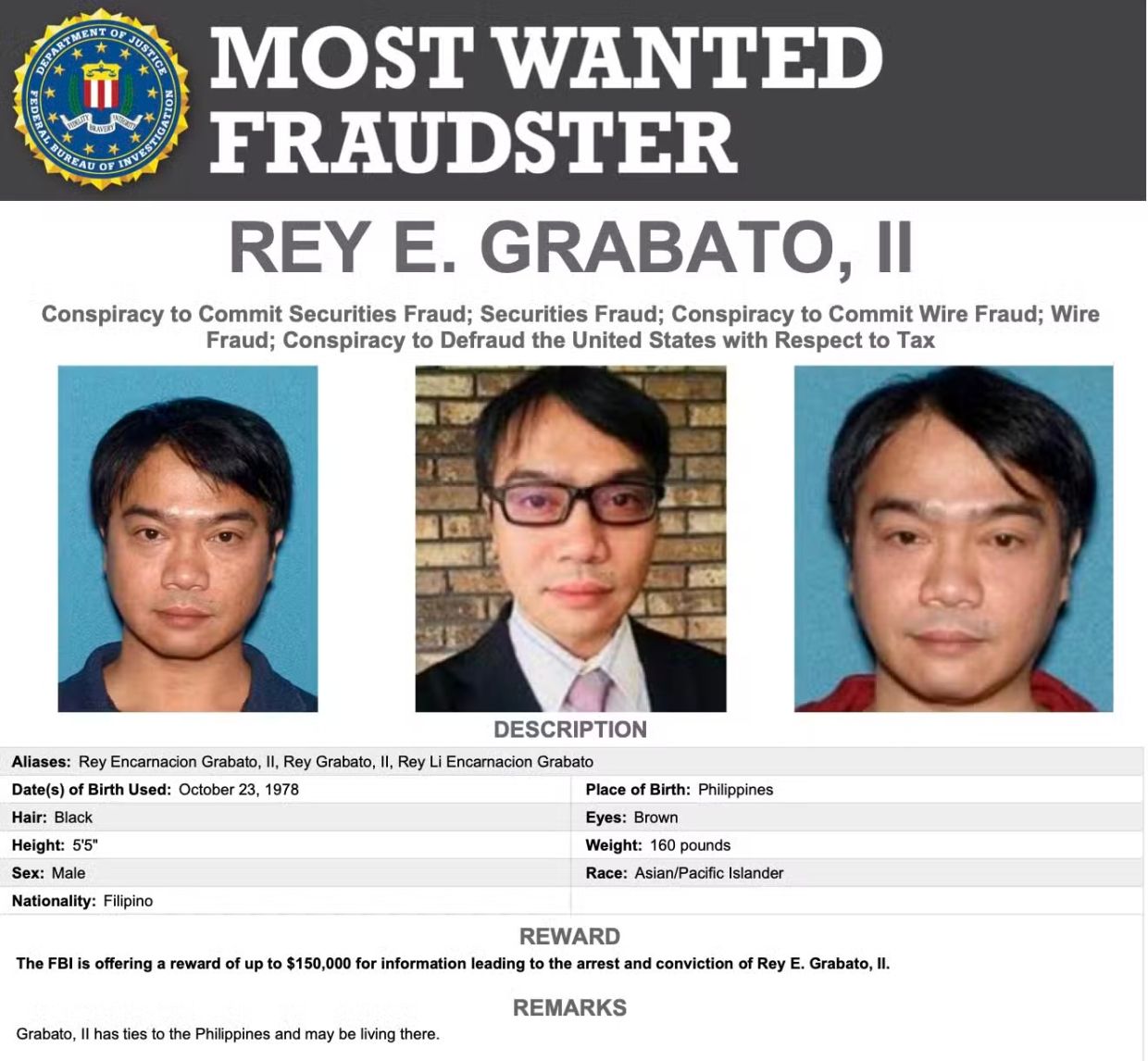
A prominent figure with ties to the Philippines has landed on the Federal Bureau of Investigation's Most Wanted Fraudsters list, marking an escalation in one of the largest investment schemes ever perpetrated against American citizens. Rey E. Grabato II, whose father Rey P. Grabato serves as mayor of Mina in Iloilo Province, stands accused of orchestrating a massive Ponzi operation that defrauded roughly 2,000 investors of more than US$650 million through a now-defunct real estate fund. The case illustrates the transnational dimension of financial crime and the challenges law enforcement faces when perpetrators operate across international borders, a concern that resonates deeply in Southeast Asia where similar schemes have victimized regional investors.
Grabato II's family background underscores the troubling intersection of business, politics, and financial malfeasance. His father has held the mayoral position in the Iloilo municipality, while his mother, Lydia Encarnacion Grabato, previously served in the same role. This political connection adds another layer of complexity to the case, raising questions about accountability and regulatory oversight at local government levels. The family's prominence in municipal affairs stands in stark contrast to the allegations levelled against Grabato II, who operated his fraudulent scheme from Hoboken, New Jersey, while maintaining registered addresses in both the United States and the Philippines.
The fraudulent enterprise centred on National Realty Investment Advisors LLC, or NRIA, where Grabato II served as former president and majority owner. Working alongside co-conspirator Thomas Nicholas Salzano, Grabato II allegedly orchestrated a sophisticated marketing blitz to attract investors to the NRIA Partners Portfolio Fund I LLC, a purported real estate investment vehicle. The campaign deployed multiple channels including mass email distributions, television spots, radio advertisements, and outdoor billboard promotions, complemented by in-person investor presentations designed to build credibility and confidence in the scheme.
Investors were systematically misled through false representations regarding the fund's financial stability and profit-generating capacity. Prosecutors allege that NRIA presented itself as a sound, profitable enterprise when in reality it generated minimal returns. The operation functioned as a classic Ponzi mechanism, where payments to early investors came not from legitimate investment returns but rather from capital supplied by newly recruited participants. This unsustainable structure inevitably collapsed as the flow of fresh investor capital diminished, leaving thousands of victims with substantial financial losses. Hundreds of investors came from New Jersey alone, though the scheme's marketing reach extended nationwide throughout the February 2018 to January 2022 operational period.
Beyond the primary fraud, prosecutors identified a systematic pattern of asset misappropriation targeting investor funds. Grabato II and his associates allegedly diverted millions of dollars for personal use or undisclosed purposes, compounding the harm inflicted on victims already deceived by false profit representations. This layered criminal conduct suggests a deliberate intent to exploit investor trust rather than isolated financial mismanagement. The scheme's sophistication and scale indicate substantial planning and execution, requiring coordination across multiple jurisdictions and maintenance of fraudulent documentation systems to sustain the deception.
The indictment encompasses additional criminal conduct extending beyond the core Ponzi operation. Grabato II faces charges related to a separate scheme designed to obstruct Internal Revenue Service collection efforts targeting approximately US$26 million in unpaid tax obligations owed to the federal government. This obstruction scheme operated independently from November 2007 through August 2022, suggesting Grabato II's involvement in tax evasion extended across nearly a decade and predated the primary investment fraud. The convergence of multiple criminal schemes underscores a pattern of systematic lawbreaking rather than isolated missteps.
A federal arrest warrant issued on October 12, 2022, in the US District Court for the District of New Jersey in Newark set the formal legal machinery in motion. However, Grabato II evaded apprehension and has remained at large since the charges were formally filed. His co-conspirator, Thomas Nicholas Salzano, was arrested in October 2022 and faces the same federal securities fraud and wire fraud charges. Grabato II's continued absence from custody, despite the magnitude of alleged crimes and international law enforcement coordination, points to the practical difficulties authorities encounter when pursuing fugitives with access to resources and multiple geographic havens.
The FBI has designated several aliases associated with Grabato II—including Rey Encarnacion Grabato II, Rey Grabato II, and Rey Li Encarnacion Grabato—reflecting the complexity of tracking individuals across borders who exploit name variations to evade detection. The agency has offered a substantial reward of up to US$150,000 for credible information leading to his arrest and conviction, demonstrating the case's priority status within federal law enforcement hierarchies. This reward amount reflects both the gravity of the alleged offences and the anticipated difficulty in locating and apprehending the fugitive.
Grabato II's inclusion on the Most Wanted Fraudsters list places him alongside other individuals with Philippine and Southeast Asian connections currently sought for major financial crimes. Michael Lizaso Marasigan, a Filipino-American dual citizen with Guam connections, appears on the same roster following his May 2025 conviction for illegal gambling operations, money laundering, and wire fraud charges. Similarly, husband-and-wife team John Michael Dimitrion and Julieanne Baldueza Dimitrion remain fugitives after failing to appear for sentencing in a 2009 Hawaii mortgage fraud case, having evaded authorities since July 2010.
The FBI formally established its Most Wanted Fraudsters list in June 2026 as part of a strategic pivot toward heightened enforcement against high-profile financial crime fugitives. This initiative reflects growing recognition within federal law enforcement that major fraud cases warrant the same intensive investigative resources traditionally concentrated on violent crime and terrorism matters. The list serves dual purposes: it consolidates information about the most damaging financial perpetrators while leveraging public awareness through media dissemination to generate tips from community sources.
For Malaysian and Southeast Asian readers, the case carries significant implications regarding investment security and due diligence. Schemes originating in or operating across the region increasingly target victims throughout Asia-Pacific, and perpetrators frequently exploit regulatory gaps and jurisdictional complexities. The Grabato II case demonstrates that even investors in major American financial hubs remain vulnerable to sophisticated deception, suggesting that regional investors should exercise proportionate caution when approached with unsolicited investment opportunities, regardless of purported geographic legitimacy or professional presentation.
The transnational investigation underscores the interdependence of international law enforcement frameworks and the necessity for cooperation between US federal agencies and foreign government counterparts. Capturing Grabato II will require coordinated intelligence-sharing and operational coordination potentially involving Philippine authorities, particularly given his registered Philippine address and family political connections. The case also highlights vulnerabilities in financial regulatory systems where determined operators can circumvent safeguards through sophisticated marketing and false documentation practices.
Individuals with information regarding Grabato II's whereabouts or activities can contact their nearest FBI field office or US embassy or consulate. The investigation remains active, and international cooperation continues to be pursued through diplomatic channels. As the case unfolds, it will likely influence regulatory approaches to oversight of real estate investment funds and marketing practices across multiple jurisdictions, potentially leading to strengthened investor protections and enhanced scrutiny of cross-border financial operations.

