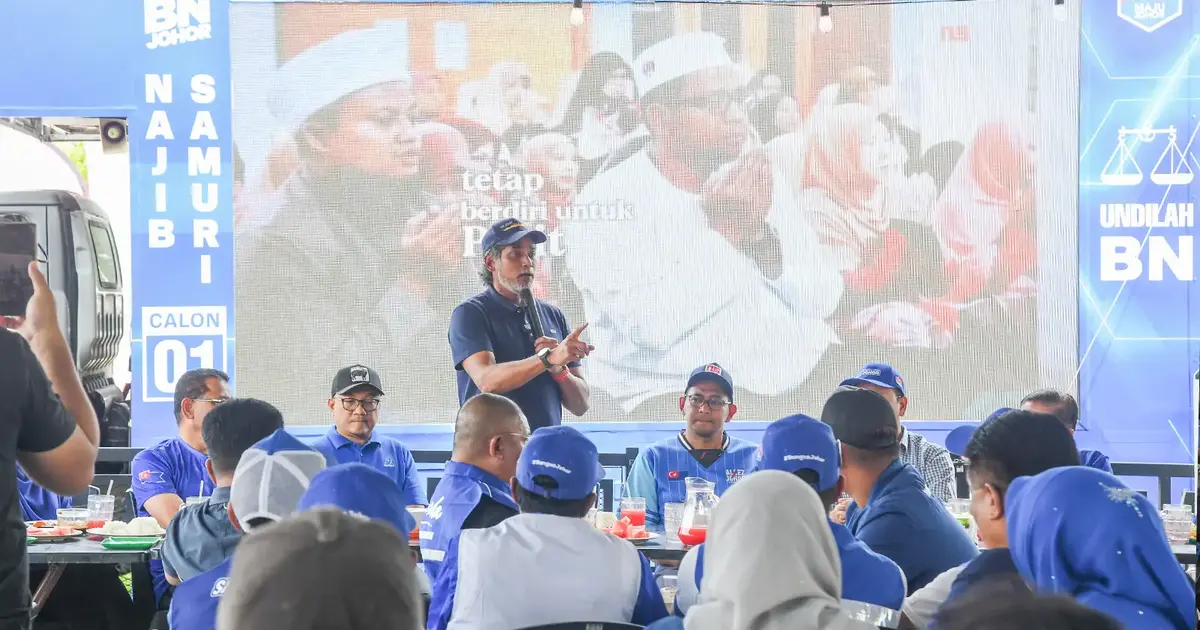
The escalating jostling for political advantage in Johor has taken a fresh turn as Khairy Jamaluddin, the former Umno Youth chief, imposed a prerequisite on Pakatan Harapan's engagement with the state's senior leadership. Khairy contended that PH must nominate its own prospective menteri besar if the opposition coalition intends to hold a public debate with Onn Hafiz Ghazi, the powerful chairman of Johor's Barisan Nasional chapter.
This demand reflects a broader positioning battle in Malaysian politics, where rival coalitions have become increasingly calculated about which figures participate in high-profile confrontations. The condition effectively establishes what Khairy frames as a "same level" requirement—a principle that privileges rank equivalency in political discourse. Such stipulations are common in campaign strategy, where parties seek to ensure their most credible and representative voices command the debate stage.
Onn Hafiz Ghazi holds considerable sway as both menteri besar and BN chairman in Johor, one of the nation's most politically significant states. His position combines substantial executive authority with party organisational responsibility, making him a formidable figure in any political contest. By insisting on parity, Khairy appears intent on protecting Onn Hafiz from what BN might characterise as a mismatch or asymmetric confrontation that could undermine the incumbent's standing.
The broader context matters considerably for understanding this development. Johor has emerged as a crucial battleground ahead of potential state elections, with both BN and PH investing heavily in grassroots mobilisation and candidate selection. The outcome in the state will carry implications for federal politics, given Johor's substantial parliamentary representation and its long historical association with Umno dominance. Any erosion of BN's traditional stronghold could signal broader shifts in the national political landscape.
For PH, the challenge is both tactical and substantive. The coalition must identify a prospective menteri besar candidate with sufficient credibility and public recognition to satisfy such demands. This is not merely a matter of fielding any prominent figure; Malaysian voters increasingly scrutinise opposition readiness to govern, particularly when state-level administration is at stake. The prospective candidate must demonstrate governance competence, electoral viability, and the ability to withstand public scrutiny.
KJ's intervention is noteworthy given his own trajectory within Malaysian politics. As a former Umno Youth leader and minister, his voice carries weight within conservative circles and represents establishment perspectives. His framing of the debate condition suggests Umno-linked figures are constructing coherent messaging around political engagement protocols, potentially signalling unity after years of internal party turbulence.
The debate itself remains hypothetical at this stage, but the preconditions now publicly articulated will shape how any eventual engagement unfolds. PH will need to weigh whether complying with this requirement strengthens or weakens its negotiating position. Fielding a prospective menteri besar in a high-stakes public debate carries genuine risks; a weak performance could undermine the candidate's electoral prospects, whilst a strong showing might establish momentum.
Regional observers will note that such public positioning reflects deeper concerns about legitimacy and governance capacity. Malaysian voters, particularly in traditionally dominant BN strongholds like Johor, remain sceptical about opposition capability to manage state affairs competently. Debates serve partly to assuage these concerns, allowing PH to demonstrate administrative readiness through detailed policy articulation and cogent responses to probing questions.
The timing of this intervention also merits consideration. As political movements intensify around potential Johor state elections, both coalitions are testing boundaries and establishing frameworks for competition. Such preliminary skirmishing often precedes formal campaign periods, allowing parties to signal strength and set terms of engagement before voting commences.
For Malaysian politics more broadly, this development illustrates how debate protocols have become increasingly formalised and strategically significant. Rather than spontaneous or impromptu exchanges between political figures, contemporary Malaysian politics features carefully negotiated parameters around public discourse. This reflects both growing sophistication in political communication and heightened stakes around policy contests.
PH's response will prove illuminating. Should the coalition identify and nominate a credible menteri besar candidate willing to undertake such a public confrontation, it would signal serious intent regarding Johor. Conversely, declining to meet Khairy's stipulation could allow BN to frame PH as unwilling to subject itself to rigorous scrutiny or lacking suitable candidates for state leadership roles. Either path carries implications for how Malaysian voters assess opposition readiness for power.

