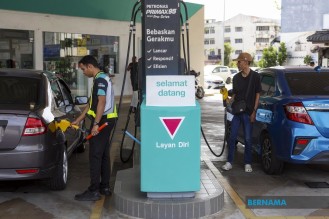
Petronas petrol stations across Malaysia will maintain adequate fuel supplies through August, according to assurances provided by the government during the National Economic Action Council's weekly meeting on June 25. Datuk Seri Azalina Othman Said, Minister in the Prime Minister's Department (Law and Institutional Reform), made the statement after receiving an official briefing from Petronas on the company's fuel position and future projections. The confirmation addresses earlier concerns raised by parliamentarians about supply guarantees that had been quoted as extending only to the end of June 2026, prompting questions about contingency arrangements for the months ahead.
The Petronas station network represents a critical backbone of Malaysia's energy infrastructure, commanding approximately 50 percent of the nation's domestic fuel demand through its publicly listed subsidiary, Petronas Dagangan Bhd. This substantial market share means that any disruption to the company's supply chain would have immediate ripple effects throughout the broader economy and across the daily lives of Malaysian motorists and businesses. The scale of Petronas's distribution footprint underscores why government monitoring of its fuel position has become a priority issue at the highest levels of economic coordination and policy-making.
To tackle the complex challenge of maintaining energy security amid escalating global tensions, the Malaysian government has established a dedicated Crisis Management Task Force (PPPK) operating under the auspices of MTEN. This specialised unit was created specifically to address the implications of the West Asia conflict for Malaysia's energy situation and to ensure coordinated governmental response across relevant agencies and departments. The task force represents an acknowledgement that energy disruptions stemming from international instability require proactive, centrally coordinated management rather than ad-hoc departmental responses.
The mandate of the Crisis Management Task Force extends beyond simple supply monitoring. Officials emphasise that the unit continuously assesses the country's fuel, petroleum, and energy supply outlook, tracking both immediate and medium-term requirements while evaluating potential vulnerabilities. Crucially, the task force maintains a dual focus: ensuring that supplies remain adequate to meet national needs while simultaneously implementing price controls to prevent cost shocks that would burden consumers and businesses. This balance between availability and affordability reflects the government's recognition that energy security encompasses not just physical supply but also economic accessibility.
Beyond price management, the task force has also prioritised preventing irregular activities that could undermine fuel distribution networks. Fuel smuggling represents a persistent challenge in the Southeast Asian region, diverting supplies intended for domestic use and potentially creating artificial shortages. By coordinating enforcement efforts and intelligence gathering, the government aims to preserve the integrity of legitimate supply channels and ensure that domestic allocations reach intended consumers and retailers. These enforcement dimensions operate alongside diplomatic and commercial efforts to secure additional supply sources.
Recognising the structural challenges posed by Middle Eastern supply dependencies, Malaysian energy planners have initiated efforts to diversify crude oil procurement from regions outside West Asia. The government is actively pursuing supply arrangements with exporters in West Africa and the Americas, thereby reducing exposure to geopolitical risks concentrated in a single volatile region. However, such diversification cannot proceed through unilateral decision-making; crude oil purchases depend on matching grade specifications with national refineries' technical requirements and negotiating commercially viable terms that align with government budgetary constraints and market conditions.
The diversification strategy reflects a broader pattern observed across Asia-Pacific energy importing nations, where geopolitical instability in traditional energy-producing regions has prompted governments and companies to re-evaluate their supply chain architecture. Malaysia's approach mirrors efforts undertaken by other regional economies to build resilience through geographic distribution of supply sources. Nevertheless, shifting sourcing patterns involves practical complications including logistics, refining infrastructure compatibility, and long-term contractual negotiations with unfamiliar suppliers.
The confirmation that fuel supplies will remain stable through August provides temporary reassurance to Malaysian businesses planning operations and consumers managing transportation costs during the coming months. This extended timeframe offers government and industry stakeholders a window to implement longer-term strategic adjustments. However, the implicit understanding is that August represents a checkpoint rather than a final deadline, and that continued monitoring and adaptation will be necessary as the global energy situation evolves.
The government's establishment of the Crisis Management Task Force and its public disclosure of monitoring mechanisms signal an intent toward transparency regarding energy security challenges, a departure from earlier periods when energy assessments occurred largely outside public awareness. This communication approach serves multiple purposes: reassuring the public and business community about governmental vigilance, demonstrating coordination across agencies, and acknowledging that energy security requires sustained attention beyond traditional quarterly or annual planning cycles. The question posed by Opposition parliamentarian Khairil Nizam Khirudin, which prompted this public response, highlights how energy security has become a legitimate subject for legislative scrutiny and accountability within Malaysian parliamentary proceedings.

