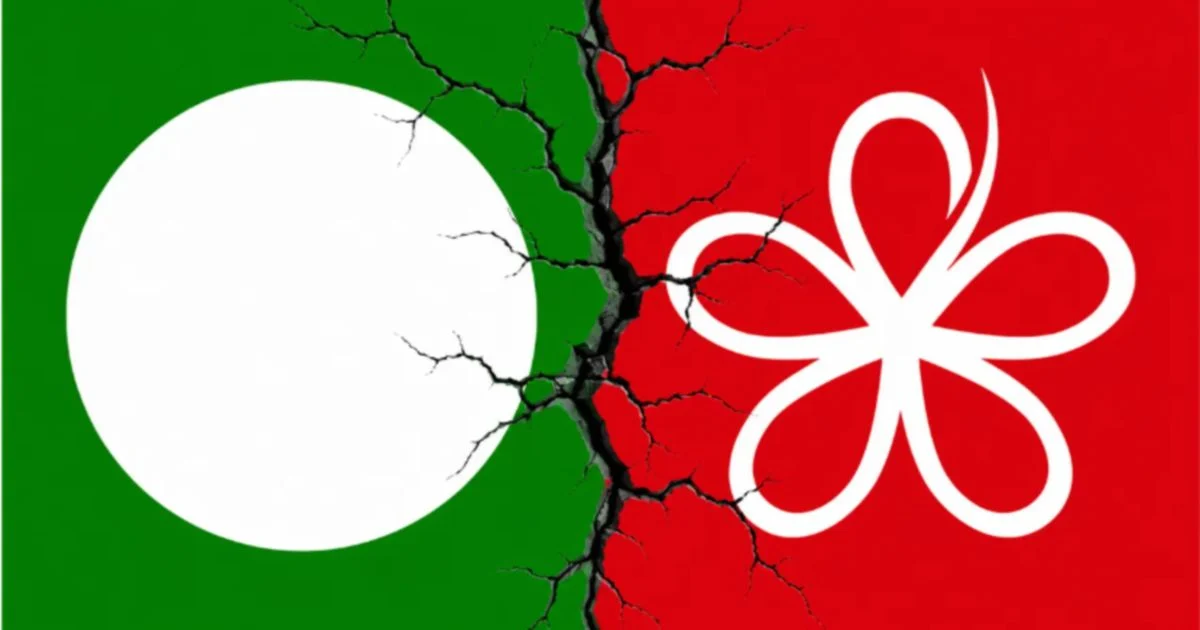
The deepening fault lines within Perikatan Nasional between its two largest component parties, PAS and Bersatu, pose an existential threat to the coalition's ambitions in the 16th General Election. Political analysts caution that the deteriorating relationship between the Islamist party and the KeADILan-splinter faction could trigger a cascade of defections among voters who previously consolidated support around the opposition bloc, fundamentally altering the electoral calculus that has defined Malaysian politics over the past five years.
The schism between these ostensible allies reflects a collision of competing ideological priorities and power-sharing arrangements that have festered beneath the surface since Perikatan Nasional's formation. PAS, long accustomed to dictating the terms of Islamisation policy and governance within its strongholds, increasingly views Bersatu's presence within the coalition as a constraint on its autonomy. Conversely, Bersatu has struggled to establish a distinct political identity beyond its association with Muhyiddin Yassin's residual faction, leading to jurisdictional disputes over resource allocation and candidate selection in contested constituencies.
The electoral consequences of this rupture extend beyond symbolic political theatre. Perikatan Nasional derives considerable organizational strength from the notion of unity against Pakatan Harapan and UMNO-led Barisan Nasional—a narrative that mobilised middle-class urban voters, younger demographics seeking political alternatives, and traditional BN supporters disillusioned with the ruling coalition. A visibly fractured partnership signals to these constituencies that Perikatan Nasional cannot manage internal cohesion, raising fundamental questions about its capacity for governance.
Dissident voices within both parties have begun articulating alternative arrangements, with some PAS figures suggesting that the party would fare better competing independently or realigning with UMNO, whilst certain Bersatu members openly question whether continued affiliation with an increasingly dominant PAS serves their long-term interests. These defections of prominent figures and intellectual capital represent not merely personality clashes but substantive disagreements over Perikatan Nasional's ideological direction and electoral strategy.
The timing of this internal crisis proves particularly damaging given the compressed campaign schedule and the necessity for unified messaging in a fragmented media landscape. Voters encountering conflicting narratives from coalition partners experience cognitive dissonance that typically translates into lower turnout among sympathetic constituencies—precisely the segments Perikatan Nasional requires to compensate for its geographic disadvantages relative to Barisan Nasional's nationwide infrastructure and administrative advantages.
Regionally, Perikatan Nasional's struggle carries implications for opposition dynamics throughout Southeast Asia, where soft-Islamist parties grapple with similar tensions between ideological expansion and coalition pragmatism. Malaysia's experience demonstrates the precarity of such arrangements when foundational disputes regarding religious authority, party autonomy, and electoral viability remain unresolved.
The Malaysian electorate, accustomed to coalition politics, nevertheless exhibits measurable sensitivity to visible unity failures. Swing voters and ticket-splitters—demographic segments vital to determining election outcomes in marginal constituencies—often interpret public acrimony between coalition partners as evidence of dishonesty or tactical desperation. This perception, once established, proves remarkably resistant to remedial messaging and tends to reinforce support for competitors perceived as more stable or cohesive.
Both PAS and Bersatu confront a strategic dilemma: dissolving the partnership might allow each party to pursue distinct electoral strategies, yet fragmentation eliminates Perikatan Nasional's capacity to challenge entrenched advantages held by Barisan Nasional's integration of state apparatus, media apparatus, and decades of incumbent privilege. The coalition thus faces a paradox wherein continued association entails accepting influence constraints, whilst separation guarantees diminished collective leverage.
Financial and organizational flows within Perikatan Nasional have already begun reflecting this deterioration, with disputes emerging over campaign funding allocations, division of nomination rights, and control over media messaging apparatus. These technical disputes, though ostensibly procedural, frequently mask deeper questions regarding each party's valuation within the coalition and its strategic prospects in contested territories.
Local party machinery in crucial swing states reports receiving contradictory directives from central party leadership, creating operational inefficiencies that undermine grassroots mobilisation and volunteer recruitment. This dysfunction proves particularly consequential in parliamentary constituencies where electoral margins have narrowed substantially since the 2022 General Election.
The resolution of Perikatan Nasional's internal crisis remains uncertain, with party leaders publicly expressing commitment to unity whilst privately exploring contingencies. Whether the coalition successfully navigates these tensions—through negotiated power-sharing adjustments, leadership changes, or ideological compromises—will substantially determine whether it emerges from the 16th General Election as a viable governing alternative or fades into factional irrelevance.