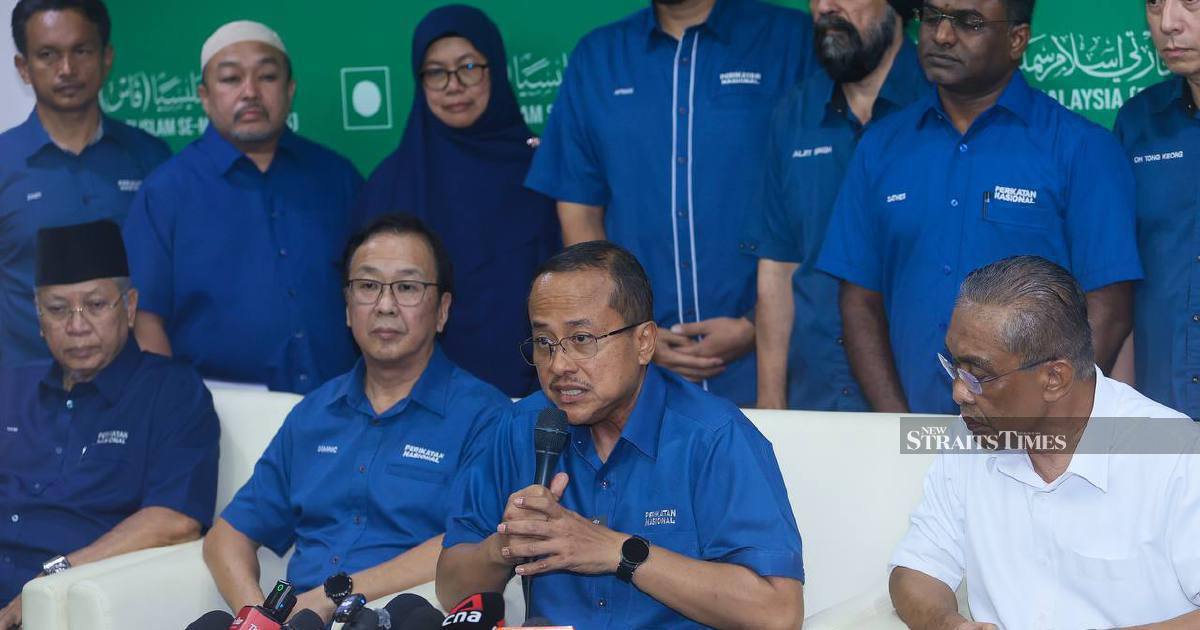
Perikatan Nasional has opened its doors to two additional political parties following an emergency Supreme Council meeting convened in Kuala Lumpur, according to PN chairman Datuk Seri Dr Ahmad Samsuri Mokhtar. The expansion represents the latest development in the coalition's ongoing evolution since its formation, though critical disagreements between member parties appear to have been deliberately shelved at this critical juncture.
The inclusion of the two new parties signals that PN remains focused on broadening its political base and increasing its collective parliamentary representation ahead of what observers anticipate will be significant political realignments. By welcoming additional members, the coalition demonstrates its capacity to attract and integrate smaller political entities into its structure, even as internal tensions simmer beneath the surface.
Notably, PN's leadership chose not to address what have become two of the most contentious issues within the coalition: the controversial logo design and fundamental disagreements over Wawasan—the coalition's strategic vision and ideological direction. These omissions suggest a deliberate strategy to avoid escalating existing friction between member parties, each of which has distinct regional bases and political agendas.
The logo dispute has emerged as a surprisingly significant flashpoint within PN, with different parties holding competing visions for the coalition's visual identity and the symbolism it conveys to voters. The failure to resolve this matter indicates that compromise remains elusive, and postponing discussion may have been deemed preferable to forcing a resolution that could trigger withdrawals from disgruntled members.
The Wawasan question carries even greater implications for PN's political future. This encompasses not merely sloganeering but fundamental differences over the coalition's ideological positioning, its relationship with Islamist principles, federalism, and economic policy. By sidestepping this discussion, PN's Supreme Council avoided what could have been a destabilizing confrontation that might have fractured the coalition at a moment when unity serves its strategic interests.
For Malaysian political observers, this approach reveals much about how PN manages its internal contradictions. The coalition brings together entities with genuinely divergent worldviews and voter bases, yet maintains cohesion through strategic issue avoidance and calculated pragmatism. This may prove effective in the short term but raises questions about whether PN possesses the ideological coherence necessary for sustained governance.
Regionally, PN's expansion matters beyond Malaysia's borders. As Southeast Asian nations navigate complex political transformations and coalition-building remains central to governance across the region, how PN manages internal disputes while maintaining external strength offers instructive lessons. Other emerging coalitions in the region watch closely to see whether PN can sustain itself despite fundamental disagreements on core questions.
The timing of this expansion is particularly significant. By admitting new members now, PN strengthens its numerical position without simultaneously attempting to resolve divisive internal matters that could fracture the coalition. This suggests PN's leadership believes the political environment favors growth and consolidation over ideological refinement.
Datuk Seri Dr Ahmad Samsuri Mokhtar's statement explicitly noting that the Wawasan and logo issues were not discussed indicates these topics were consciously removed from the meeting's agenda. This transparency about what was avoided is itself noteworthy, as it signals to member parties that leadership recognizes the sensitivity of these matters and respects existing disagreements, at least for now.
The practical implications for PN's effectiveness remain uncertain. A coalition can function without complete agreement on vision and symbolism if members agree on tactical objectives and seat-sharing arrangements. However, presenting a unified front to voters becomes more challenging when fundamental questions about identity and direction remain unresolved. PN will need to clarify these matters before contesting elections in states or federally.
For Malaysian voters, the expansion raises questions about what PN actually represents beyond a mathematical convenience. If the coalition cannot articulate a coherent Wawasan and struggles with even basic visual presentation, how effectively can it communicate its governance platform to constituents?
Moving forward, the two newly admitted parties will discover whether PN's internal culture emphasizes substantive debate and ideological alignment or merely transactional political cooperation. The coalition's ability to ultimately resolve the logo and Wawasan disputes will significantly determine whether it emerges as a governing force capable of articulating a clear alternative to existing Malaysian political arrangements.