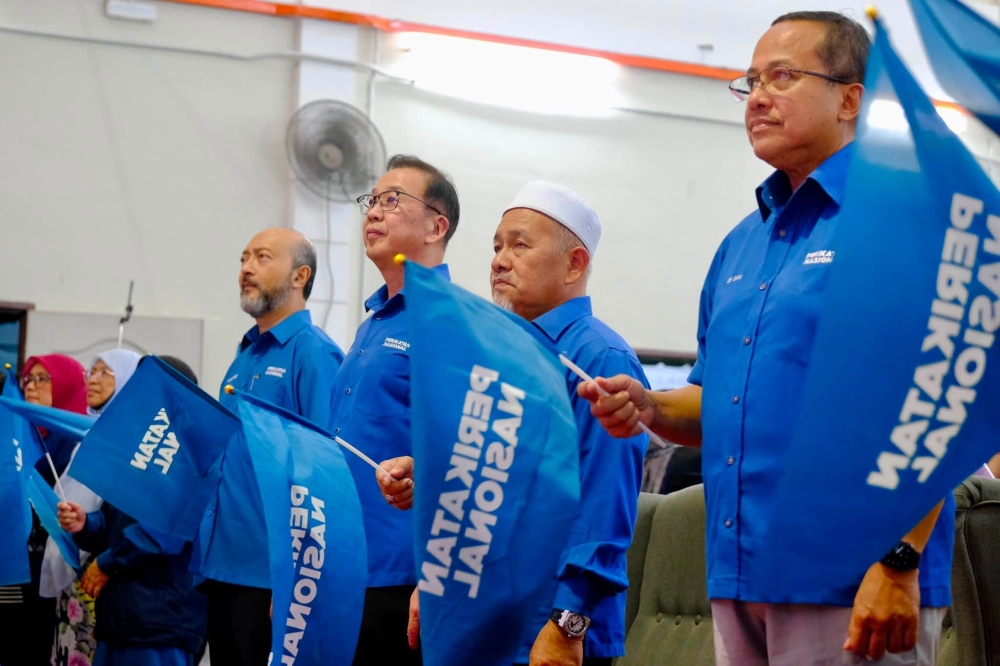
Perikatan Nasional chairman Datuk Seri Ahmad Samsuri Mokhtar has opened the door to a potential continuation of the coalition's working relationship with Barisan Nasional beyond the current political cycle, signalling that the two power blocs could remain aligned for the 16th general election if their experimental partnership at state level yields positive results. The remarks represent a significant shift in coalition mathematics ahead of what is expected to be a closely contested national election, and underscore how Malaysian politics continues to revolve around fluid alliance-building among competing factions.
Ahmad Samsuri's comments hinge critically on the performance of a recent agreement struck in Negeri Sembilan, where Perikatan and Barisan have opted to cooperate rather than compete directly. That arrangement serves as a testing ground for whether the two coalitions can manage shared governance and navigate divergent interests without the friction that has historically fragmented Malaysian political blocs. The Negeri Sembilan model is thus far more than a state-level experiment—it functions as a bellwether for national coalition possibilities and a statement about pragmatism in Malaysian politics.
The broader context matters here. Malaysia's political landscape has been marked by recurrent realignments, with parties frequently shifting allegiances based on electoral prospects and internal calculations. Barisan Nasional, long the dominant political force, has faced erosion in recent elections, while Perikatan Nasional emerged as a significant challenger, particularly after its strong showing in the 2022 general election. Rather than remaining in perpetual opposition to one another, these coalitions have explored pockets of cooperation, particularly in state-level arrangements where shared interests and negotiated settlements can defuse competition.
The Negeri Sembilan pact demonstrates a recognition among leadership in both PN and BN that continued fragmentation of the non-Pakatan Harapan vote could weaken their respective negotiating positions. Electoral mathematics in Malaysia often reward consolidated blocs, and a fractured opposition or non-government coalition can see its influence diluted. By proving that coexistence and cooperation are possible at the state level, both coalitions can demonstrate to their grassroots members and potential voters that pragmatic governance trumps rigid ideological positioning.
However, Ahmad Samsuri's conditional language—that a GE16 extension depends on Negeri Sembilan's success—also reveals the inherent tensions. Perikatan and Barisan remain fundamentally different entities with distinct membership bases, ideological orientations, and ambitions for national leadership. Sustaining such an alliance requires careful management of expectations, clear delineation of territories where one bloc takes precedence over another, and mechanisms to resolve disputes without triggering broader coalition collapse. The Negeri Sembilan arrangement will be watched for signs of whether these mechanisms can hold under pressure.
For Malaysian voters, the implications are substantial. A PN-BN alliance extending to GE16 would reshape the electoral battlefield, presenting voters with a consolidated bloc that could compete more effectively against Pakatan Harapan's coalition. This could reduce the number of three-way contests in marginal seats, potentially tightening races and reducing the fragmentation of parliamentary representation. From a governance perspective, such an alliance—should it win—might offer more stability than previous coalition arrangements that cobbled together disparate parties with minimal shared vision.
Yet there are risks embedded in Ahmad Samsuri's proposal. Perikatan, which includes Bersatu, PAS, and other components, has developed distinct bases of support, particularly among rural and religious-conservative voters where PAS holds substantial influence. Barisan, traditionally anchored in UMNO with its own electoral machinery and demographic reach, brings different strengths. Merging these under a single coalition banner requires resolving fundamental questions about seat allocations, ministerial positions, and policy direction that have derailed previous attempts at grand alliances.
The international context of Malaysian politics deserves consideration as well. Larger regional geopolitical shifts, economic pressures, and cross-border challenges increasingly shape domestic politics. Both PN and BN will be navigating these pressures during their Negeri Sembilan trial run, and their ability to present unified positions on economic policy, regional relations, and security matters will be tested.
Regional observers across Southeast Asia will monitor how Malaysia's major coalitions navigate this phase. Coalition-building and electoral alliances remain central to politics across the region, and a successful model for sustained inter-bloc cooperation could have ripple effects. Conversely, if the Negeri Sembilan experiment collapses amid recriminations, it will reinforce the perception that Malaysian political coalitions remain transactional arrangements lacking durable foundations.
Ahmad Samsuri's comments should be understood as both an aspiration and a trial balloon. The Perikatan leadership is testing whether the idea of sustained PN-BN cooperation resonates with party members and the broader political establishment. Success in Negeri Sembilan would provide concrete evidence that such arrangements can work. Failure or significant friction would vindicate those within both coalitions who believe that fundamental differences make long-term alliances untenable. The coming months will be instructive as Negeri Sembilan governance unfolds and both coalitions signal their intentions more clearly for the 16th general election.

