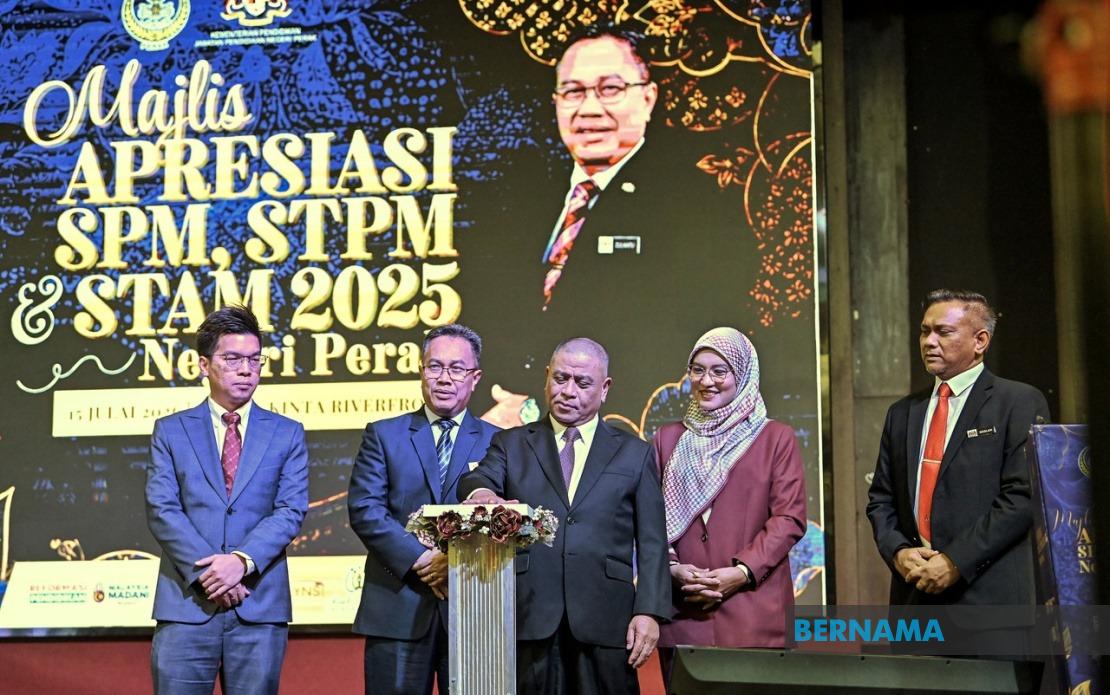
Perak's state government scholarship programme is delivering tangible benefits to students and their families, offering crucial financial support that enables young Malaysians to pursue their studies without overwhelming household budgets. The Menteri Besar Scholarship, distributed through a formal appreciation ceremony honouring top achievers in secondary and religious education, represents a targeted intervention addressing one of Malaysia's persistent educational equity challenges: ensuring that capable students from middle and lower-income households can afford the full costs of secondary and tertiary education.
Yoong Lam, a 20-year-old student from Sekolah Menengah Kebangsaan Sultan Yussuff who achieved a perfect 4.00 OGPA in the Sijil Tinggi Persekolahan Malaysia examination, illustrates how the RM1,200 per-semester allocation functions as a practical lifeline for families navigating educational expenses. The scholarship funds cover immediate necessities including school fees, academic reference materials, and supplementary tuition—outlays that collectively strain household budgets, particularly for self-employed parents serving as sole breadwinners. For Yoong Lam's household, the assistance has reduced pressure on her father's income while allowing her to invest in the additional academic support that contributed to her exceptional examination performance. Her case underscores a fundamental reality of Malaysian education: financial constraints can constrain opportunity, even among high-achieving students.
The scholarship extends beyond purely academic considerations to address broader social equity. By targeting students across different educational streams, including religious schools and tahfiz institutions, the programme acknowledges that excellence emerges from diverse pathways and student populations. Muhammad Haziq Hafit, aged 19 from Al-Ulum Al-Syar'Iyyah Religious Secondary School in Bagan Datuk, received RM1,000 to facilitate his transition to tertiary studies in education at the University of Malaya. Similarly, Muhammad Taufiq Ikwan Mohammad Asri from the same institution utilised his allocation to prepare for undergraduate studies in Egypt. These varied trajectories—from public universities to international study—highlight how the scholarship enables students to pursue differing educational ambitions without parents bearing the full burden of initial expenses.
Perak's educational outcomes provide quantitative context for understanding the scholarship programme's effectiveness within a broader improvement strategy. The state achieved a Grade Point Average of 4.49 in the 2025 SPM results, marking the strongest performance in thirteen years and continuing an upward trajectory sustained across three consecutive examination cycles. This achievement reflects cumulative improvements across multiple intervention points rather than any single initiative, but the scholarship forms part of a comprehensive ecosystem designed to remove barriers and create conditions for sustained academic progress.
A particularly significant dimension of Perak's 2025 results concerns geographic equity. The performance gap between candidates in urban centres and rural communities measured only 0.04 points, indicating that the state has substantially narrowed traditional disparities in educational access and quality. This compression of the urban-rural differential suggests that targeted programmes—including scholarships, instructional support, and resource provision—are functioning to democratise educational opportunity across the state's diverse geography. For Malaysia's broader development agenda, such equalisation matters enormously: rural talent channels into university systems and professional pathways rather than becoming constrained by circumstance.
Complementing the financial assistance scheme, Perak's Tuisyen Cikgu Saarani programme distributes supplementary reference materials designed to strengthen conceptual mastery in core examination subjects. The education director Zulkafli Mohamed Mokhtar identified this initiative as contributing substantively to the 2025 examination improvements. Over 63,000 copies of these supplementary reference books were distributed to secondary students throughout the state, with nearly 25,000 SPM candidates expected to benefit from the expanded 2026 iteration. The reference materials, developed collaboratively by experienced educators and Yayasan Perak with input from the state education department, address identified gaps in student comprehension of complex concepts and examination technique.
The expansion of this instructional support into religious schools and tahfiz institutions represents a deliberate policy choice to ensure that students pursuing Islamic education receive equivalent preparation intensity. Sekolah Menengah Tahfiz Darul Ridzuan and Sekolah Menengah Agama Rakyat students now access the same supplementary materials, with implementation overseen by the Perak Islamic Religious Department. This integration acknowledges that Malaysia's diverse educational system encompasses multiple legitimate pathways to qualification and credibility, and that quality assurance and performance improvement must reach across all institutional types.
Menteri Besar Datuk Seri Saarani Mohamad's framing of these educational results as evidence of systemic improvement reflects a governance philosophy emphasising long-term institutional capacity building. The state leader's public recognition of examination achievements and scholarship recipients functions partly to reinforce a cultural narrative—that diligence and capability receive recognition and support, and that excellent outcomes merit celebration. For students themselves, particularly those from households where tertiary education may represent a generational first, such public acknowledgement carries significance beyond the instrumental value of the financial assistance itself.
For Malaysian policymakers, Perak's approach offers instructive lessons regarding the integration of financial assistance and instructional improvement. Scholarships alone, while materially important, address only one dimension of educational equity; simultaneously strengthening the quality of teaching materials and instructional approaches amplifies effectiveness. The state has avoided positioning scholarship provision as charity or remedial intervention, instead framing it as recognition of merit and investment in human capital. This positioning likely influences how students and families perceive the assistance—as validation of capability and potential rather than welfare provision.
The programme's sustainability merits consideration, particularly regarding resource allocation and the potential for expansion. Perak's willingness to extend support across diverse educational streams and to intermediate supplementary materials at scale requires stable funding commitments and institutional coordination. As Malaysia confronts persistent concerns regarding educational equity and the risk that talented students from disadvantaged backgrounds remain unrecognised, programmes like Perak's demonstrate that targeted interventions, when coherently designed and adequately resourced, can produce measurable improvements in both individual outcomes and system-wide metrics.
Looking forward, the implications for other Malaysian states are substantial. Perak's successive years of examination performance improvement, achieved partly through combining financial support with instructional enhancement and culminating in reduced urban-rural disparities, suggests a replicable model for educational development. As Malaysia aims toward higher participation and completion rates in tertiary education and seeks to ensure that geographic location and household income do not determine educational trajectory, the integration of scholarships, supplementary learning resources, and committed institutional coordination offers a pathway worthy of broader adoption and investment.

