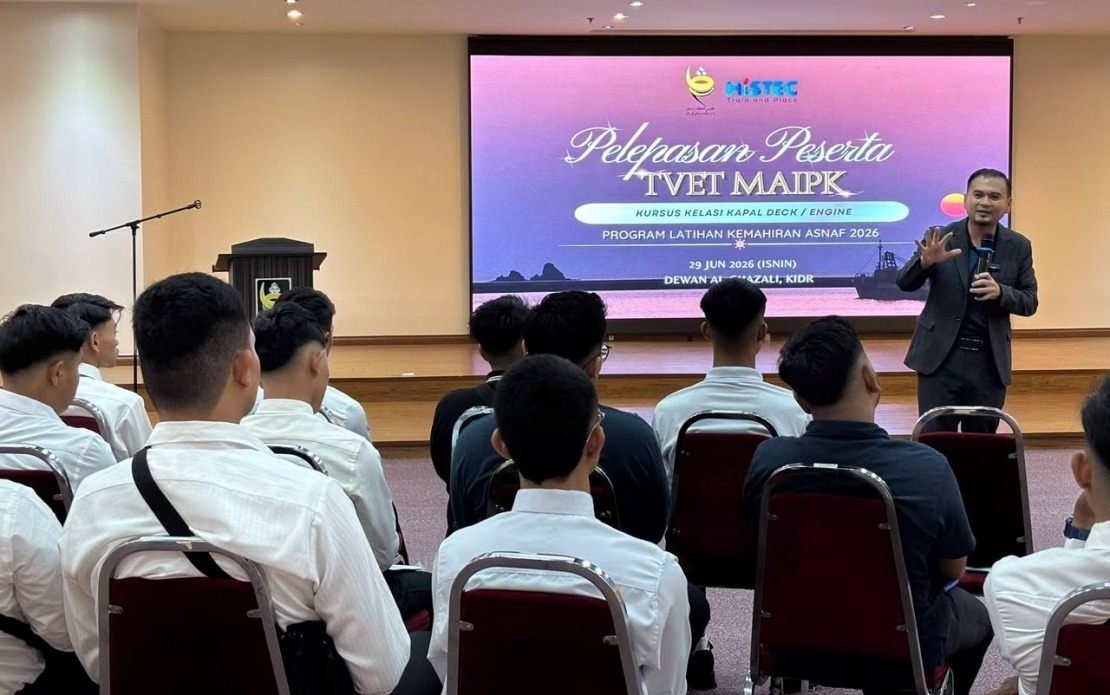
The Perak Islamic Religious and Malay Customs Council (MAIPk) has pledged RM470,000 to support 25 asnaf youth undertaking professional training in the maritime sector, marking a significant institutional commitment to vocational education as a vehicle for economic empowerment. The sponsorship, covering a full ship crew course encompassing both deck and engine specialisations, represents an investment of RM18,800 per participant and underscores the council's alignment with Malaysia's broader Technical and Vocational Education and Training (TVET) policy agenda.
The initiative reflects an increasingly recognised understanding within government and faith-based institutions that technical and vocational pathways offer tangible alternatives to traditional academic routes, particularly for economically disadvantaged communities. By directing resources toward maritime skills training, MAIPk is responding to documented labour shortages in the shipping and seafaring industries while simultaneously creating direct employment pathways for participants. The maritime sector, which continues to expand across Southeast Asia as regional trade grows, presents viable career advancement opportunities for trained crew members, with competitive wage structures that can substantially improve participants' earning potential and living standards.
The three-month training programme, to be conducted at the Ranaco Education and Training Institute in Chukai, Terengganu, combines classroom instruction with hands-on practical experience, a methodology recognised internationally as effective for maritime workforce development. Participants will acquire theoretical knowledge alongside practical competencies while pursuing professional certification and the seaman's licence—credentials that function as formal gatekeepers to employment in the shipping industry. This structured approach ensures that graduates enter the job market with both formal qualifications and demonstrable technical proficiency, reducing employer hesitation regarding hiring individuals from disadvantaged backgrounds.
The emphasis on immediate post-training employment placement distinguishes this initiative from many conventional skills programmes that leave graduates to navigate job markets independently. By securing employment opportunities within the maritime industry before or immediately upon course completion, MAIPk creates a seamless transition from training to productive economic participation. This placement guarantee reduces the risk of skill atrophy and maintains participant momentum, while simultaneously addressing labour gaps that maritime companies face in sourcing adequately trained crew members within Malaysia and the broader region.
From a socio-economic perspective, the programme targets the asnaf category—those classified as underprivileged under Islamic charitable frameworks—demonstrating MAIPk's interpretation of religious obligation toward community uplift through practical economic means. Rather than relying solely on direct financial assistance, the council has channelled resources into human capital development, a longer-term strategy with compounding benefits. Participants who successfully transition into maritime careers establish stable income sources that extend benefits beyond themselves to family members and dependents, thereby multiplying the programme's social impact across household units and contributing to gradual poverty reduction.
The initiative also responds to broader Malaysian workforce development challenges. As the nation pursues higher-value manufacturing and service sectors, demand for skilled technical workers—particularly in transportation, logistics, and maritime industries—continues to outpace supply. Programmes such as this address critical labour market gaps while simultaneously providing genuine advancement pathways for citizens whose socio-economic circumstances might otherwise restrict their access to quality vocational training. The maritime sector's international dimension also exposes participants to global employment opportunities and potential career mobility beyond Malaysia's borders, expanding horizons that would otherwise remain closed to asnaf youth.
The ceremonial send-off at Kompleks Islam Darul Ridzuan, officiated by MAIPk Asnaf Empowerment Division General Manager Amirudin Osman, signals institutional recognition of the programme's significance and creates visible affirmation of the council's commitment. Such public engagement and ceremonial acknowledgment can enhance participants' sense of social validation and institutional backing, psychological factors that research suggests correlate positively with training completion rates and subsequent employment retention. The visibility of such initiatives within community frameworks may also encourage other underprivileged youth to pursue TVET pathways, gradually normalising vocational training as a legitimate and respectable career route within Malaysian society.
For Malaysian policymakers, this allocation represents a model worthy of replication across other states and religious authorities. The combination of skills-focused training, employment placement guarantees, and targeting of economically marginalised populations aligns with multiple government priorities simultaneously—TVET promotion, asnaf empowerment, sectoral labour demand satisfaction, and inclusive economic growth. The RM18,800 per-participant cost, while substantial in isolation, warrants comparison against the lifetime economic productivity gains of individuals who transition from informal or low-wage work into skilled maritime employment, typically yielding significant positive returns on investment within five to ten years.
Looking forward, the programme's success will likely depend on several implementation factors: the quality of training delivery at Ranaco Institute, the durability of employment placements, and the adequacy of post-placement support for participants navigating unfamiliar industry environments. Maritime work presents distinctive challenges including extended time away from families, exposure to occupational hazards, and adaptation to ship-based hierarchical cultures—factors that some participants may find difficult despite strong initial motivation. Establishing mentorship structures and peer support networks within maritime companies could strengthen retention rates and career progression for this cohort.
The initiative also carries implications for understanding how religious and community institutions in Malaysia can function as development partners working alongside government agencies. Rather than viewing TVET primarily as a state responsibility, this model demonstrates how faith-based organisations possess both financial capacity and community credibility to mobilise resources toward vocational training. As Malaysia's asnaf population remains substantial and TVET capacity continues expanding, collaborative funding arrangements between government bodies, religious councils, and private sector partners may prove essential to meeting training demand and ensuring equitable access across Malaysia's diverse communities.

