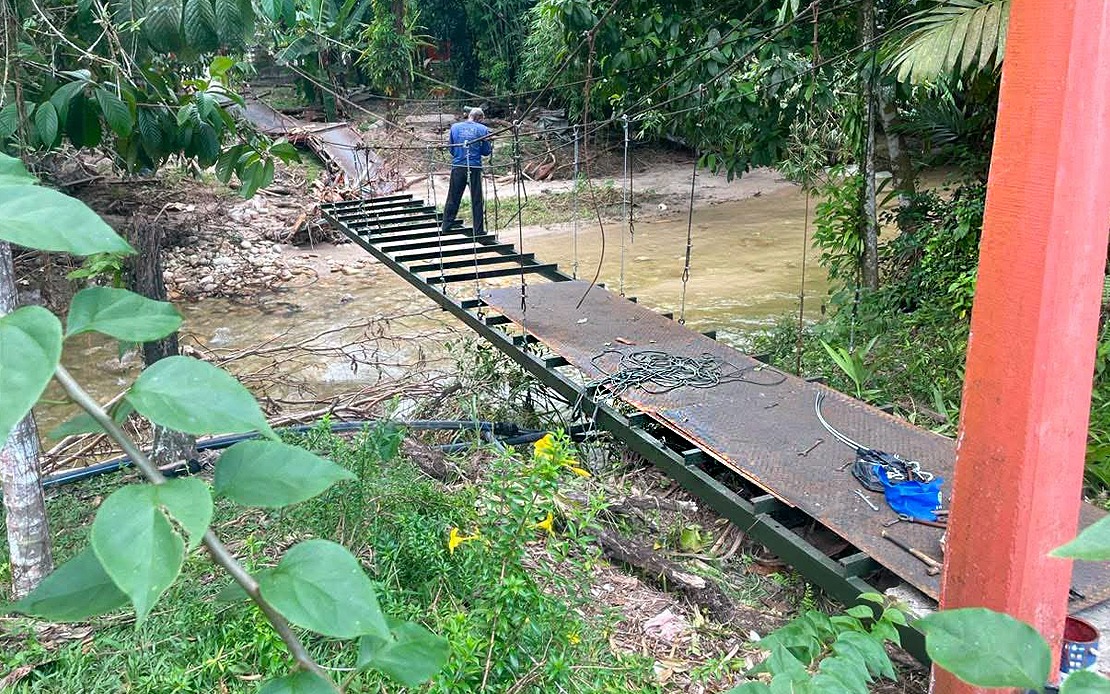
The Perak state government has greenlit a half-million ringgit development package to reconstruct critical infrastructure in Kampung Ulu Geruntum after a catastrophic flood destroyed the village's only bridge and severed road access on June 19. The decision represents a comprehensive response to one of the region's recent natural disasters, with authorities committing funds across multiple phases to restore both permanent and interim connectivity to the isolated settlement in Gopeng.
The primary allocation of RM500,000 is earmarked for constructing a permanent concrete bridge designed to withstand future water surges and provide long-term security for residents. This investment reflects lessons learned from the bridge's sudden collapse, which caught residents unprepared and forced an emergency evacuation of more than 50 people who were temporarily sheltered at Gopeng Town Hall. State Housing and Local Government Committee chairman Sandrea Ng Shy Ching explained that construction will proceed only after all remedial work currently underway is finalised, ensuring safety protocols are met before heavy machinery mobilises.
Beyond the major infrastructure project, the state government has authorised an emergency allocation of RM150,000 for an interim suspension bridge now under active construction. This temporary structure is expected to be completed by mid-July, providing crucial interim connectivity well before the permanent concrete bridge reaches completion. The dual-approach strategy recognises the humanitarian urgency: residents of Kampung Ulu Geruntum require immediate passage for daily necessities, medical access, and livelihood activities that cannot wait for months-long construction cycles. The suspension bridge represents a pragmatic intermediate solution that balances speed of deployment with structural safety.
Water supply disruptions added another layer of hardship to the community's crisis, prompting Sandrea—who represents the Teja state assembly seat—to allocate RM45,000 from her personal constituency development budget to repair damaged pipelines and restore supplies. This commitment demonstrates how state representatives are leveraging available discretionary funds to address secondary impacts of the disaster that, while perhaps less dramatic than bridge reconstruction, directly affect daily living conditions and public health.
The June 19 incident itself proved a stark reminder of how quickly natural disasters can transform isolated rural areas into cut-off zones. Strong currents generated by the water surge produced forces sufficient to demolish the main bridge, a structure that residents had likely crossed countless times without contemplating its vulnerability. The collapse created an instantaneous barrier: the fifty-plus residents suddenly found themselves unable to access mainland facilities—shops, schools, health services, and employment. This physical isolation compounded the psychological trauma of displacement and property damage.
Sandrea's public acknowledgment of personnel working in response operations reflects the multi-agency coordination required for effective disaster response. Emergency services, engineering teams, relief coordinators, and local government staff converged on the site to manage evacuation, deliver immediate aid, and assess damage. She expressed hope that these ongoing efforts would accelerate so that normalcy could return swiftly. Such statements serve dual purposes: they recognise frontline responders and signal to residents that their plight has state-level attention.
For Malaysian readers in rural and semi-rural areas, the Kampung Ulu Geruntum incident carries important implications. Flash flooding and water surge events have increased in frequency across Southeast Asia in recent years, partly attributable to climate variability and land-use changes. Communities positioned near water bodies or reliant on single access routes face elevated vulnerability. The Perak government's response—rapid allocation of emergency funds combined with phased infrastructure solutions—offers a template that other states might consider when developing disaster preparedness and recovery protocols.
The financial commitment, while substantial, reflects the genuine cost of rural infrastructure resilience. A RM500,000 permanent bridge represents a meaningful state investment in a small village that likely numbers only a few hundred residents. This allocation signals a policy orientation that prioritises equitable service delivery across urban and rural constituencies, even when communities are geographically peripheral. In the Malaysian context, where development has historically concentrated in urban centres, such investments in remote settlements carry political and social significance beyond their engineering scope.
The timeline for the suspension bridge—mid-July completion—will be closely monitored by both authorities and residents. Delays could reignite tensions, particularly if monsoon rains return and raise flood risks again. The permanent concrete bridge's construction schedule remains less defined, creating a multi-month period during which residents will rely on the interim structure. Any unforeseen complications could necessitate further fund allocation or timeline adjustments, underscoring the resource-intensive nature of disaster recovery in geographically challenging terrain.
Looking forward, the incident may prompt broader conversations within Perak about infrastructure auditing, flood risk mapping, and early warning systems for vulnerable rural communities. The bridge's sudden failure, while tragic, offers an opportunity to examine other critical access routes and water-management systems across the state. Engineers and planners will likely conduct post-incident reviews to understand precisely why the structure failed and how future designs might be hardened against similar scenarios. Such forensic analysis, while academic in nature, directly informs public safety policy and infrastructure investment decisions.
For Kampung Ulu Geruntum residents, the coming weeks will be defined by construction activity and the gradual restoration of normalcy. The suspension bridge will mark the first tangible sign that recovery is underway; the permanent concrete structure will eventually represent the return to the stability they enjoyed before June 19. Until then, the community remains in transition—no longer isolated, but not yet secure. The state government's financial commitment provides the material foundation for that transition, even as residents themselves provide the emotional resilience that carries them through extended recovery periods.

