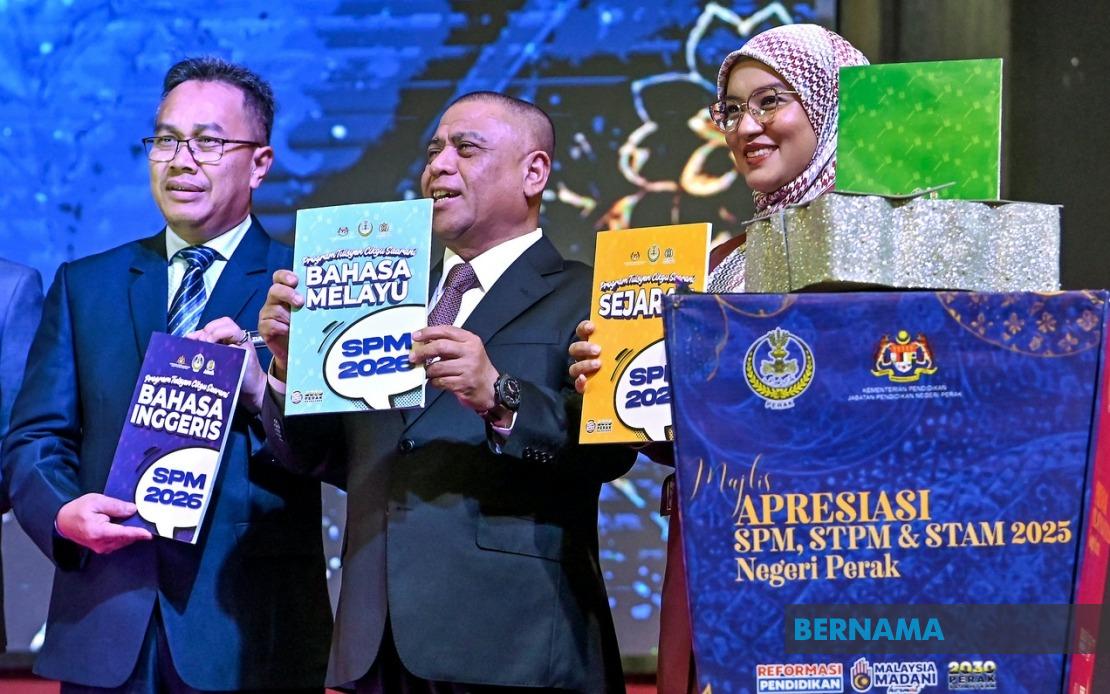
Perak has reached a significant educational milestone, recording its most impressive Sijil Pelajaran Malaysia (SPM) results in thirteen years with a State Average Grade (GPN) of 4.49 in 2025. The achievement signals sustained progress in the state's education sector and reflects the culmination of multi-year efforts to enhance academic quality across the state's secondary institutions. Menteri Besar Datuk Seri Saarani Mohamad highlighted this accomplishment at a recent recognition ceremony, emphasizing that the upward trajectory spanning three consecutive years demonstrates the effectiveness of state-level education initiatives and the dedication of educators, administrators, and supporting communities.
One of the most striking aspects of Perak's 2025 results lies in the marked reduction of educational disparities between different geographical regions. The achievement gap separating urban and rural examination candidates has compressed to merely 0.04 grade points, a considerable improvement that carries substantial implications for equity in the Malaysian education system. This narrowing gap suggests that initiatives designed to distribute educational resources more equitably across Perak's diverse communities are beginning to bear tangible fruit, ensuring that students in less urbanized areas have increasingly similar opportunities to excel academically as their urban counterparts. The significance of this development extends beyond mere statistics; it reflects a commitment to dismantling structural inequalities that have historically disadvantaged rural learners and represents a model that other states may observe with considerable interest.
Beyond SPM results, Perak has demonstrated broad-based academic excellence across multiple examination systems. In the Sijil Tinggi Persekolahan Malaysia (STPM) cohort, the state achieved a Cumulative Grade Point Average (CGPA) of 2.91, surpassing the national benchmark of 2.88. This performance is particularly noteworthy as STPM results directly influence university admission prospects and are closely watched by tertiary institutions nationwide. Of the 1,336 students nationwide who attained the highest CGPA of 4.00, Perak contributed 116 candidates, representing approximately 8.7 percent of this elite cohort despite being one of Malaysia's mid-sized states. This concentration of high achievers suggests effective upper secondary instruction and increasingly competitive academic culture within Perak's schools.
Performance in the Sijil Tinggi Agama Malaysia (STAM) examination further underscores the state's educational diversity and strength across different academic pathways. Perak recorded a GPN of 3.03 in STAM, with 36 candidates attaining the prestigious Mumtaz grade—the examination's highest classification. Islamic education remains a critical component of Malaysia's educational ecosystem, and strong results in this area indicate that Perak's religious schools and Islamic programmes are effectively balancing traditional Islamic scholarship with contemporary pedagogical standards. The presence of 36 Mumtaz achievers demonstrates institutional capacity and student commitment to religious learning at the highest levels.
Menteri Besar Saarani's remarks at the ceremony stressed an important philosophical perspective that extends beyond examination metrics alone. He articulated that student success cannot be reduced to grades or scores, but rather represents a collective achievement involving teachers, parents, school administrators, and entire educational communities. This holistic framing proves particularly valuable in Malaysia's context, where there is occasional tendency to overemphasize quantitative academic outcomes at the expense of character development, critical thinking, and social responsibility. By publicly reinforcing that recognition ceremonies acknowledge not solely individual student performance but the collaborative ecosystem supporting academic development, Saarani positioned Perak's educational narrative within a broader humanistic framework that acknowledges the multifaceted nature of learning and growth.
The recognition ceremony itself honoured 266 recipients encompassing students, educators, schools, and District Education Offices (PPD) across Perak. This comprehensive approach to recognition extends beyond top performers to acknowledge institutional innovation, administrative support, and district-level coordination. By including educators and administrative bodies in formal appreciation ceremonies, Perak signals that systemic improvement requires investment across all educational levels and that teachers and education officials merit acknowledgment alongside high-achieving students. This inclusive recognition strategy can reinforce professional morale and encourage sustained commitment to quality improvement initiatives.
For Malaysian observers, Perak's education trajectory carries implications extending beyond the state's borders. As one of Malaysia's several mid-sized states, Perak's demonstrated ability to close urban-rural achievement gaps while simultaneously improving overall academic performance provides evidence that geographic disparity in educational outcomes is not inevitable but addressable through targeted policy implementation and resource allocation. Other states contemplating similar equity initiatives may find Perak's three-year improvement trajectory informative, particularly regarding strategies for supporting rural schools and students. The specific mechanisms underlying these gains—whether policy changes, teacher professional development, infrastructure investment, or curriculum adjustments—merit deeper investigation and documentation for potential replication elsewhere.
The 2025 results also arrive at a significant juncture in Malaysia's broader educational landscape, as the nation continues transitioning toward the Malaysian Education Blueprint's long-term objectives of improving quality and accessibility simultaneously. Perak's progress suggests that decentralized implementation of education policy, with state-level leadership taking ownership of outcomes and investing strategically in improvement, can yield measurable results. The role of Menteri Besar-level engagement in education ceremonies and public articulation of educational priorities underscores the importance of executive leadership in driving institutional change within state-controlled educational systems.
Looking ahead, Perak's sustained improvement trajectory will be tested by the challenge of maintaining momentum while continuing to raise baseline performance. As the state's GPN approaches the upper end of what is realistically achievable through current methodologies, further gains may require innovations in curriculum design, teaching pedagogy, or student support systems rather than incremental refinements to existing approaches. The state education department and school administrators face the next challenge: translating strong SPM and STPM results into improved tertiary education access and ultimately into enhanced employment outcomes for graduates, thereby completing the cycle from examination success to meaningful economic and social advancement.
The recognition of achievement across STAM examinations also reflects Malaysia's commitment to maintaining Islamic education as a valued academic pathway with equivalent status to secular streams. Strong performance in religious education demonstrates that students pursuing this pathway achieve excellence at competitive levels, potentially encouraging continued enrollments in Islamic studies programmes and ensuring that Islamic education remains intellectually rigorous and contemporary. This balance proves essential in maintaining religious education's credibility and appeal among ambitious students and their families.

