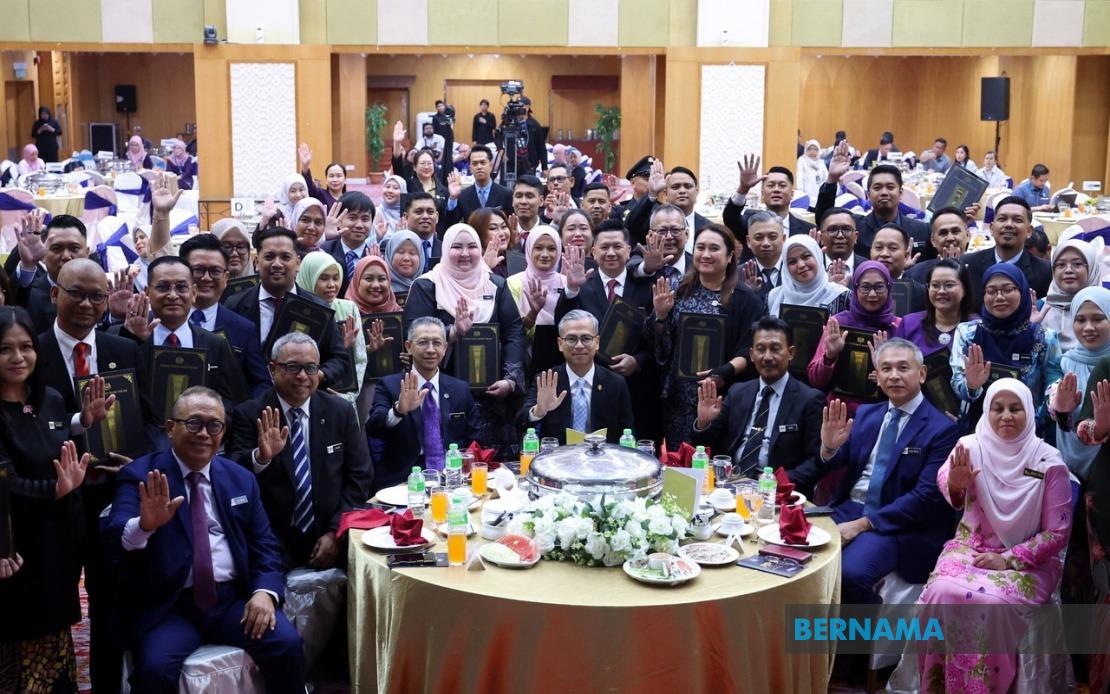
The MADANI Government's measure of economic success ultimately rests not on headline macroeconomic figures but on whether ordinary Malaysians experience improvement in their everyday circumstances, Communications Minister Datuk Seri Fahmi Fadzil has stressed. Speaking at the Communications Ministry's Sabah and Labuan Zone Excellent Service Awards ceremony in Kota Kinabalu, Fahmi articulated a philosophy that places lived experience at the centre of governance, distinguishing between statistical achievement and tangible welfare gains.
While Malaysia's economic indicators present an encouraging picture—with growth recorded across investment, revenue, reserves, gross domestic product, and trade at both national and state levels—Fahmi cautioned that these metrics alone do not constitute success. The true test, he argued, lies in whether citizens perceive concrete improvements in their financial circumstances and quality of life. This framing reflects a broader shift in how the government evaluates policy effectiveness, moving beyond traditional economic aggregates to consider distributional outcomes and individual welfare.
Fahmi illustrated his point through the example of the Government's targeted diesel subsidy scheme, known as BUDI MADANI, which he characterised as a practical manifestation of people-centred economics. The initiative demonstrates how macroeconomic management must account for geographical and logistical realities on the ground. In states like Sabah and Sarawak, where significant distances separate districts and transportation costs constitute a substantial household expense, the design and implementation of such schemes carries outsized importance for residents' daily budgets and economic security.
The minister's emphasis on geographical context addresses a persistent challenge in Malaysian governance: the need to tailor national policies to accommodate the diverse circumstances of Malaysia's varied geography. East Malaysian states, characterised by dispersed populations and limited road infrastructure in certain areas, require particular attention when subsidy schemes are designed or modified. Without careful consideration of these realities, even well-intentioned policies risk creating unintended consequences or failing to achieve their intended impact for vulnerable populations in remote areas.
Fahmi noted that Prime Minister Datuk Seri Anwar Ibrahim and his Cabinet are actively engaged with these considerations, signalling that people-centred economics has support at the highest levels of government. This positioning represents an important signal to both the bureaucracy and the public that economic policy will be evaluated through the lens of household welfare rather than purely through aggregate growth metrics. Such messaging can shape how government agencies prioritise their work and allocate resources when designing or implementing programmes.
Crucially, Fahmi identified a communication challenge inherent in modern governance: ensuring that the link between national economic performance and individual benefit is clearly understood by the public. When economic growth fails to translate visibly into improved personal circumstances, citizens may become sceptical of government claims about economic performance, regardless of underlying macroeconomic data. Bridging this perception gap requires sustained effort to articulate how national-level policies and programmes connect to household-level outcomes.
The minister stressed that ministries and government agencies bear responsibility not only for implementing policies effectively but also for explaining them comprehensively to the public. Misinterpretation or confusion about policy objectives and mechanics can undermine public support, even for programmes designed to deliver genuine benefits. In the context of targeted subsidies, where eligibility criteria, application procedures, and coverage areas may be complex, clear communication becomes especially critical to ensure that intended beneficiaries understand and can access support.
This emphasis on transparency and communication reflects lessons from previous policy cycles where inadequate public understanding contributed to controversy or reduced policy effectiveness. By prioritising clear explanation alongside effective implementation, the government aims to build public confidence that economic decisions are genuinely oriented toward improving household circumstances rather than serving other interests.
For Southeast Asian observers, Malaysia's articulation of people-centred economics offers a useful counterpoint to purely technocratic approaches to development policy. The region grapples with the challenge of converting aggregate growth into widely distributed welfare gains, particularly in countries where income inequality remains substantial and geographical dispersion complicates service delivery. Malaysia's explicit commitment to measuring policy success through household-level impact suggests one possible framework for evaluating governance effectiveness across the region.
The focus on people's economy also carries political significance within Malaysia's domestic context. By anchoring the MADANI Government's legitimacy to tangible improvements in citizen welfare—particularly for populations in Sabah and Sarawak that have historically felt marginalised in development priorities—Fahmi's remarks signal an attempt to build political support through substantive delivery rather than rhetoric alone. How successfully the government translates this commitment into reality will likely shape both its political trajectory and public attitudes toward economic policy in coming years.

