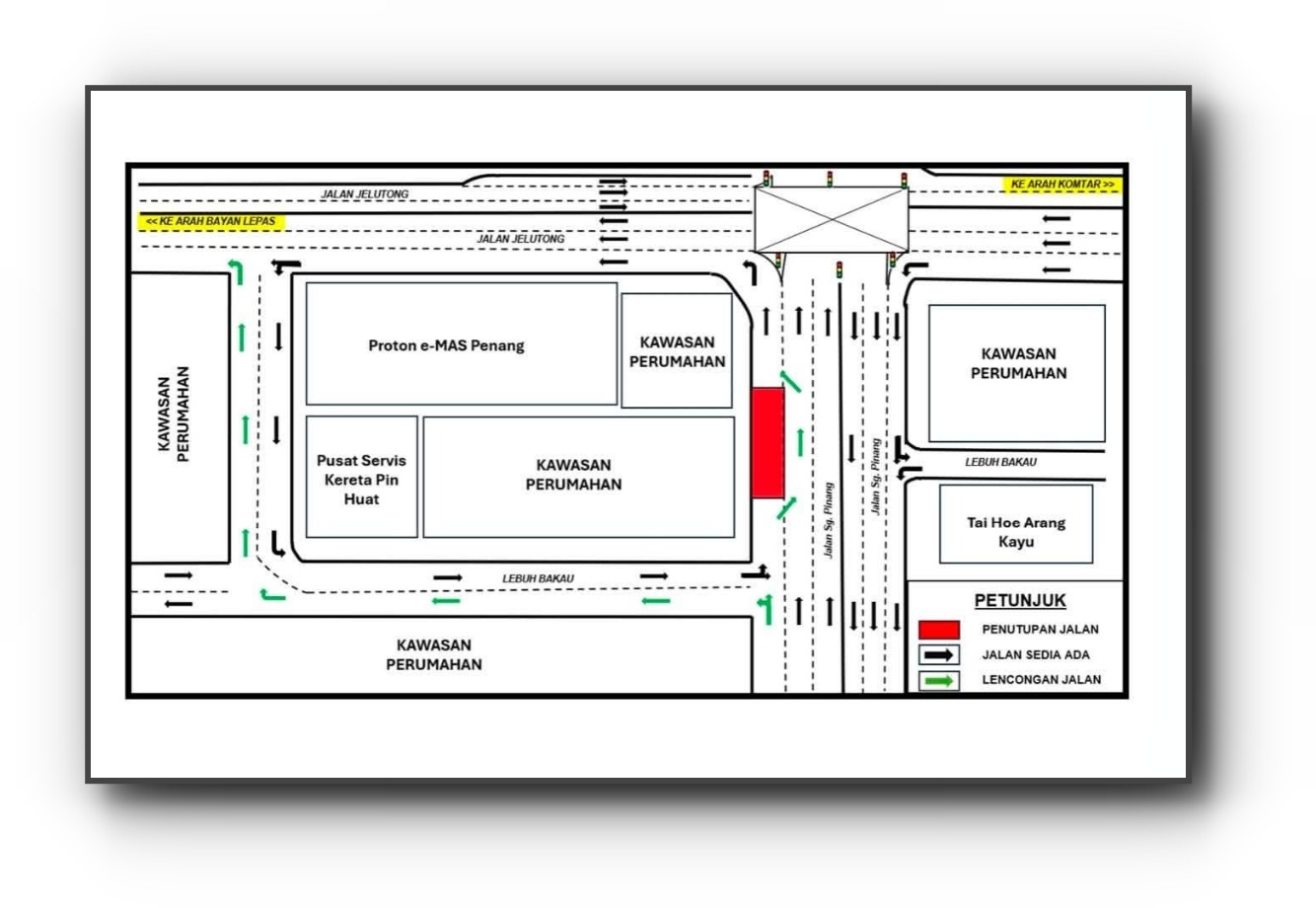
A significant section of Jalan Sungai Pinang in George Town will undergo partial closure beginning Friday, August 28, as Malaysia's national power utility undertakes critical infrastructure realignment work. The leftmost lane heading towards Jalan Jelutong will remain inaccessible to traffic for the full 10-day period, concluding at the end of business on September 6, according to an announcement by Sungai Pinang state assemblywoman Lim Siew Khim.
The closure specifically targets the stretch between Lebuh Bakau junction and the Jalan Sungai Pinang-Jalan Jelutong traffic light intersection, affecting a comparatively short but strategically important segment of one of George Town's primary arterial routes. Tenaga Nasional Bhd, or TNB, requires this extended window to safely relocate utility infrastructure—a procedure that demands meticulous planning and execution to prevent service disruptions across the wider city area. The scale of such utility works typically involves underground cables and overhead lines that serve thousands of households and businesses throughout the vicinity.
Operations will commence at 9 am on Friday and continue on a round-the-clock basis until 11.59 pm on September 6, meaning commuters should anticipate disruption throughout the entire day-night cycle. This 24-hour work schedule reflects TNB's efforts to minimise the overall duration of inconvenience by maximising labour deployment and equipment usage during the authorised closure window. For residents and business operators who depend on this corridor, the compression of work into 10 consecutive days, rather than a prolonged part-time schedule, represents a pragmatic trade-off between immediate disruption and long-term convenience.
Lim, who serves as state Social Development, Welfare and Non-Islamic Religious Affairs Committee chairman, stressed that the three remaining lanes of Jalan Sungai Pinang will continue operating normally, allowing the road to function at reduced but functional capacity. This partial rather than complete closure demonstrates coordination between local government and the utility provider to balance infrastructure maintenance against economic continuity. Businesses along the route, delivery services, and regular commuters can still access the area, albeit with longer travel times due to increased congestion in the remaining lanes.
Motorists seeking to circumvent the affected stretch have been advised to divert via Lebuh Bakau, which runs parallel to the closed section and provides a viable alternative connection towards Jalan Jelutong. This routing option is particularly relevant for through-traffic and heavy vehicles, which can reduce pressure on the congested section. However, the effectiveness of this diversion depends on existing traffic patterns on Lebuh Bakau and the surrounding network's capacity to absorb displaced vehicles without creating secondary bottlenecks elsewhere in George Town's traffic system.
The state assemblywoman emphasised the importance of cautious driving throughout the affected area, acknowledging that construction sites and reduced lane capacity create elevated accident risks. Her appeal reflects standard safety protocols that accompany major road works in urban settings, where pedestrian activity, commercial vehicle movements, and individual drivers may not immediately adapt to altered traffic configurations. Incidents during utility work zones can cascade into wider traffic congestion, multiplying the inconvenience already caused by the partial closure.
To manage the inherent risks, TNB and the relevant authorities will deploy comprehensive traffic control infrastructure including safety signboards, traffic cones, and on-site flagmen stationed throughout the work zone. These personnel will actively guide vehicles through the remaining open lanes and monitor for potential hazards or emergency situations requiring immediate intervention. In Malaysian urban contexts, such visible and active traffic management often proves essential for maintaining orderly flow and preventing dangerous improvisation by drivers attempting to navigate poorly marked or confusing work sites.
Utility relocation works of this nature are increasingly common across Penang as the state undergoes infrastructure modernisation to support growing population density and commercial development. Older utility lines, many dating from decades past, require repositioning to accommodate new road configurations, building projects, and improved service standards. TNB's undertaking of this specific work suggests that the current underground and overhead arrangements no longer meet contemporary safety standards, capacity requirements, or the state's broader urban planning objectives.
For businesses operating along Jalan Sungai Pinang, the 10-day disruption may create logistical challenges affecting customer accessibility and supply chain management. Small retailers, restaurants, and service providers typically face measurable revenue fluctuations during major road works, as convenient access becomes compromised. However, the compressed timeframe means the disruption period is clearly defined and foreseeable, allowing businesses to implement contingency measures and inform regular customers about the anticipated inconvenience.
The broader implications extend to George Town's traffic management capacity and the increasing complexity of coordinating large-scale infrastructure work in densely developed urban areas. As Penang continues expanding, such utility relocations will become more frequent, necessitating improved advance notification systems, alternative route planning, and integration between multiple government and private sector agencies. The success of this particular project will set precedents for how similar future works are managed in terms of communication, traffic mitigation strategies, and community preparedness.
Motor vehicle users should mark their calendars and plan journeys accordingly during the closure period. Peak traffic periods, particularly morning and evening commute hours, will likely experience greater congestion than the stated 10-day average, suggesting that flexibility in scheduling and route planning offers the most practical approach to minimising delay-related frustration and maintaining timely arrivals at destinations.

