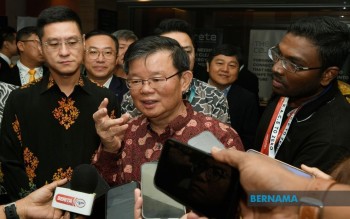
Twenty-five enterprises have signalled their intention to tap into Penang's fledgling Climate Mitigation Fund, reflecting a gathering momentum among the state's manufacturers to embrace environmental commitments. Five of these applications have already entered the formal assessment phase, according to Chief Minister Chow Kon Yeow, who unveiled the progress during remarks at the R.A.C.E To Zero: Penang Edition conference in George Town.
The fund represents a collaborative venture between the Penang state government and Alliance Bank, underpinned by the broader Penang Green Industry Programme. The initial capital commitment stands at RM20 million—comprising RM5 million from state coffers and RM15 million from the banking partner—though officials have flagged the potential for this to expand substantially, with discussions pointing towards a ceiling of RM100 million as demand accumulates and the scheme matures.
Eligible manufacturers, particularly small and medium enterprises and mid-tier companies, can access preferential borrowing arrangements capped at RM500,000 per applicant. Beyond simple financing, the ecosystem supporting these loans includes direct grants, comprehensive sustainability assessments tailored to individual operations, and access to expert advisory services. This holistic approach distinguishes the fund from conventional commercial lending, positioning it instead as a dedicated instrument designed to help firms transition operational models while managing associated costs.
Chow's framing of the initiative placed particular emphasis on competitiveness and market survival rather than relying solely on environmental stewardship as motivation. He outlined how multinational corporations increasingly embed stringent carbon reduction targets into their procurement practices, effectively transmitting sustainability requirements down global supply chains to their component suppliers and manufacturers. For Penang's enterprises, many of which feed into these international networks, compliance with such expectations has moved from peripheral concern to existential business necessity.
Penang's position as Malaysia's electronics and electrical equipment manufacturing hub makes this transition especially consequential. The state accounted for RM436.9 billion in E&E exports during the previous financial year, representing approximately 68 per cent of the country's total E&E sectoral exports. This concentration means that decisions made by Penang's manufacturing base regarding energy sourcing and emissions management ripple across the entire national industry. Multinational firms selecting among potential locations for new investment or expansion now routinely interrogate the renewable energy availability and carbon profiles of prospective host regions, adding another layer of pressure on state governments to demonstrate credible commitments to clean energy infrastructure.
The state government has responded with the Penang Energy Framework, formally introduced in November 2024, which establishes binding targets for 2030. These commitments include reducing energy intensity across the economy by one quarter whilst simultaneously raising the proportion of renewable energy within the state's electricity mix to no less than 10 per cent. Given Penang's constrained geographical footprint and the premium commanded by available land, rooftop solar installations have emerged as the most pragmatic pathway to scaling renewable generation capacity. Accordingly, new commercial and industrial building codes now require developers to dedicate at least three-quarters of roof surfaces to photovoltaic panels or alternatively achieve equivalent renewable energy sourcing in line with their respective Tenaga Nasional Berhad tariff classifications.
Beyond rooftop installations, Penang has initiated investigation into alternative renewable platforms better suited to the state's specific context. The Penang Water Supply Corporation is currently evaluating floating solar technology deployed across reservoir surfaces, an approach that simultaneously generates clean electricity whilst minimising evaporative water losses—a dual benefit particularly attractive given the state's water management imperatives. The development of Silicon Island incorporates renewable generation from inception, encompassing a dedicated Green Tech Park powered substantially by on-site solar capacity, exemplifying how new industrial zones can embed sustainability into their foundational architecture rather than retrofitting it subsequently.
Energy efficiency forms the complementary pillar of Penang's decarbonisation architecture. The state has established comprehensive energy intensity measurement systems enabling individual facilities to quantify consumption patterns, benchmark performance against peer operations, and identify concrete efficiency opportunities. Government-owned buildings and properties managed by local authorities now undergo systematic evaluation of their renewable energy potential and energy conservation possibilities. For newly constructed public facilities, the administration has targeted securing a minimum five per cent of total energy consumption from renewable sources, whilst encouraging existing government infrastructure to pursue parallel objectives as budgets permit and technological opportunities arise.
Chow emphasised the alignment between Penang's policy framework and federal-level sustainability architecture, specifically the National Energy Efficiency Action Plan 2.0. This federal programme targets an 11.6 per cent reduction in nationwide energy consumption by 2035, creating a coherent policy environment where state and national initiatives reinforce rather than contradict one another. Such vertical policy coherence proves essential in Malaysia's federal system, as manufacturers operating across multiple states require predictability and consistent regulatory direction. When state governments and federal authorities move in divergent directions on energy policy, the resulting regulatory fragmentation imposes compliance costs and discourages investment.
The convergence of market forces, regulatory requirements, and financial incentives through instruments like the Climate Mitigation Fund signals a maturing recognition among Malaysian policymakers that sustainability imperatives need not conflict with economic competitiveness. Rather, the availability of preferential financing, technical advisory support, and regulatory frameworks that reward sustainable practice can position early-adopting regions as magnets for investors prioritising long-term resilience over short-term cost minimisation. For Penang, which has traditionally competed on basis of established infrastructure and talent pools, clean energy credentials represent a newly crucial differentiator in attracting and retaining high-value manufacturing operations increasingly indifferent to locations unable to demonstrate genuine environmental commitment alongside operational capability.

