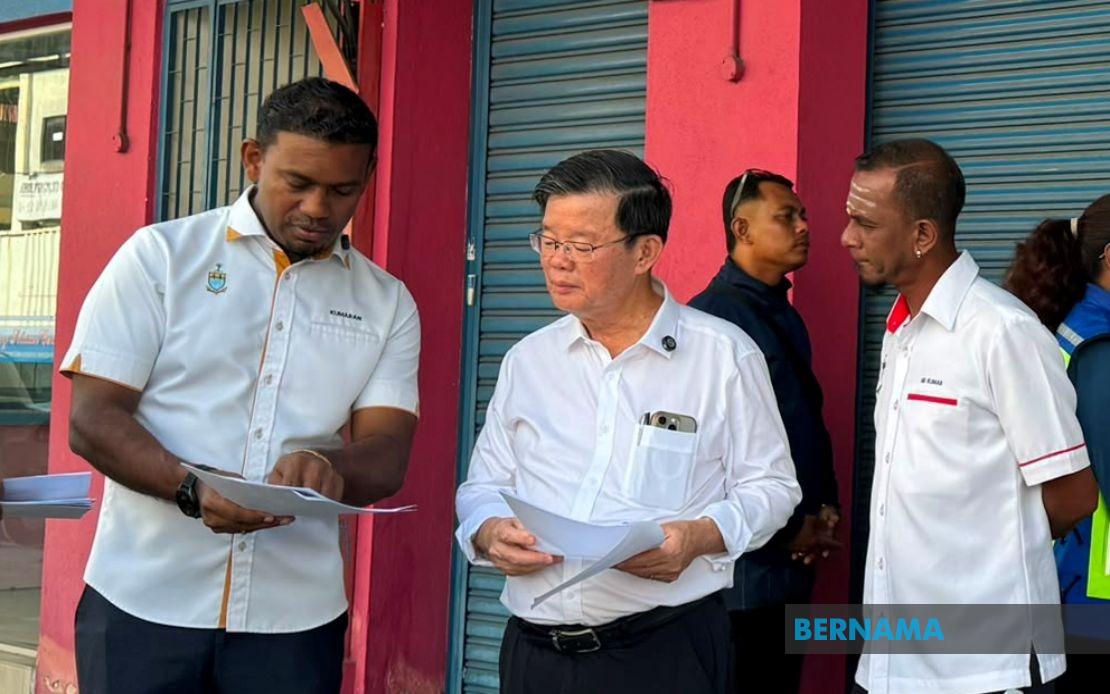
Penang's state government will proceed without further delay on the new water tariff structure that commenced on July 1, Chief Minister Chow Kon Yeow announced on July 17, brushing aside requests from opposition figures to postpone implementation. The decision, made after extensive deliberation, marks the end of a deferral period that itself extended nearly a year beyond the original timeline set by the Federal Government's National Water Services Commission (SPAN) for a July 30, 2025 rollout.
The rationale underpinning the government's stance centres on financial necessity rather than mere regulatory compliance. Chow articulated that the tariff adjustment is projected to generate approximately RM20 million in additional annual revenue, a quantum he characterised as indispensable to the Penang Water Supply Corporation's (PBAPP) capacity to finance an ambitious portfolio of water security initiatives. Without this funding mechanism, he suggested, the state's ability to address mounting water infrastructure demands would be severely constrained.
The scale of infrastructure investment required underscores why the state believes the tariff increase cannot be indefinitely postponed. PBAPP faces capital expenditure requirements totalling nearly RM2 billion solely for projects designed to fortify Penang's existing water supply network. Beyond this, the corporation must also invest billions more in the proposed water supply project sourced from Perak, an undertaking that assumes heightened importance given demographic pressures and industrial growth across the northern corridor.
From a broader governance perspective, Chow noted that the tariff-setting mechanism itself is not discretionary at the state level. SPAN establishes the framework adopted uniformly across Malaysia, with water operators permitted to petition for tariff reviews at three-year intervals, justified by demonstrated increases in operational expenditure and capital development requirements. This centralised approach, while perhaps limiting Penang's autonomy, reflects efforts to standardise water pricing principles nationally.
A key aspect of the tariff structure warrants attention for its implications regarding cross-subsidy arrangements. Domestic consumers in Penang continue to benefit from rates substantially below the actual unit cost of water production, which has exceeded RM1.00 per cubic metre. The new tariff sees household users paying only approximately RM0.65 per cubic metre, a disparity bridged by non-domestic sectors. Industrial and commercial users effectively bear a disproportionate share of costs, funding the differential through elevated charges that subsidise residential consumption patterns. This redistributive mechanism reflects a social compact favouring household affordability, though it inevitably increases operating pressures on commercial entities.
The practical impact on households, according to PBAPP chief executive Datuk K. Pathmanathan, remains modest for the majority of consumers. Approximately 82 per cent of Penang households, defined as those consuming up to 35 cubic metres monthly, would face an incremental cost of only RM0.08 daily, equivalent to RM2.55 monthly. Business consumers with substantially higher consumption—around 500 cubic metres per month—would encounter RM77.70 in additional monthly expenses, reflecting both their larger consumption volumes and the cross-subsidy burden they carry.
The opposition voice to the tariff increase came from Bagan Member of Parliament Lim Guan Eng, who petitioned the state government via a Facebook statement to consider a one-year postponement of the RM0.20 per cubic metre increase. His appeal characterised the timing as inauspicious, though it did not succeed in shifting the government's position. This disagreement reflects broader tensions around the appropriate balance between infrastructure investment necessities and household cost-of-living pressures, a persistent fault-line in Malaysian water policy debates.
The state government has positioned the tariff increase as temporally critical rather than optional. Pathmanathan stressed that further postponement would compromise the timeline for executing the Water Contingency Plan 2030 (WCP 2030), a strategic framework addressing Penang's medium-term water security. The projects to be funded through the new revenue include construction of additional water treatment facilities at Mengkuang Dam and Sungai Perai, rehabilitation and expansion work at the existing Sungai Dua treatment plant, land acquisition for the planned Sungai Muda treatment facility, and pipeline infrastructure connecting Macallum and Bukit Dumbar. Collectively, these represent critical capacity augmentations.
For Malaysian consumers and policymakers observing from other states, Penang's experience illustrates the tension between maintaining affordable water access and accumulating capital for infrastructure modernisation. The state's decision to implement the tariff increase despite political pressure suggests that technical assessments of supply adequacy have outweighed electoral sensitivities, at least in the current political configuration. Whether this precedent influences tariff discussions in other states remains uncertain, though the underlying infrastructure financing challenge is endemic across Malaysia's water sector.
The cross-subsidy model sustaining domestic affordability also deserves scrutiny as Malaysian industrial competitiveness faces international pressures. Commercial and industrial entities, already bearing elevated water costs relative to households, may find the additional tariff burden relevant to location and expansion decisions, particularly for water-intensive operations. This potential economic cost-shifting warrants consideration in future policy reviews, alongside the legitimate imperative to fund adequate water supply systems that serve both public health and development objectives.

