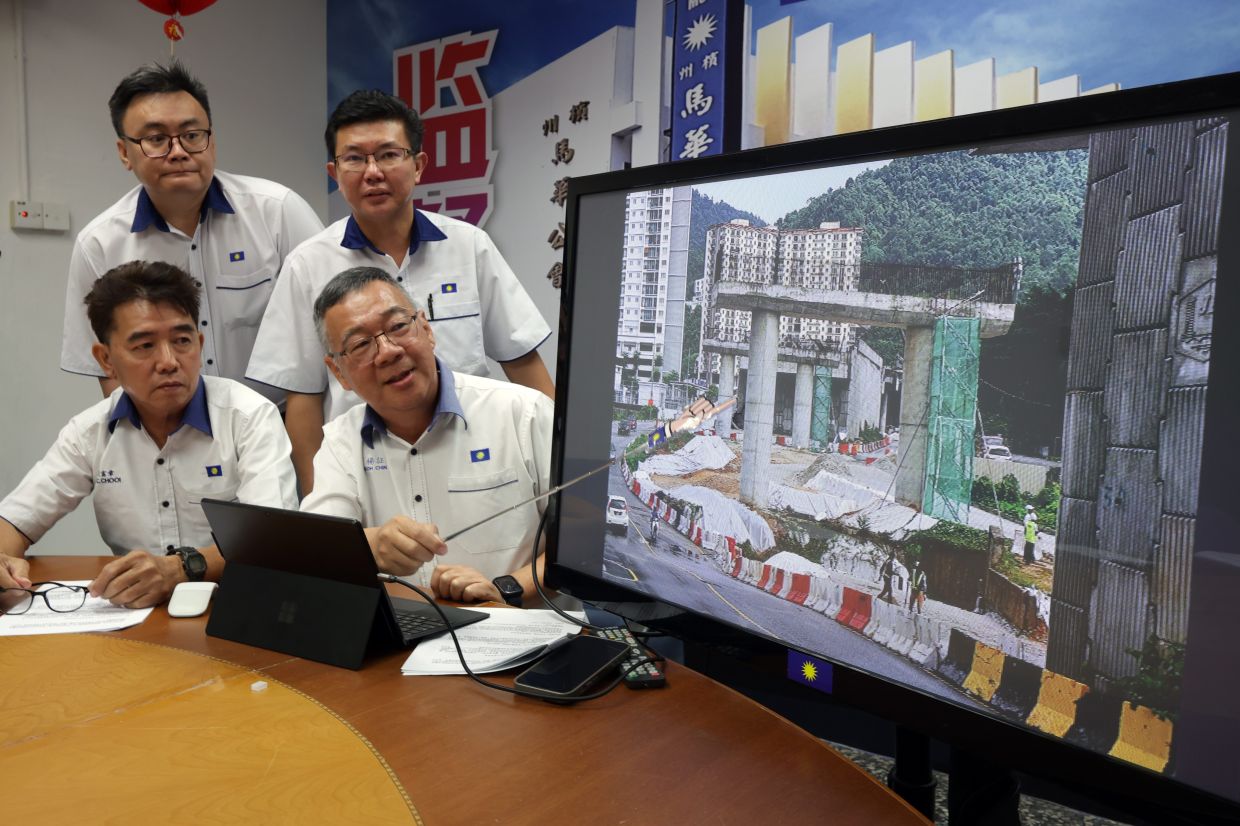
The Penang MCA chapter has intensified scrutiny of the Air Itam-Tun Dr Lim Chong Eu Expressway bypass project, shifting the debate from construction delays to fundamental questions about governmental accountability and transparency. Party secretary Yeoh Chin Kah has issued a formal call for the state government to release payment records, consultants' certification reports, and comprehensive project assessment documents within seven days. The escalation marks a significant shift in tone from previous discussions that focused primarily on explaining schedule slippages, moving instead toward examining the credibility of progress claims themselves.
Yeoh's intervention hinges on a fundamental discrepancy between official completion percentages and ground-level observations. While the state government characterised the project as being in its "final sprint" with progress jumping from 80 per cent in May to 89 per cent in December, a Penang MCA inspection team on July 1 documented significant outstanding work. Surveyors found multiple sections—Valley Road, Changkat Tembaga, and Jalan Thean Teik among them—nowhere near completion, with bridge piers erected but bridge beams and decks absent, road surfacing incomplete, and safety features such as guardrails and noise barriers still pending installation. These observations raise legitimate questions about whether reported completion figures accurately reflect actual construction progress or whether measurement methodologies may not align with conventional project assessment standards.
The 6-kilometre toll-free bypass represents a critical component of Penang's ambitious infrastructure renewal programme, forming Package Two of the broader undersea tunnel and paired roads initiative. Upon completion, the expressway will connect Lebuhraya Thean Teik in Bandar Baru Air Itam with the Tun Dr Lim Chong Eu Expressway via a sophisticated network of elevated viaducts, underground tunnels, and surface-level roads. The project's eventual opening promises significant benefits for approximately 300,000 residents across Air Itam, Bandar Baru Air Itam, and Paya Terubong, with anticipated reductions in congestion and substantial shortening of commute times for communities that have endured increasingly gridlocked roads.
The project's timeline has proven troublesome throughout its execution. Originally envisaged for completion in 2024, the contractor has sought and received two separate extensions, with the current target date set for April 12, 2027. This extended schedule represents a delay of approximately three years from initial projections, a significant slippage that has tested public patience and renewed concerns about project management and oversight mechanisms. For residents who have anticipated this infrastructure investment as a solution to long-standing traffic congestion, successive postponements understandably generate frustration and heightened demands for credible progress updates.
Penang MCA's seven-day ultimatum carries considerable weight given the party's pledge to escalate the matter should the state government decline to provide documentation. The organisation has committed to filing formal reports with the National Audit Department and the Malaysian Anti-Corruption Commission, representing a significant escalation that could trigger federal-level investigations. Additionally, Penang MCA intends to establish a specialised monitoring committee dedicated to tracking both reported progress and payment compliance, institutionalising ongoing scrutiny beyond this immediate dispute.
Paya Terubong assemblyman Wong Hon Wai has countered with more optimistic assessments, asserting that the project has achieved 91 per cent completion and remains positioned for delivery according to schedule. Wong claims the contractor has provided assurances regarding the April 2027 deadline and details specific upcoming milestones, including the launching of twelve beams on the Gelugor side scheduled for July and August, with the remaining six beams targeted for the fourth quarter. These details suggest ongoing construction activity, though they do not directly address the Penang MCA's core contention that visible ground conditions do not correspond with reported completion percentages.
Wong's explanation regarding bridge construction provides additional technical context relevant to understanding the apparent disparity. He notes that while all bridge beams on the Bandar Baru Air Itam side have been launched, substantial work remains on deck slabs and parapets. Crucially, Wong indicates that even upon construction completion, the roadway will not immediately open to traffic. Instead, the relevant government agency will conduct a Road Safety Audit, with the Public Works Department subsequently determining an opening date based on audit findings. This distinction between construction completion and actual public opening is important for understanding project timelines and explains why residents may perceive incompleteness even as construction teams report advancing progress.
The broader context for this dispute extends beyond a single infrastructure project. Penang has undertaken unprecedented development initiatives, including the undersea tunnel project of which this bypass forms a component. Managing large-scale infrastructure delivery while maintaining public confidence requires consistent, transparent communication and credible progress reporting. When official completion figures diverge markedly from observable conditions, it necessarily erodes public trust in governmental communications and project management, regardless of ultimate delivery capability.
For Malaysian observers more broadly, this situation illustrates common tensions in major infrastructure projects across the region. Contractors, government agencies, and oversight bodies frequently operate with different measurement methodologies and completion criteria. What engineers classify as 89 per cent complete based on technical specifications may appear substantially less finished to citizens observing a construction site. Effective project management increasingly requires bridging this perception gap through transparent communication, regular public reporting, and independent verification mechanisms.
The Penang MCA's demands for documentation represent a constructive mechanism for addressing these concerns through institutional channels rather than through political confrontation alone. Should the state government provide comprehensive documentation demonstrating that reported progress figures accurately reflect work completed, it would substantially strengthen official credibility. Conversely, if documentation reveals discrepancies or measurement issues, early identification enables corrective action before larger credibility failures accumulate. For a state government managing multiple major infrastructure initiatives, establishing clear reporting protocols and independent verification processes would likely prevent similar disputes across other projects.
The four-month period until the state government's response deadline will test both the quality of project management and the effectiveness of Penang's institutional oversight mechanisms. The outcome will significantly influence public confidence in future major infrastructure announcements and may establish important precedents for project transparency across Malaysian development programmes. Residents of Air Itam and surrounding communities, meanwhile, continue to await clarity regarding both realistic completion timelines and the actual improvements they can expect from this long-anticipated investment.

