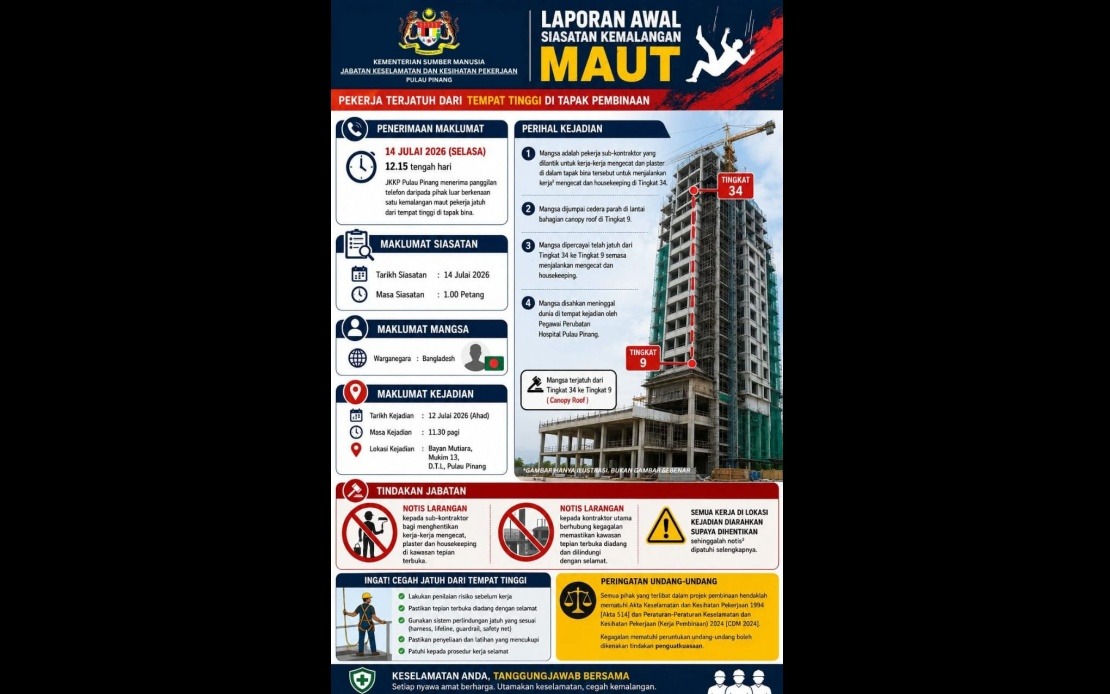
The Penang Department of Occupational Safety and Health (DOSH) has opened an investigation into the fatal accident that claimed the life of a migrant worker on a high-rise construction project in Bayan Mutiara, George Town, highlighting persistent workplace safety concerns in Malaysia's booming construction sector. The incident, confirmed on July 15, underscores the vulnerability of foreign labourers working on Malaysia's expanding urban skyline and raises fresh questions about enforcement of safety protocols at major development sites.
Authorities received word of the tragedy at 12.15 pm, prompting an immediate dispatch of investigating officers to the scene. According to Penang DOSH director Hairozie Asri, the victim was engaged by a subcontractor responsible for painting, plastering, and housekeeping operations at the complex. The worker had apparently been stationed on the 34th floor when the accident occurred, resulting in him landing critically injured on a canopy roof structure at Level 9—a catastrophic fall spanning approximately 25 storeys. Medical professionals from Penang Hospital subsequently pronounced him dead at the location.
The incident reveals a troubling pattern within Malaysia's construction landscape where migrant workers, who comprise a substantial proportion of the sector's labour force, face heightened exposure to hazardous conditions. Bangladesh has long been a primary source of construction workers for Malaysian projects, yet tragic accidents involving nationals from South Asian countries continue to occur despite increasing regulatory attention. This particular case raises uncomfortable questions about whether safety measures for work at significant heights were adequately implemented and enforced.
Hairozie's statement disclosed that preliminary findings indicated the subcontractor had been executing tasks in open-edge zones without apparent protective measures sufficient to prevent falls. The critical nature of work at height—particularly on elevated floors of multi-storey structures—demands rigorous adherence to fall protection systems, including harnesses, safety nets, and barriers. The fact that a worker could fall from the 34th floor suggests either inadequate equipment, insufficient training, or lax supervision, or a combination thereof.
In response to the tragedy, DOSH moved swiftly to enforce compliance mechanisms. The department issued a prohibition notice requiring the subcontractor to immediately cease all painting, plastering, and housekeeping operations in any open-edge areas of the site. A separate prohibition notice was simultaneously directed at the principal contractor overseeing the overall project. These notices carry significant legal weight in Malaysia's occupational safety framework and signify regulatory dissatisfaction with conditions on the site.
Beyond the prohibition notices, DOSH ordered a complete suspension of all work activities connected to the accident location pending full compliance with the regulatory requirements outlined in the notices. This comprehensive shutdown effectively halts progress on affected sections of the development until the contractor and subcontractor demonstrate that all safety deficiencies have been remedied. The decision reflects DOSH's determination to prevent further incidents and enforce accountability through administrative action.
The construction industry has long grappled with safety performance metrics that remain disappointing despite substantial investments in awareness campaigns and regulatory frameworks. Malaysia's rapid urbanisation and infrastructure development have generated enormous demand for construction labour, much of which is satisfied through migrant workers who often lack comprehensive understanding of local safety regulations or possess limited bargaining power to demand safer working conditions. Language barriers and unfamiliarity with Malaysian occupational health standards compound these vulnerabilities.
Foreign workers in Malaysia's construction sector frequently operate within employment structures that prioritise speed and cost efficiency, sometimes at the expense of rigorous safety compliance. Subcontracting arrangements, which characterised this incident, can further diffuse responsibility for safety oversight across multiple parties, potentially creating gaps in supervision and accountability. The incident at Bayan Mutiara exemplifies how complex contractual chains in large construction projects may inadvertently enable safety lapses.
The investigation proceeding under DOSH authority will likely examine multiple dimensions of the incident, including whether the subcontractor provided appropriate personal protective equipment, whether workers received adequate safety induction and training, whether fall arrest systems were installed and functional, and whether site supervisory practices met regulatory standards. The investigation will also scrutinise whether the principal contractor exercised adequate oversight of subcontractors' safety performance—a critical responsibility under Malaysia's occupational safety legislation.
This tragedy carries implications extending beyond the immediate workplace. For Bangladesh, which sends hundreds of thousands of nationals to work abroad annually, the incident represents another confirmation of occupational risks faced by its diaspora workers. Bangladeshi authorities and labour advocacy groups have consistently raised concerns about workplace fatalities among migrant workers employed in Malaysia and other destination countries, prompting calls for stronger bilateral cooperation on worker protection.
For Malaysia's construction industry broadly, the incident serves as a sobering reminder that despite regulatory frameworks and enforcement mechanisms, fatal accidents continue to occur. The sector's rapid expansion, combined with competitive pressures and labour shortages, can create environments where safety considerations become subordinated to project timelines and budgetary constraints. Industry stakeholders, including major developers and contractor associations, face renewed scrutiny regarding their commitment to genuine safety culture rather than mere regulatory compliance.
The suspension of work at the site will impose costs on the project timeline and budget, potentially incentivising the contractor to resolve safety deficiencies expeditiously. However, the fundamental challenge remains ensuring that safety measures become genuinely embedded within construction practices rather than treated as obstacles to overcome. The investigation findings, once concluded, should provide clarity on specific factors contributing to this tragedy and potentially inform enhanced regulatory guidance or enforcement priorities.

