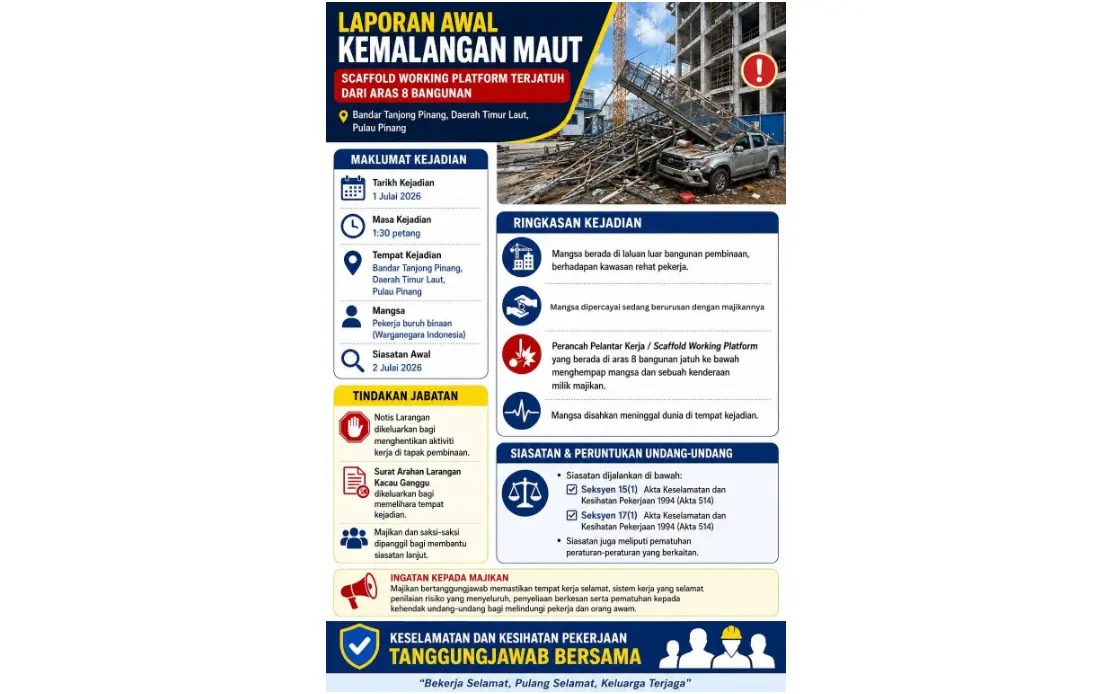
The Department of Occupational Safety and Health (DOSH) in Penang has suspended all operations at a construction site in Bandar Tanjong Pinang after a tragedy claimed the life of a foreign worker on July 1. The move underscores the regulatory authority's determination to investigate workplace safety failures that result in fatal incidents and holds employers accountable for breaches of occupational safety standards in the state's bustling construction sector.
According to DOSH's official statement, the fatal incident occurred at 1.30 pm when an Indonesian construction worker was struck by a scaffolding working platform that fell from the eighth floor of a building under development. The victim was positioned on an external walkway situated in front of the workers' rest area and was engaged in conversation with his employer at the moment the structure gave way. The falling scaffold also damaged a vehicle belonging to the employer, compounding the severity of the accident and the investigation that followed.
Immediate action was taken to secure the site and preserve evidence. DOSH issued a prohibition notice that mandates the immediate cessation of all work-related activities, accompanied by a non-disturbance order to maintain the scene in its original state throughout the investigation period. This dual-pronged approach prevents potential obstruction of the probe while signalling to stakeholders that workplace safety violations will be met with decisive enforcement measures.
The investigation is examining whether the accident resulted from violations of the Occupational Safety and Health Act 1994 (Act 514), specifically Sections 15(1) and 17(1), which establish the duties and responsibilities employers must uphold. Section 15(1) generally requires employers to provide and maintain safe working conditions, while Section 17(1) focuses on employers' obligations regarding safety and health measures in their operations. Investigators are interviewing employers and witnesses to piece together the sequence of events that led to the scaffolding's collapse and identify any negligence or non-compliance.
For Malaysia's construction industry, which relies heavily on migrant workers from Indonesia, Thailand, and Bangladesh, such incidents highlight persistent vulnerabilities in safety practices and enforcement. Despite regulations, fatal accidents remain disturbingly common on Malaysian construction sites, where workers from neighbouring countries often face language barriers, inadequate training, and pressure to complete tasks quickly. The death of the Indonesian worker in Bandar Tanjong Pinang is not an anomaly but reflects systemic challenges that regulatory bodies like DOSH continue to combat.
Penang, as a major commercial and industrial hub in northern Malaysia, hosts numerous ongoing construction projects ranging from residential developments to commercial complexes. The state's rapid urbanisation and infrastructure expansion create high demand for construction labour, making occupational safety particularly critical. When accidents occur, they not only devastate families and companies but also signal to investors and the public whether the state can maintain adequate workplace standards while pursuing growth.
DOSH's statement emphasised that all workplace accidents, particularly fatal ones, are treated with utmost seriousness and warranted comprehensive investigation. The regulatory body called upon employers, developers, main contractors, and subcontractors to ensure all work activities are meticulously planned and executed with safety as the paramount concern. This messaging serves dual purposes: it reaffirms DOSH's commitment to worker protection and warns industry stakeholders that complacency or corner-cutting will result in penalties.
Enforcement action will follow if the investigation uncovers violations of legal safety provisions. Penalties can range from fines to criminal charges depending on the severity of breaches and whether negligence contributed to the fatality. Main contractors bear particular responsibility as they oversee subcontractors and must enforce safety standards across their project hierarchy. The threat of prosecution, coupled with reputational damage, creates incentives for companies to prioritise worker safety and invest in proper training, equipment, and supervision.
The broader implications for Malaysia's construction sector are significant. Insurance companies, banks, and investors increasingly scrutinise safety records when assessing project viability and contractor reliability. A fatality linked to inadequate safety protocols can derail future contracts and financing for responsible companies and tighten scrutiny across the entire industry. This dynamic creates pressure for genuine improvements rather than mere compliance theatre.
For migrant workers and their families, incidents like this underscore the need for stronger worker advocacy, clearer communication of rights, and accessible complaint mechanisms. Many migrant labourers hesitate to report safety concerns for fear of losing employment or facing deportation. Regulatory agencies must balance enforcement with accessible reporting channels that protect whistleblowers from retaliation.
Penang DOSH's decisive action—issuing the stop-work order, preserving the scene, and launching a thorough investigation—demonstrates that enforcement mechanisms exist and can be deployed rapidly. However, the real test lies in whether the investigation leads to meaningful penalties, whether lessons learned are integrated into industry practice across Malaysia, and whether workers feel genuinely protected rather than expendable in the pursuit of development timelines.

