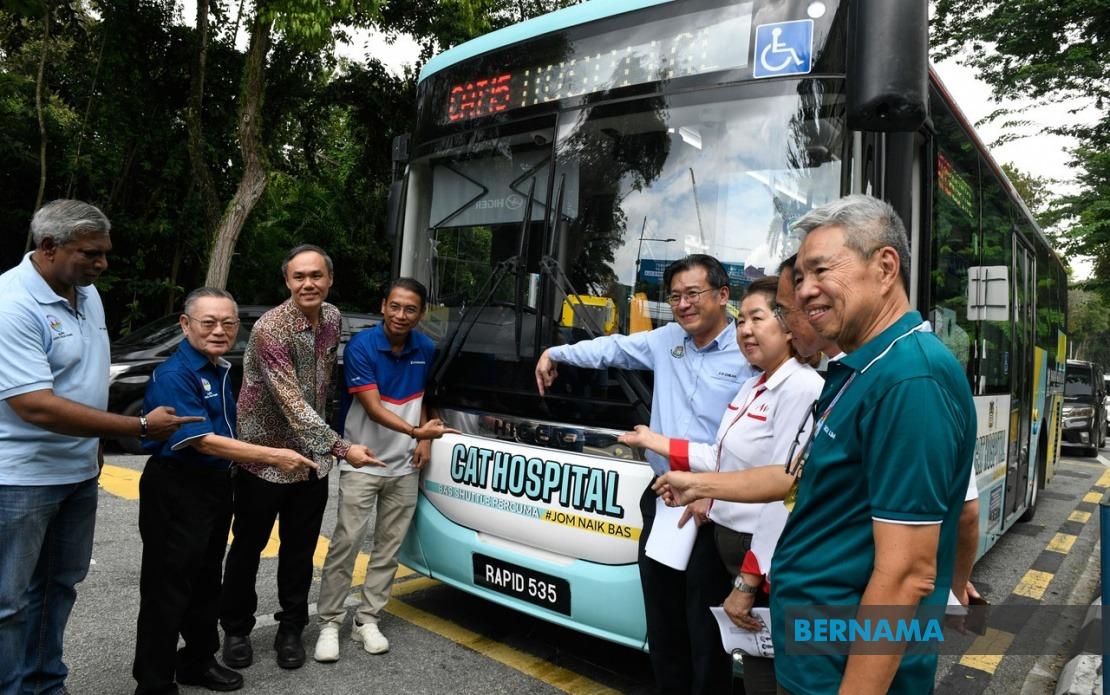
The Penang Island City Council (MBPP) is investing RM900,000 each year to sustain its free Central Area Transit (CAT) shuttle bus service, which began operations on January 1 and now transports residents between the city's commercial hub at Komtar and Penang Hospital alongside three private medical facilities and additional healthcare centres clustered in the George Town area. The commitment reflects a strategic effort by local authorities to integrate healthcare accessibility with sustainable urban mobility in Malaysia's northern corridor.
According to MBPP Engineering Director Cheah Chin Kooi, the initiative emerged directly from expansion work at Penang Hospital, which highlighted severe parking and congestion challenges in the vicinity. Rather than respond with traditional infrastructure expansion, the council opted for a demand-management approach centred on public transport enhancement, recognising that medical facilities attract substantial vehicle traffic from patients, visitors, and staff. The scheme specifically targets vulnerable user groups—elderly patients, caregivers assisting the unwell, and economically disadvantaged citizens—by eliminating the RM2 to RM5 fares typically charged on comparable routes.
The operational scale is modest but purposeful. Three buses deployed by Rapid Penang serve the eight-kilometre corridor during extended hours from 6 am to 8 pm, with vehicles arriving at 20-minute intervals and completing 36 daily journeys. This frequency aims to minimise waiting times for time-sensitive passengers, particularly those attending medical appointments or collecting prescriptions. Cheah outlined the service's dual purpose: encouraging modal shift toward public transport while alleviating vehicular pressure on surrounding roads and parking facilities, a chronic problem that degrades the hospital experience and constrains medical operations.
Early performance data suggests the initiative is gaining traction among users. Since commencement, daily ridership has climbed from roughly 300 passengers to approximately 600, representing a 100 percent increase within months. While these figures remain relatively modest in absolute terms, the doubling trajectory indicates growing awareness and acceptance, particularly as word-of-mouth spreads through patient networks and hospital staff communicate the service to visitors. This organic growth pattern suggests potential for further expansion if promotion and service reliability continue improving.
Penang Hospital director Dr Goh Hin Kwang reinforced the facility's commitment to accessibility by unveiling complementary infrastructure investments. The hospital has upgraded pedestrian walkways along Jalan Residensi and initiated reconstruction of its main entrance on Jalan Utama to create seamless connections with the shuttle terminus. These physical modifications demonstrate institutional recognition that transportation solutions require accompanying environmental design—a lesson often overlooked in Malaysian urban planning, where new transit services frequently fail when terminus conditions remain uninviting or poorly integrated with surrounding spaces.
The broader context reveals how Malaysian local authorities are experimenting with targeted subsidisation of public transport for specific user demographics and trip purposes. Unlike city-wide fare subsidies, which impose high fiscal burdens and often benefit infrequent or discretionary riders, the CAT model concentrates resources on a defined corridor serving high-need populations. This approach has proven effective in comparable settings internationally, where medical-facility shuttle services generate strong ridership momentum while controlling costs and maintaining service focus.
For Malaysia's healthcare system, the free shuttle represents a practical innovation addressing long-standing equity concerns. Hospital parking shortages disproportionately disadvantage elderly and disabled patients unable to walk long distances from remote car parks, while simultaneously elevating stress for family members navigating congested surroundings. By providing direct, barrier-free access, the scheme reduces out-of-pocket costs and time burdens for lower-income households, indirectly promoting preventive care uptake among populations that might otherwise defer medical visits due to transport complications.
The initiative also aligns with Penang's broader sustainability agenda. As a state contending with rapid motorisation and congestion comparable to Kuala Lumpur and Selangor, Penang has positioned public transport expansion and car dependency reduction as core planning objectives. The CAT service demonstrates commitment to these goals while generating data on how targeted free-transit schemes perform operationally and fiscally. If outcomes continue favoring expansion, the model could be replicated to other major institutions—universities, commercial centres, administrative hubs—creating a network of premium transit corridors serving high-volume, time-sensitive destinations.
The involvement of Rapid Bus Sdn Bhd Northern Region head Mohd Amir Abd Halim alongside civic and hospital leadership underscores the collaborative governance framework required for successful public transport innovation. Malaysian bus operators often lack incentives to serve routes with thin profit margins or dispersed passenger patterns, necessitating direct council subsidy and partnership. This arrangement shifts financial risk from the operator to the municipal authority, requiring sound planning and monitoring to prevent mission creep or unsustainable escalation of annual allocations.
Moving forward, MBPP's RM900,000 commitment hinges on sustained ridership growth and political continuity. If usage plateaus or declines, cost-per-passenger ratios will worsen, prompting reassessment. Conversely, if the doubling trend persists and daily passengers approach 1,000 or beyond, the council may face pressure to expand fleet size or service hours, requiring supplementary funding. The council will need transparent metrics and regular public communication about service outcomes to maintain taxpayer support for an initiative benefiting a specific constituency.
The Penang Hospital shuttle ultimately represents a pragmatic intersection of healthcare policy, urban mobility, and fiscal equity. Rather than pursuing expensive parking or road expansion, MBPP recognised that mobility—not parking supply—was the actual bottleneck. By combining modest technology (existing bus fleet), straightforward funding (municipal budget), and clear targeting (medical facility users), the council achieved measurable impact at manageable cost. For other Malaysian cities facing similar healthcare-related congestion, the model offers a replicable template worthy of examination and adaptation to local conditions.

