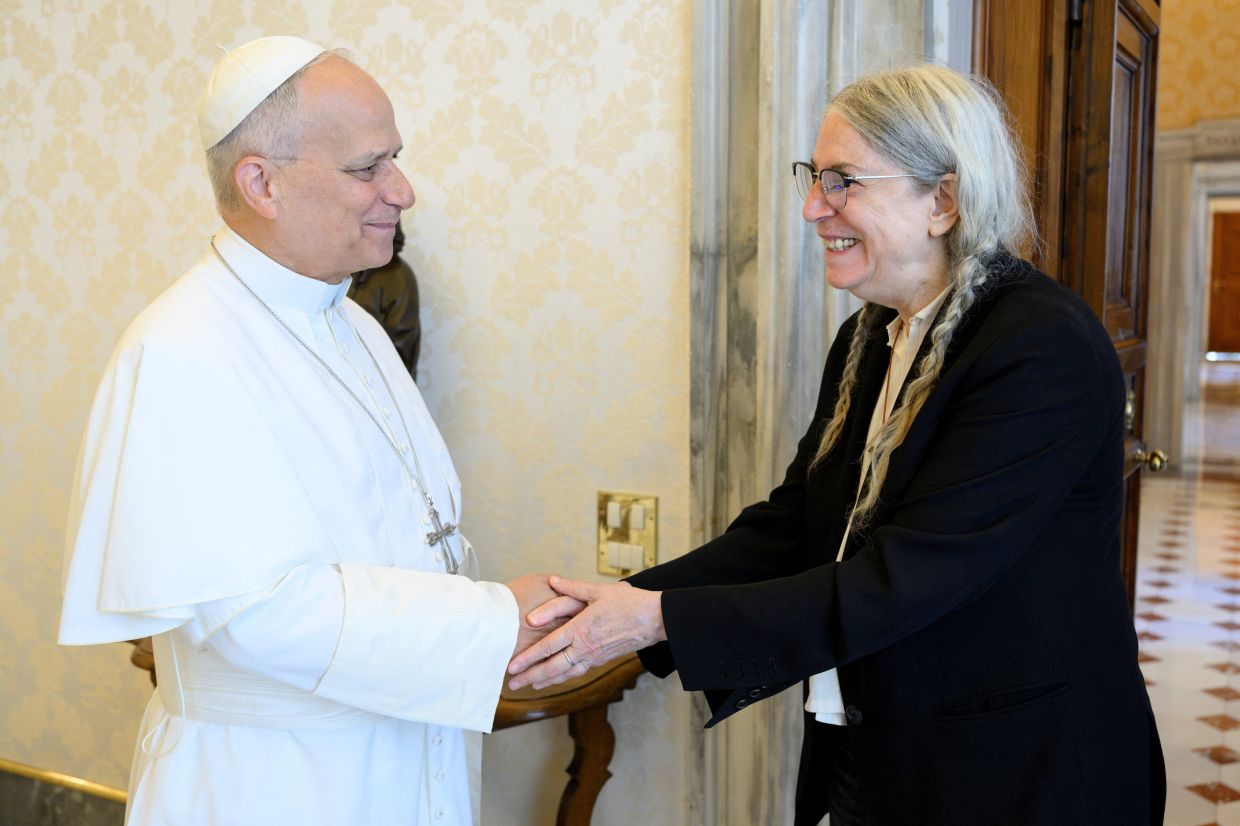
Rock icon Patti Smith sat down with Pope Leo XIV on Friday for an intimate audience at the Apostolic Palace, a moment that left the legendary musician notably subdued despite her usual eloquence. Greeting the pontiff with a simple "Hi," Smith—adorned in her signature braided hairstyle and a crucifix necklace—found herself in a rare moment of quiet reflection, underscoring the significance of the encounter for the artist who has long navigated the intersection of spirituality and creative expression.
Smith's growing presence within Vatican circles represents a remarkable cultural bridge, one facilitated primarily through her friendship with Rev Antonio Spadaro, who holds the position of undersecretary in the Vatican's culture ministry. This connection has allowed the American musician, who does not identify as Catholic, to establish an increasingly substantive relationship with the Holy See. Her integration into Vatican cultural life reflects broader institutional efforts to engage with prominent figures in the arts and humanities, signalling a deliberate strategy to connect religious leadership with secular creative communities.
The singer has articulated her attraction to the current papacy with particular clarity, expressing admiration for Pope Francis and what she characterised as his "gentle, open, and steadfast sense of humanity." This public affinity for the late pontiff's approach to faith and contemporary social concerns positioned Smith as an unexpected but authentic voice reflecting broader cultural appreciation for Francis's papacy beyond traditional religious constituencies. Her willingness to engage with the Vatican despite her secular identity speaks to the universal resonance of his message among artists and intellectuals worldwide.
Smith's history with the Church extends further back, to an earlier period when she held similar regard for Pope John Paul I. Her 1979 composition touching on this papal figure demonstrates how Smith has woven ecclesiastical themes throughout her artistic career, treating spiritual and religious subjects with the same seriousness she applies to matters of social justice and human experience. When Pope Leo XIV, upon hearing reference to this earlier work during their meeting, responded with "That was marvelous," he demonstrated familiarity with Smith's discography and artistic trajectory.
The timing of Smith's Vatican engagement has been carefully coordinated with significant moments in the Church's calendar and cultural initiatives. Earlier this year, on May 8—which coincided with Pope Leo's election anniversary—Smith performed during the inauguration of the Holy See's pavilion at the Venice Biennale, one of the world's most prestigious contemporary art exhibitions. This appearance underscored the Vatican's commitment to positioning itself within contemporary artistic discourse and using cultural events as diplomatic and spiritual platforms.
According to Spadaro's account, the Friday audience lasted approximately 40 minutes, a substantial duration reflecting the substantive nature of their conversation rather than a ceremonial exchange. Notably, both participants shared Chicago as their birthplace, establishing a geographical and cultural commonality that appears to have deepened their connection. Spadaro characterised the meeting as transcending the formal nature typically associated with papal audiences, describing it instead as "a conversation between two people discovering they were old friends, sharing memories woven from words and music, dreams, visions, and hopes—both from yesterday and for today."
Smith's relationship with the late Pope Francis, whom she first met in 2013 and performed for in 2014, evidently left a profound imprint on her consciousness and artistic output. When Francis passed away on April 21, 2025, Smith responded through social media with a poem comparing the pontiff to a dandelion, evoking both humility and resilience. In her memorial composition, she wrote that "Nature and poetry and the suffering shall miss their champion," articulating a perspective that elevated Francis beyond institutional religious leadership to a broader role as advocate for the vulnerable and voiceless.
Smith's presence at the Vatican also reflects the increasing recognition of artistic and cultural figures as legitimate partners in dialogue around faith, meaning, and social transformation. Her non-denominational spirituality—grounded in a deep engagement with existential questions rather than doctrinal adherence—resonates with evolving approaches to religious engagement in secular societies. The Vatican's cultivation of such relationships suggests institutional awareness that contemporary spiritual influence extends far beyond traditional religious channels.
The broader context of Smith's Vatican activities positions her within a tradition of artists who have found common ground with Church leadership around shared commitment to human dignity, creative expression, and moral seriousness. Her comfortable navigation between secular artistic spaces and ecclesiastical institutions demonstrates that the boundaries between these worlds remain far more porous than often assumed, particularly when individuals of genuine spiritual depth engage across these divides.
Pope Leo's own engagement with cultural figures has been evident throughout his early papacy. Just two days prior to meeting Smith, on Wednesday July 29, he attended a concert honouring him performed by renowned tenor Andrea Bocelli, further demonstrating his commitment to fostering relationships with prominent artists and using music as a vehicle for spiritual and diplomatic expression. These encounters signal a papal approach that emphasises cultural dialogue and the arts as essential components of contemporary religious leadership and institutional vitality.

