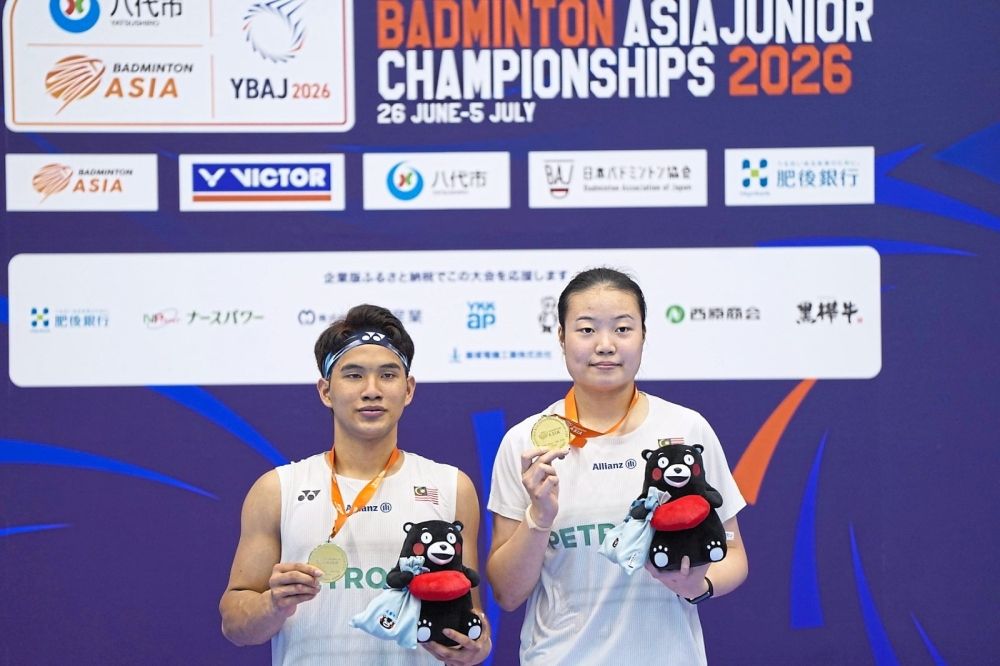
Ahmad Redzuan Zulwaqqarizal and Low Zi Yu have delivered a significant breakthrough for Malaysian badminton by securing the mixed doubles crown at the Asian Junior Championships in Yatsushiro, Japan, severing a drought that stretched back nearly two decades. The pair's 21-15, 22-20 victory over China's Zheng Weigang and Li Menghan ended Malaysia's 19-year hunt for the prestigious title, with the previous champions being Tan Wee Kiong and Woon Khe Wei, who won at home in Kuala Lumpur back in 2007. The 43-minute encounter proved to be a testament to composure under pressure, with the Malaysians navigating a treacherous second game where they had to recover from a demanding baseline battle.
The final unfolded as a gripping contest that saw the momentum swing repeatedly, particularly during the decisive second game which went right down to the wire at 20-20. Low Zi Yu reflected on the psychological battle, noting that her partnership's patience ultimately proved to be the decisive factor against their determined Chinese opponents. Where many pairs might have attempted aggressive shotmaking or lost their focus in such circumstances, Redzuan and Zi Yu maintained their discipline and court awareness. The pair drew additional strength from their supporting teammates, whose vocal encouragement from the sidelines provided an emotional lift during the most critical juncture of the match. This communal support system, often overlooked in individual sports narratives, played a tangible role in sustaining their mental resilience when the title hung in the balance.
For Redzuan, the triumph carries profound personal significance given his journey through three consecutive tournaments marked by disappointment. The Terengganu shuttler's association with the Asian Junior Championships began in 2023 when he competed in both boys' doubles and mixed doubles in Yogyakarta, only to exit prematurely from both events. Rather than capitalising on that exposure, he endured similar frustrations at the 2024 edition held in Yogyakarta and again at Surakarta in 2025. These repeated setbacks could easily have discouraged a young athlete, yet Redzuan's persistence through the tournament circuit demonstrates the resilience required to compete at Asia's junior elite level. His breakthrough triumph represents vindication of his continued commitment and serves as a reminder that championship success often rewards those willing to absorb disappointment and continue developing their craft.
Redzuan's measured assessment of his performance reveals a player focused on continuous improvement rather than simply savoring victory. He expressed satisfaction with his execution of the tactical elements worked on during training sessions, suggesting that his team's preparation proved sound when tested against quality opposition. However, his acknowledgment that further development is necessary before stepping up to senior competition indicates both realistic self-evaluation and understanding of the demanding progression pathway in professional badminton. This maturity in perspective is often characteristic of athletes who succeed through sustained effort rather than early talent alone, suggesting that Redzuan has internalized lessons from his previous tournament disappointments and transformed them into constructive motivation.
Low Zi Yu, at just 15 years old, has demonstrated the tactical intelligence and physical capability required to excel in multiple disciplines simultaneously. Alongside her mixed doubles achievement, she secured a girls' doubles bronze medal after falling to Japan's second-seeded pairing of Aoi Banno and Yuzu Ueno in the semi-finals, with the Japanese pair ultimately taking the title. The loss in that semi-final, despite its disappointment, was ultimately a narrow affair that extended into a third game, suggesting competitive parity at the tournament's upper echelon. Her approach to managing the dual commitments reveals sophisticated thinking about compartmentalization, as she emphasizes trusting her partners' capabilities in each discipline rather than attempting to control every aspect of play. This delegation of responsibility, rather than burden-sharing, appears to reduce psychological load and allow her to concentrate on her individual technical execution.
Zi Yu's observation that both her partners demonstrated sufficient court craft to handle themselves independently underscores the quality of Malaysian junior badminton development at present. Rather than requiring constant guidance or support, her counterparts in both disciplines proved capable of managing their own technical and tactical challenges, suggesting a depth of talent emerging through the national junior system. This competence among peers creates an environment where superior players can elevate their performance without being anchored to teammates requiring excessive direction. Her willingness to offer encouragement when partners made errors also indicates a supportive team culture, one that recognizes that negative reinforcement often proves counterproductive during tournament pressure.
The mixed doubles final itself reflected broader patterns visible in contemporary junior badminton, where Chinese partnerships consistently deliver strong performances but increasingly encounter sustained resistance from non-Chinese pairings. Zheng Weigang and Li Menghan's inability to convert their opportunities at crucial junctures, particularly when forcing the decider from 20-20, suggests that championship destiny is not preordained by seeding or reputation. The first-game margin of victory favoring Malaysia was comparatively comfortable, but the second game's trajectory demonstrated how momentum in badminton can shift dramatically when players maintain focus at critical score intervals. Malaysia's superior composure at deuce situations provided the decisive advantage in what was ultimately a contest of nerves rather than raw technical superiority.
This victory holds considerable significance for Malaysian badminton's junior pipeline, which has faced scrutiny regarding the development of competitive pairs in mixed doubles specifically. The category has historically proven challenging for Malaysian players to dominate at continental junior level, making this breakthrough particularly valuable as evidence that systematic talent development is bearing fruit. The success of Redzuan and Zi Yu provides a template and confidence boost for younger pairs coming through the system, demonstrating that victories over top-seeded Chinese pairings are achievable through disciplined preparation and mental fortitude. Their triumph may catalyze enhanced investment in mixed doubles development pathways and inspire greater attention to the category among aspiring junior players.
The broader context of Malaysian badminton's recent performance trajectory suggests this title represents genuine progress rather than isolated fortune. While the national senior team has experienced competitive challenges at recent international tournaments, the junior sector continues to produce promising talent across multiple categories. The Asian Junior Championships, held annually in rotating locations, provides crucial development experience that shapes players who will form the backbone of Malaysia's senior contingent within the next three to five years. Each medalist at these championships represents a young athlete accumulating the match experience, psychological resilience, and tactical sophistication necessary to function effectively on the professional circuit.
Looking forward, both Redzuan and Zi Yu face the challenging transition from junior to senior competitions, where the physical demands increase substantially and the margin for tactical error diminishes considerably. Their success at Yatsushiro demonstrates that they possess the foundational skills and competitive temperament necessary for this progression, but the step up remains demanding and unforgiving. The 19-year gap since Malaysia's previous mixed doubles triumph underscores how difficult it is to sustain success in this category at continental level, suggesting that the challenges ahead should not be underestimated. Nevertheless, their achievement has redefined what Malaysian junior badminton players should expect to accomplish, raising the baseline of ambition for future generations and providing tangible evidence that sustained effort through disappointment can yield significant rewards.

