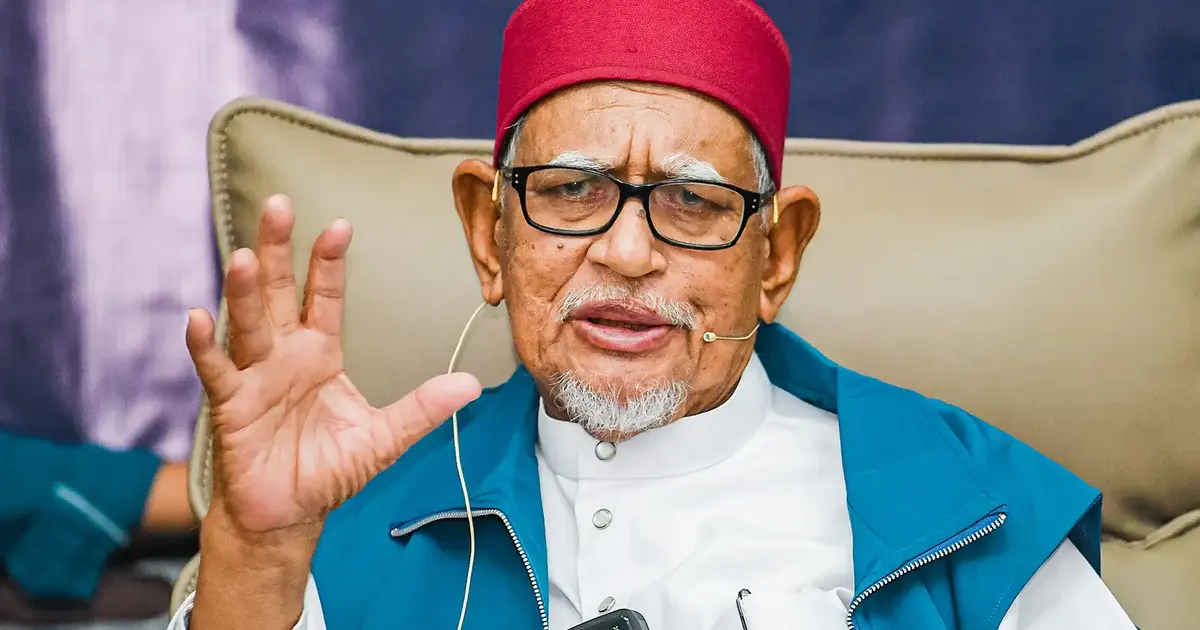
PAS president Hadi Awang has declared that Bersatu has effectively withdrawn from Perikatan Nasional, arguing that the party's stated ambitions to establish a fresh political alliance following the Negeri Sembilan election constitute an automatic departure from the coalition. The pronouncement represents a significant escalation in tensions between two of Malaysia's major Malay-Muslim political players and underscores the fragile nature of the opposition grouping that has held together since the 2022 general election.
Hadi's assertion hinges on the interpretation that Bersatu's public moves towards coalition-building conversations with other parties signal a fundamental incompatibility with membership in PN. According to PAS's reading of events, a party that simultaneously maintains PN affiliation while negotiating separate political arrangements violates the implicit commitment expected within any functioning coalition structure. This stance reveals how closely the Islamic party views exclusive loyalty as a prerequisite for participation in PN.
The Negeri Sembilan election has emerged as a flashpoint for latent divisions within Perikatan Nasional. As a state where the coalition's influence has waned and where opposition forces remain competitive, the contest became an opportunity for parties to reassess their electoral positioning and explore alternative arrangements. For Bersatu, discussions about post-election coalition possibilities suggest the party may be hedging its bets rather than remaining committed to PN's long-term political project.
Bersatu's pivoting carries particular weight given the party's role in PN's formation. The Muhyiddin-led organisation brought credibility and organisational capacity to the coalition when it was established, and its strategic repositioning raises questions about whether the founding members of PN genuinely envision a stable, durable political entity or whether the arrangement remains fundamentally transactional. For Malaysian political observers, this latest development suggests that coalitions in the post-2018 landscape remain susceptible to rapid reconfiguration when individual parties calculate that alternative arrangements might better serve their interests.
The implications for Perikatan Nasional's cohesion are substantial. If Bersatu's departure becomes formalized, the coalition loses a significant component of its organisational infrastructure and parliamentary representation. This comes at a moment when PN has been attempting to position itself as a credible alternative governing force to the Anwar Ibrahim administration. Fragmentation within opposition ranks typically weakens their collective bargaining position and reduces their capacity to mount coordinated challenges to government policy and legislative initiatives.
From a broader Southeast Asian perspective, Malaysia's coalition dynamics reflect patterns observable across the region where political alliances frequently dissolve under electoral pressure or shifting leader calculations. Unlike established democratic systems where coalition structures are regulated by constitutional frameworks and institutional conventions, Malaysia's coalitions operate with relatively loose binding mechanisms, making them vulnerable to sudden realignments when individual parties perceive electoral advantage elsewhere.
Hadi's public declaration also serves a strategic function within PAS itself. By asserting that Bersatu has already left PN, PAS positions itself as the coalition's guardian and true believer. This rhetorical move allows PAS to maintain the moral high ground while simultaneously suggesting that if PN dissolves, responsibility lies with Bersatu's disloyalty rather than with any PAS action. Such narrative control matters significantly in Malaysian politics where factional disputes frequently turn on questions of which party betrayed shared commitments first.
The timing of these tensions also merits consideration. Malaysia faces several significant electoral contests over the coming years, including potential state elections across multiple provinces. Coalition stability during this period could determine which parties emerge as attractive partners for future governing arrangements. Bersatu's exploration of alternatives suggests the party believes it can negotiate better terms by maintaining flexibility rather than remaining locked into PN commitments that may not yield optimal electoral outcomes.
For PAS, maintaining PN cohesion while excluding Bersatu could paradoxically strengthen the Islamic party's position. By appearing to purge disloyal elements, PAS reinforces its identity as the coalition's backbone and most committed member. This matters because PAS has traditionally drawn political legitimacy from representing Malay-Muslim interests, and a smaller, more ideologically unified coalition might actually align better with that constituency's preferences than a larger but more fractious grouping.
The Negeri Sembilan election itself becomes significant not merely as a local contest but as a litmus test for broader coalition viability. If Bersatu performs poorly or if opposition forces led by PN underperform, this reinforces Bersatu's calculation that alternative arrangements offer better prospects. Conversely, a strong PN showing might demonstrate that coalition discipline yields electoral rewards and could induce Bersatu to recommit fully. Either way, the state election results will likely determine whether Hadi's declaration represents the final formal dissolution or whether negotiations might still salvage PN's unity.
Looking ahead, Malaysian politics appears set for another round of coalition reconfiguration. Bersatu's willingness to discuss alternatives suggests that the opposition landscape will remain fluid and contested. For voters and observers seeking stability and predictable governance, such instability reflects the broader challenge facing Malaysia's political system: balancing genuine ideological and programmatic differences against the practical need for coalitions capable of governing effectively and pursuing coherent policy agendas across electoral cycles.

