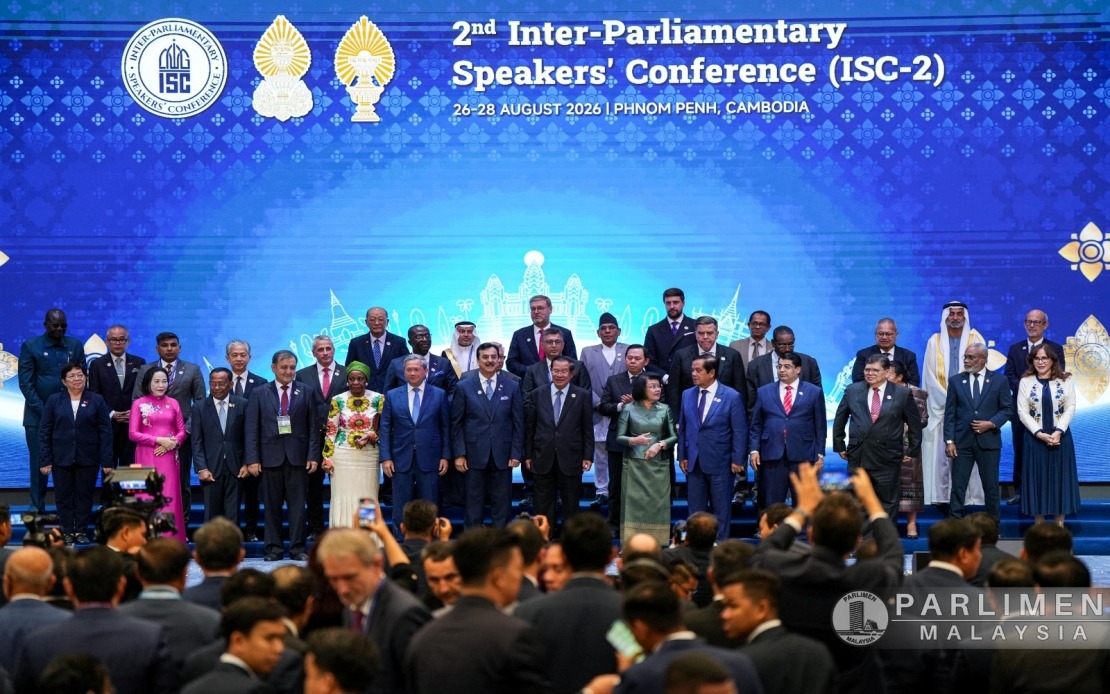
Dewan Rakyat Speaker Tan Sri Dr Johari Abdul has underscored the necessity for parliaments to wield considerably greater influence when confronting the world's mounting crises, from armed conflicts to geopolitical rivalries and environmental catastrophes. Speaking in Phnom Penh on Friday at the Second Inter-Parliamentary Speakers' Conference, Johari articulated a vision whereby legislative chambers function not as passive observers but as active partners in steering global affairs toward stability and prosperity.
The conference, convened jointly by Cambodia's National Assembly and Senate from August 26 to 28, assembled parliamentary leaders under the banner "Solidarity for Peace and Shared Prosperity: Strengthening International Law and Resolving Conflicts Peacefully." This gathering provided Johari with a pivotal stage to argue that the compartmentalisation of international diplomacy and conflict resolution within executive hands alone represents an incomplete approach to global governance. By extending legislative participation into these domains, he contended, nations can tap into institutional capacities that executives may overlook or undervalue.
Johari elaborated that the Inter-Parliamentary Speakers' Conference constitutes a rare institutional mechanism through which legislatures can meaningfully engage with transnational crises threatening both stability and human welfare. The platform permits parliamentary delegations to pool insights, share experiences and coordinate responses to challenges that transcend individual borders. When geopolitical tensions mount and climate-induced disasters displace populations or devastate ecosystems, parliaments possess distinctive vantage points from which to perceive threats and formulate remedies. Rather than treating legislators as subordinate to executive decision-makers, Johari posited that complementary engagement between these branches yields superior outcomes.
In remarks delivered during the conference's general debate, Johari painted a sobering picture of contemporary international disorder. Conflicts, he observed, have metamorphosed into bewildering webs of competing interests and transnational dimensions. The erosion of geopolitical consensus has strained the very institutions—principally the United Nations framework—that were architected after World War II to arrest large-scale violence. Beyond statistical accounting, Johari emphasised, the toll of warfare encompasses shattered families, educational deprivation for entire generations and the psychological fracturing of communities. These human dimensions often escape the calculus of realpolitik-minded executives.
Parliamentary diplomacy, Johari suggested, functions as an alternative channel through which nations can preserve substantive dialogue even when governmental relations freeze. Unlike official diplomatic protocols, which can rupture during crises, parliamentary exchanges permit legislators to maintain conversation across factional and national boundaries. This continued engagement constructs foundations of trust between institutions and normalises the principle that disagreement need not precipitate confrontation. For regions prone to sudden diplomatic ruptures or historical grievances, such parliamentary backdoors carry outsized significance in preventing misunderstanding from metastasising into military confrontation.
Malaysia's foundational commitment to international order, Johari stressed, rests upon respect for national sovereignty, territorial integrity, compliance with international legal frameworks and the peaceful adjudication of disputes. These principles acquire heightened relevance within Southeast Asia, where ASEAN's entire institutional logic hinges upon dialogue, consultation and the deliberate cultivation of regional harmony. The Association's founding members recognised that prosperity and security cannot flourish amid chronic suspicion or militarised borders. Rather, sustained diplomatic engagement and multilateral confidence-building generate the conditions in which economic cooperation and cultural exchange can flourish.
Within this Southeast Asian context, Johari argued that parliaments shoulder particular responsibility for consolidating peace mechanisms. Whenever bilateral tensions surface between neighbouring states, ASEAN's institutional apparatus offers forums for constructive resolution. Parliaments, exercising their constituent roles within this architecture, can amplify these efforts by fostering mutual comprehension among their respective populations and championing solutions anchored in international law, reciprocal respect and regional equilibrium. By strengthening cross-border parliamentary ties and encouraging legislators to champion lawful dispute settlement, the region can inoculate itself against zero-sum power struggles.
The cascading crises that define the current era—from Ukraine's ongoing conflict to Middle Eastern tensions, from nuclear proliferation anxieties to climate migration pressures—demonstrate the inadequacy of executive-only approaches to international governance. Parliaments, being elected bodies answerable to their constituents, possess legitimacy that unelected bureaucracies or executive offices cannot claim. When legislators champion peace initiatives or advocate for compliance with international conventions, they carry moral authority derived from democratic mandates. This legitimacy gap, Johari implicitly suggested, makes parliamentary engagement indispensable for anchoring any durable global settlement.
Looking ahead, the Inter-Parliamentary Speakers' Conference series has gained institutional momentum. Pakistan hosted the inaugural gathering in 2025, establishing precedent and procedural norms. Cambodia's hosting of the second edition demonstrated Southeast Asian commitment to parliamentary diplomacy. Indonesia's designation as host for the third ISC signals that the initiative has transcended its initial framing as a one-off gathering and is consolidating into a recurring mechanism through which parliamentary leadership can collectively address transnational challenges. This progression reflects growing recognition that legislators, when mobilised as coherent diplomatic actors, furnish resources and perspectives that strictly governmental channels may neglect.
For Malaysia specifically, Johari's advocacy positions the country as a champion of inclusive, rules-based global governance architectures. In an era when unilateralism and great-power competition threaten multilateral institutions, Malaysia's parliamentary leadership has articulated a compelling counter-vision: that international peace and prosperity depend upon strengthening rather than abandoning the legal and diplomatic frameworks that subordinate raw power to consensual norms. By elevating parliamentary participation in global affairs, Malaysia argues implicitly for a world wherein smaller states retain meaningful voice and wherein might does not automatically determine right. This stance aligns with Malaysia's historical foreign policy trajectory while addressing contemporary anxieties about a bifurcating world order.

