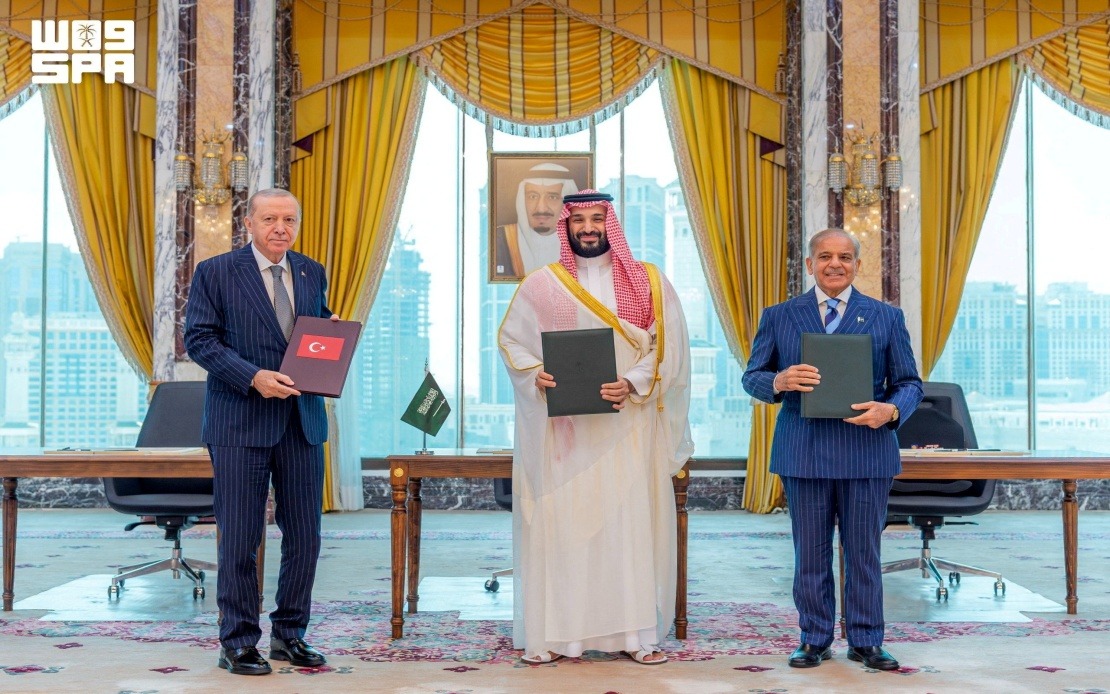
Three major Muslim-majority powers formalised sweeping defence commitments on Friday, establishing a framework for collective protection that signals deepening strategic alignment in a volatile geopolitical landscape. Saudi Crown Prince Mohammed bin Salman bin Abdulaziz Al Saud, Pakistan Prime Minister Shehbaz Sharif, and Turkish President Recep Tayyip Erdogan inked the Joint Defence Agreement following high-level talks at Al Safa Palace in Makkah, creating binding obligations that treat any military assault on one signatory as an affront to all three.
The agreement represents a crystallisation of longstanding bilateral relationships into a trilateral security architecture. Pakistan and Saudi Arabia established bilateral defence ties just last year with a September accord requiring reciprocal military assistance, while Ankara and Islamabad have maintained robust defence partnerships spanning decades. Türkiye's inclusion elevates the arrangement beyond the Middle East, incorporating a transcontinental NATO member with substantial military capabilities and geopolitical reach. The convergence of these three strategic actors reflects broader regional efforts to consolidate influence and counterbalance competing power blocs.
The formal language of the pact establishes an explicit deterrence mechanism. Any armed attack targeting Pakistan, Saudi Arabia, or Türkiye automatically triggers collective response obligations, fundamentally altering the cost-benefit calculations for potential adversaries considering unilateral aggression. This mutual defence clause creates automatic escalation pathways, transforming bilateral disputes into potential trilateral confrontations. For regional observers, particularly those tracking Middle Eastern military dynamics and South Asian security concerns, the agreement substantially raises the stakes for any confrontational strategy against the three signatories.
Beyond the headline deterrence provisions, the accord explicitly encompasses comprehensive defence cooperation across multiple dimensions. The three nations committed to developing integrated military capabilities, harmonising strategic planning, and establishing joint operational frameworks. This integration extends to technological collaboration, intelligence sharing protocols, and harmonised procurement standards. Such deepening operational integration typically precedes genuine military interoperability, suggesting the signatories envision sustained, expanded coordination rather than merely symbolic gestures.
Pakistan's nuclear arsenal adds consequential weight to the arrangement. As one of nine nations possessing atomic weapons, Pakistan's inclusion transforms the agreement from a conventional defence compact into a nuclear-age strategic alliance. This nuclear dimension fundamentally reshapes regional balance-of-power calculations, particularly regarding potential adversaries in South Asia and the broader Middle East. The pact essentially extends nuclear deterrence implications across three geographically dispersed regions simultaneously.
Saudi Arabia's deputy public diplomacy minister Rayed Krimly sought to characterise the arrangement as purely defensive, emphasising that the pact neither threatens neighbouring states nor represents escalatory posturing. Krimly's clarification highlights sensitivities regarding regional interpretation, particularly from Iran and other states potentially viewing the alliance as anti-Iranian configuration. However, such defensive framing represents standard diplomatic language; security arrangements rarely define themselves as offensive threats, even when multiple parties perceive precisely such implications.
The Makkah setting itself carries symbolic resonance, positioning the accord within Islamic solidarity frameworks and emphasising shared religious and civilisational identities among signatories. The location implicitly anchors the agreement to broader Muslim-world cohesion narratives, potentially appealing to domestic constituencies within each nation while reinforcing the arrangement's legitimacy across Islamic-majority populations. This symbolic dimension complements the strategic calculations, embedding geopolitical strategy within cultural and religious contexts.
For Southeast Asian observers and Malaysian policymakers, the agreement warrants careful monitoring regarding its implications for regional maritime security and South China Sea dynamics. Türkiye's participation, though geographically distant, potentially extends security coordination frameworks that could eventually encompass broader Indo-Pacific considerations. Pakistan's traditional alignment with Gulf interests intersects with its own Indian Ocean strategic concerns, while Saudi Arabia maintains substantial energy export routes through Southeast Asian waters. Any operational deepening among these three powers carries indirect implications for regional shipping lanes and maritime stability.
The trilateral arrangement also reflects evolving patterns of non-Western security architectures developing outside traditional Western-led alliance structures. Unlike NATO or US-centred bilateral agreements, this pact represents autonomous strategic coordination among nations historically managing relationships with both Western and non-Western powers. This reflects broader global fragmentation wherein middle powers and regional leaders construct independent security frameworks reflecting their particular strategic interests and threat perceptions.
The agreement's evolution from bilateral arrangements to trilateral coordination suggests potential expansion trajectories. Other regional powers with existing defence relationships to these three nations might seek participation, gradually expanding the framework into broader coalition structures. Alternatively, the pact could remain an exclusive arrangement among these specific three, developing deepening operational coordination without further expansion. Either trajectory carries implications for regional geopolitical competition and alignment patterns.
Implementation remains critical; substantive defence cooperation requires institutional mechanisms, resource commitments, and genuine operational coordination extending beyond ceremonial summits. The agreement's effectiveness depends upon establishing functional command structures, joint planning processes, and sustained political will to coordinate defence policies despite competing national interests. Past multilateral defence arrangements among developing nations have sometimes foundered on implementation challenges, suggesting the signatories face considerable organisational hurdles ahead.
The pact underscores continuing evolution of strategic competition characterised by flexible alignments and variable-geometry coalitions rather than rigid Cold War-style blocs. Nations increasingly construct issue-specific partnerships addressing particular threat perceptions or opportunities rather than comprehensive alliance systems. This arrangement exemplifies such targeted coordination, bringing together nations sharing security concerns whilst potentially disagreeing on numerous other matters. Such flexibility characterises contemporary geopolitics, where alliances prove increasingly fluid and context-dependent.

