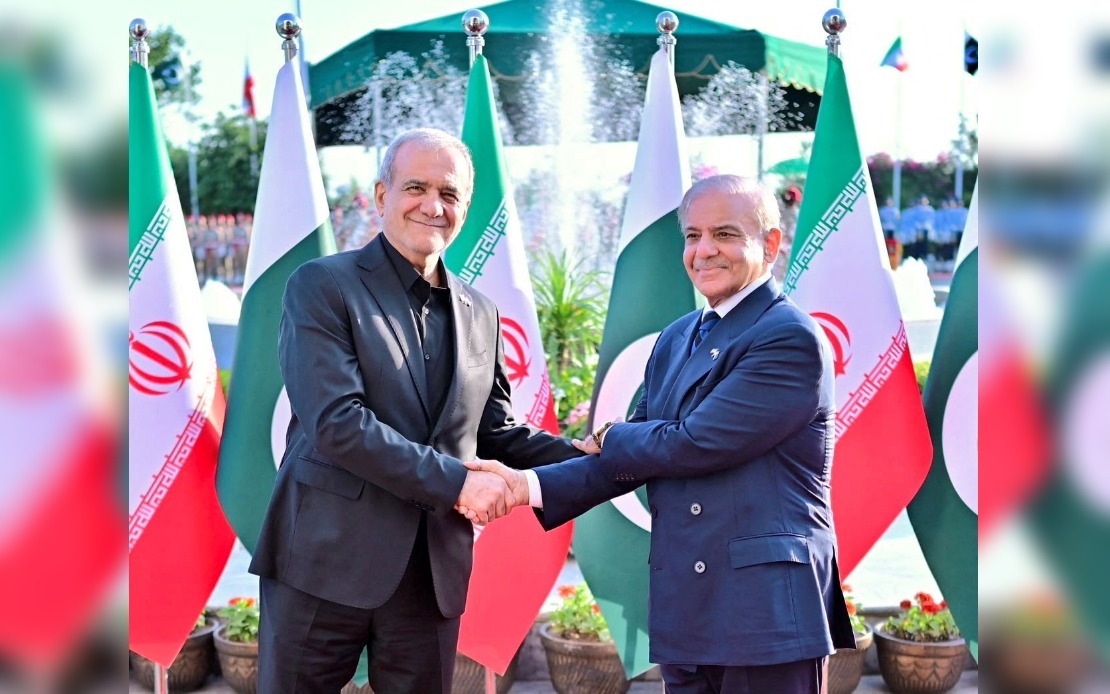
Pakistan's Prime Minister Shehbaz Sharif has thrown his weight behind Iran's ballistic missile programme, declaring during talks with visiting Iranian President Masoud Pezeshkian that Tehran's defensive capabilities should not be constrained by international pressure. Speaking in Islamabad on Tuesday, Sharif made clear that Pakistan views Iran's missile development as a legitimate exercise of national sovereignty, unbound by the memorandum of understanding reached between Iran and the United States on June 17.
The central thrust of Sharif's position centres on what he frames as the inherent unfairness of selective non-proliferation standards. By refusing to negotiate away Iran's missiles while other nations retain similar arsenals, Pakistan's leader is challenging what he characterises as a double standard in international relations. His argument carries particular weight given Pakistan's own status as a nuclear-armed state and its experience navigating between geopolitical pressures and security imperatives. The insistence that ballistic missiles never featured in the US-Iran talks appears designed to establish a clear boundary—asserting that Tehran made no concessions on this front and should face no expectations to do so.
Pakistan's mediation efforts in the region have been substantial and multifaceted. Beyond brokering the June agreement, Islamabad previously facilitated a temporary ceasefire between Iran and the United States in April, demonstrating its cultivation as a neutral intermediary despite its own strategic alignments. Deputy Prime Minister and Foreign Minister Ishaq Dar, alongside Chief of Army Staff Field Marshal Syed Asim Munir, invested significant diplomatic capital in these negotiations. Sharif's public expressions of gratitude to Iran appear calibrated not only to acknowledge successful mediation but also to strengthen bilateral ties as geopolitical tensions remain elevated across West Asia.
The Iranian perspective, articulated by President Pezeshkian at a joint press conference, frames the missile question as existential rather than negotiable. His blunt warning that Iran would face the fate of Gaza—total destruction without mercy—if stripped of defensive capabilities underscores how deeply Tehran views its arsenal as fundamental to survival. This hardline rhetorical stance reflects genuine anxieties shaped by historical experience and recent military aggression. The February 28 attacks by Israel and the United States, which prompted the current diplomatic thaw, demonstrated that Iran's adversaries possess the capability and willingness to strike at will, making any surrender of deterrent capabilities politically untenable for Iranian leadership.
The ceremonial dimensions of Pezeshkian's visit reinforced the message of strengthened partnership. Pakistan arranged an elaborate state reception, with six Pakistani Air Force fighter jets escorting the Iranian president's aircraft, a 21-gun salute fired in his honour, and personal welcomes from Prime Minister Sharif and President Asif Ali Zardari. These gestures, while traditionally part of high-level diplomatic protocol, carry symbolic weight in signalling to regional and international observers that Pakistan is publicly aligning itself with Iran's security interests and rejecting external pressure to isolate Tehran.
Notably, the position articulated in Islamabad mirrors recent statements by United States President Donald Trump, who conceded in Paris that Iran's possession of ballistic missiles was reasonable if other nations possessed them. Trump's acknowledgment that selective denial of weapons capabilities to Iran constituted unfairness represents a significant rhetorical shift from the Trump administration's previous opposition to Iran's missile programme. This convergence between Pakistan and the American president suggests that international consensus on this issue may be fragmenting, with some major powers reconsidering whether ballistic missile restrictions remain either enforceable or justified.
For Malaysian and Southeast Asian observers, Pakistan's explicit backing of Iran's military capabilities offers important insights into how major powers in neighbouring regions navigate security dilemmas and mediation roles. Pakistan's willingness to publicly defend another nation's weapons development—despite potential costs in relations with Washington and its Gulf allies—reflects a calculation that maintaining credibility as a neutral mediator requires taking principled stances on sovereignty and fairness. This approach may have resonance in Southeast Asia, where nations also balance relationships with competing powers while asserting their own strategic autonomy.
Pakistan's emphasis that spoilers exist who would undermine the US-Iran peace deal adds another layer to the diplomatic narrative. While unnamed, these obstructers are widely understood to include Israel and its regional supporters, nations which view any US-Iran rapprochement as threatening their interests. Pakistan's warning about spoilers may reflect genuine concerns about sabotage, or may serve as diplomatic cover for why the initial agreement lacks more comprehensive provisions. Either way, it underscores the fragility of diplomatic breakthroughs in West Asia and the multiplicity of actors with incentives to derail peace processes.
The timing of Pezeshkian's visit and Sharif's statements assumes added significance given broader regional instability. Lebanon and Gaza continue experiencing military operations that kill civilians daily, creating humanitarian crises that fuel anti-Western sentiment across Muslim-majority nations. Pakistan's public solidarity with Iran on the missile question may partly reflect this sentiment, allowing Islamabad to demonstrate that it champions Muslim interests rather than deferring entirely to Western preferences. Such positioning serves domestic audiences who increasingly demand their governments resist what they perceive as imperial pressure from Washington.
Looking forward, the question of whether Iran's ballistic missile capabilities will remain outside international constraints—or whether future negotiations might eventually address them—remains unresolved. Pakistan's current position appears to rule out Pakistani participation in any future efforts to restrict Iran's missiles, at least while Pakistan maintains its current leadership and strategic orientation. This constrains options for international coalitions seeking to limit Iran's arsenal and suggests that any comprehensive arms control arrangement would require either Iranian voluntary compliance or enforcement mechanisms that exclude Pakistan's cooperation.
The visit also illuminates Pakistan's broader regional strategy of cultivating partnerships that enhance its international standing without entirely sacrificing relations with Western powers. By hosting Pezeshkian and publicly supporting Iran's security interests, Pakistan demonstrates independence while its military and intelligence establishment maintains various channels to Washington and other partners. This balancing act, repeatedly executed across decades, reflects Pakistan's position as a linchpin nation whose cooperation remains valuable to multiple competing blocs despite its limited economic weight.
Ultimately, Sharif's defence of Iran's missiles represents more than support for a neighbour's weapons programme—it signals Pakistan's vision of a multipolar international system where nations retain sovereign control over their security decisions rather than accepting restrictions imposed by distant powers. Whether this position proves durable or merely rhetorical will depend partly on how the regional security situation evolves and whether the fragile US-Iran understanding can survive the considerable pressures arrayed against it.