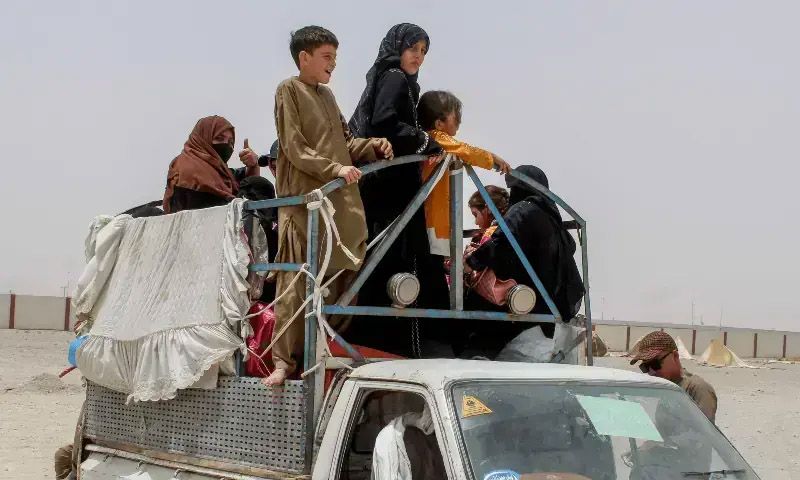
Pakistan's government has dramatically escalated its removal of undocumented Afghan nationals, with 2.59 million deportations recorded since 2023. The operation represents one of the largest mass deportation efforts in recent South Asian history and reflects mounting pressure on Islamabad to address what officials characterize as illegal immigration. The crackdown spans federal and provincial authorities, with the Punjab government playing a central enforcement role in what amounts to a systematic border management strategy with significant humanitarian and regional implications.
Punjab province, Pakistan's most populous region, has emerged as the focal point of deportation operations. The provincial government has established 36 functional detention centres across Punjab where undocumented Afghans are held pending deportation proceedings. Within these facilities, authorities have processed and removed 138,342 individuals since the campaign began. The scale of these operations underscores the logistical challenge of managing such large migrant populations and the infrastructure investment the province has devoted to enforcement activities. Currently, approximately 53 Afghan nationals remain in Punjab's holding centres awaiting final processing and removal.
The home department's foreign national security cell, a specialized unit created to tackle undocumented migration, coordinates the detention and deportation machinery. This institutional apparatus reflects how seriously Pakistani authorities treat the issue, designating it a security matter rather than purely an immigration administration challenge. The cell operates the network of holding centres and manages the administrative procedures necessary to document detainees before removal. This centralized approach enables authorities to track deportations systematically and coordinate with border authorities managing exit points.
Pakistan's stated policy framework is unambiguous: any foreign national lacking valid visa documentation faces mandatory deportation. Home department officials have publicly defended this position, emphasizing that the regulation applies uniformly regardless of nationality. However, the disproportionate focus on Afghan nationals—who constitute a substantial portion of Pakistan's undocumented migrant population—raises questions about implementation consistency. The policy's enforcement reflects broader tensions between Pakistan's historical role as a host nation for Afghan refugees and current priorities emphasizing stricter border controls.
Authorized security operations have targeted both residential neighbourhoods and commercial markets where undocumented migrants commonly congregate or find employment. The home department claims to have completed comprehensive surveys of high-density areas, systematically identifying and apprehending individuals without proper documentation. This territorial approach creates an enforcement presence throughout Punjab's urban and commercial spaces rather than limiting operations to border crossing points. Such intensive domestic enforcement signals a policy shift toward making illegal residence increasingly untenable through routine detention risks.
Detainees processed through Punjab's holding centres receive accommodation, registration services, and transportation arrangements facilitating their return to Afghanistan via the Torkham border crossing. The provision of basic services during detention reflects international humanitarian standards while maintaining the deportation pathway's operational efficiency. Torkham, located in Khyber Pakhtunkhwa province on the Pakistan-Afghanistan border, serves as the primary transit point for these deportations. The sustained flow of deportees through this crossing has created administrative and logistical demands on both nations' border management infrastructure.
Public participation in enforcement efforts is actively encouraged through official channels. Pakistani authorities have publicized an emergency hotline, 15, enabling residents to report suspected undocumented Afghans directly to law enforcement. The government has promised caller anonymity, theoretically removing disincentives for public participation. This bottom-up reporting mechanism expands enforcement capacity beyond formal security operations, enlisting civilian populations in identifying and documenting violations. Such approaches, while potentially effective enforcement tools, can also generate concerns regarding due process protections and potential misuse of reporting systems.
For Malaysian observers, Pakistan's deportation campaign carries several instructive dimensions. Southeast Asia faces comparable pressures regarding undocumented migrant populations, though typically from Myanmar, Bangladesh, and Indonesia rather than a single neighbouring nation. Pakistan's systematic approach—combining holding centre infrastructure, deportation corridors, and public reporting mechanisms—offers a governance model that regional governments may study or emulate. However, the scale and intensity of Pakistan's operations also illustrate humanitarian challenges accompanying mass deportations, particularly regarding the receiving nation's capacity to absorb returnees and the social conditions awaiting them.
The deportation campaign occurs against Afghanistan's broader instability and economic deterioration. Afghan returnees face constrained employment prospects and limited social services in their home country, creating humanitarian concerns about deportees' welfare. Pakistan's removal of such large populations simultaneously addresses domestic security and employment concerns while transferring populations to a nation with limited capacity to accommodate them. This dynamic reflects the asymmetrical burden-sharing characterizing regional migration governance, where transit and host nations bear disproportionate responsibilities relative to nations of origin or transit.
The geopolitical context shapes Pakistan's enforcement priorities. Relations between Islamabad and Kabul have periodically deteriorated, with Pakistan experiencing cross-border security incidents attributed to Afghan-based militant groups. Pakistani officials link undocumented migration to security risks, arguing that deportation contributes to border stability. Whether undocumented immigration genuinely correlates with security threats or whether this framing justifies enforcement activity remains contested among analysts. Nevertheless, Pakistan's security establishment has clearly prioritized Afghan deportations as a policy objective deserving substantial resources.
Regional stability and bilateral relations between Pakistan and Afghanistan will significantly influence the sustainability of current deportation levels. Should circumstances improve or diplomatic pressure increase, enforcement intensity might diminish. Conversely, continued instability in Afghanistan could sustain or intensify Pakistani removal operations. For ASEAN nations monitoring regional migration dynamics, Pakistan's experience illustrates how geopolitical tensions and security perceptions intersect with migration governance, potentially overriding humanitarian considerations in policy formation.
Looking forward, the scope and duration of Pakistan's deportation campaign remain uncertain. The federal government's clear policy stance suggests sustained enforcement commitment, yet logistical constraints, donor pressure, and diplomatic considerations may eventually moderate the pace. The 2.59 million figure represents merely documented deportations; estimates of undocumented Afghan populations remaining in Pakistan suggest substantial enforcement work continues. Whether current operations represent a transitional phase toward normalized migration management or a sustained policy shift will become clearer within the coming years.

