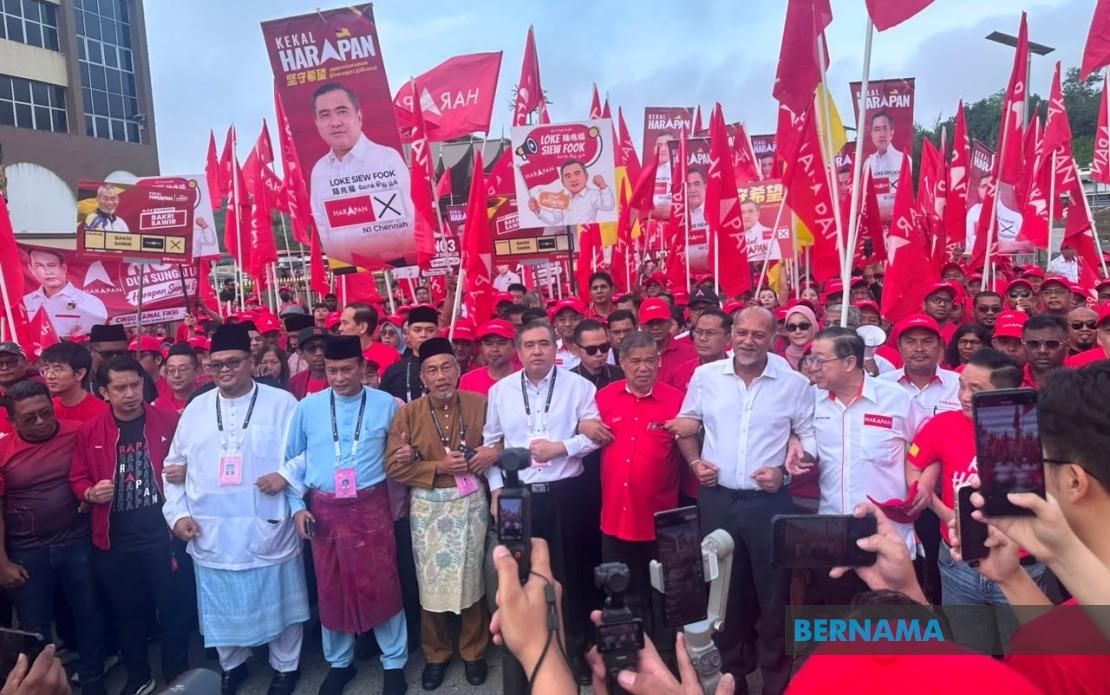
The Pakatan Harapan coalition fielded a visible show of political strength across Negeri Sembilan on July 18 as senior party figures fanned out to accompany candidates through the nomination filing process for the state's 16th legislative election. The coordinated deployment of ministers, party officials, and veteran politicians underscored the coalition's determination to defend its 2023 gains in what remains a competitive political battleground in the peninsula's central region.
Transport Minister Anthony Loke, also serving as DAP secretary-general, personally filed nomination papers for the Chennah state seat in Jelebu, arriving at Dewan Besar Kuala Klawang shortly after 8:30 am. His presence at the nomination centre was bolstered by the attendance of DAP chairman Gobind Singh Deo, party adviser Lim Guan Eng, and Amanah president Datuk Seri Mohamad Sabu. The gathering of multiple party heavyweights for a single nomination illustrates the symbolic importance PH attaches to maintaining representation across the state's geographic and demographic diversity, particularly in constituencies where the coalition faces determined opposition.
The coalition's operations across the state's nomination centres reflected a carefully orchestrated strategy. Communications Minister Datuk Seri Fahmi Fadzil stationed himself at the Jempol District and Land Office to oversee submissions from candidates contesting four separate seats: Serting, Palong, Jeram Padang, and Bahau. His presence represented an attempt to provide unified messaging and high-level validation for both returning incumbents and fresh faces entering the electoral arena. Among the candidates he shepherded was Teo Kok Seong for Bahau, who carries the advantage of incumbency from the 14th General Election, whilst three others—Yaacob Mahmood, Muhammad Zahin Zinal Abidin, and Manivanan Gowin—represent new entrants bringing fresh dynamics to their respective contests.
Menteri Besar Datuk Seri Aminuddin Harun's nomination filing at Port Dickson drew the attendance of DAP deputy secretary-general Hannah Yeoh, PKR secretary-general Datuk Dr Fuziah Salleh, and the Prime Minister's political secretary Datuk Farhan Fauzi. As both PH chairman in Negeri Sembilan and a candidate for the Linggi seat, Aminuddin occupies a pivotal position in the coalition's electoral fortunes. The gathering reflected recognition that the Menteri Besar race remains central to PH's strategic calculus, with his political survival representing a litmus test for the coalition's broader viability in the state.
Other nomination centres witnessed similar displays of solidarity. Entrepreneur and Cooperatives Development Minister Steven Sim led a contingent accompanying six PH candidates at the Wisma Majlis Bandaraya Seremban centre, arriving precisely at 8:30 am alongside Selangor State Legislative Assembly Speaker Lau Weng San, Bukit Gelugor MP Ramkarpal Singh, and PKR vice-president Datuk Seri R. Ramanan. The participation of figures with cross-state influence suggests PH is mobilising its resource base regionally to reinforce state-level operations, a tactic consistent with how the coalition has managed electoral challenges since its 2018 federal breakthrough.
The nomination day proceedings underscored the stakes involved in the August 1 polling date, which the Election Commission confirmed following the dissolution of the state assembly on June 5. That dissolution followed receipt of consent from Yang Dipertuan Besar of Negeri Sembilan Tuanku Muhriz Tuanku Munawir, formalising political calculations that had dominated state politics for weeks. Early voting has been scheduled for July 28, compressing the campaign period and intensifying the need for rapid voter outreach.
PH's current position in the state assembly reflects precarious arithmetic. The coalition holds 17 of 36 seats following the 2023 election, commanding a functional majority but lacking the cushion necessary to absorb defections or by-election losses without jeopardising its government. Barisan Nasional occupies 14 seats whilst Perikatan Nasional holds five, creating a fragmented political landscape where marginal swings in key constituencies could reshape the state's political complexion. For Malaysian observers tracking coalition stability across the peninsula, Negeri Sembilan results will offer crucial indicators about whether PH can consolidate its position in peripheral battleground states or faces gradual erosion.
The nomination day choreography also reflected generational considerations within the PH coalition. Whilst senior figures like Lim Guan Eng and Mohamad Sabu provided symbolic benediction, younger candidates and emerging political voices appeared prominently on the nomination rolls. This balance between established authority and emerging talent will likely define PH's campaign messaging and ground operations through polling day. The coalition must simultaneously reassure voters of competent governance while projecting dynamism and renewal—a challenge particularly acute in Negeri Sembilan's mix of urban, semi-urban, and rural constituencies.
Regional context further complicates the electoral equation. Negeri Sembilan sits adjacent to Selangor, Malaysia's economic powerhouse and a state PH dominates, yet political fortunes rarely transfer seamlessly across borders. The state economy's dependence on agriculture, manufacturing, and service sectors creates distinct voter preoccupations compared to metropolitan Selangor, whilst cultural and religious sensitivities in constituencies like Linggi carry different salience than in urban centres. PH's deployment of cross-state leadership figures acknowledges these complexities, attempting to apply lessons and resources from successful operations elsewhere.
For the broader Malaysian political landscape, the Negeri Sembilan contest functions as an important bellwether. It tests whether PH can maintain momentum in state-level contests following federal government formation, or whether fatigue with the coalition at federal level translates into electoral punishment at state level. The August 1 results will provide data points for assessing coalition viability heading toward the next general election cycle, influencing calculations within BN and PN about future electoral positioning and coalition possibilities. In this context, the July 18 nomination day's theatrical show of PH strength represents not merely ceremonial positioning but rather the opening salvo in a contest carrying implications extending well beyond Negeri Sembilan's borders.

