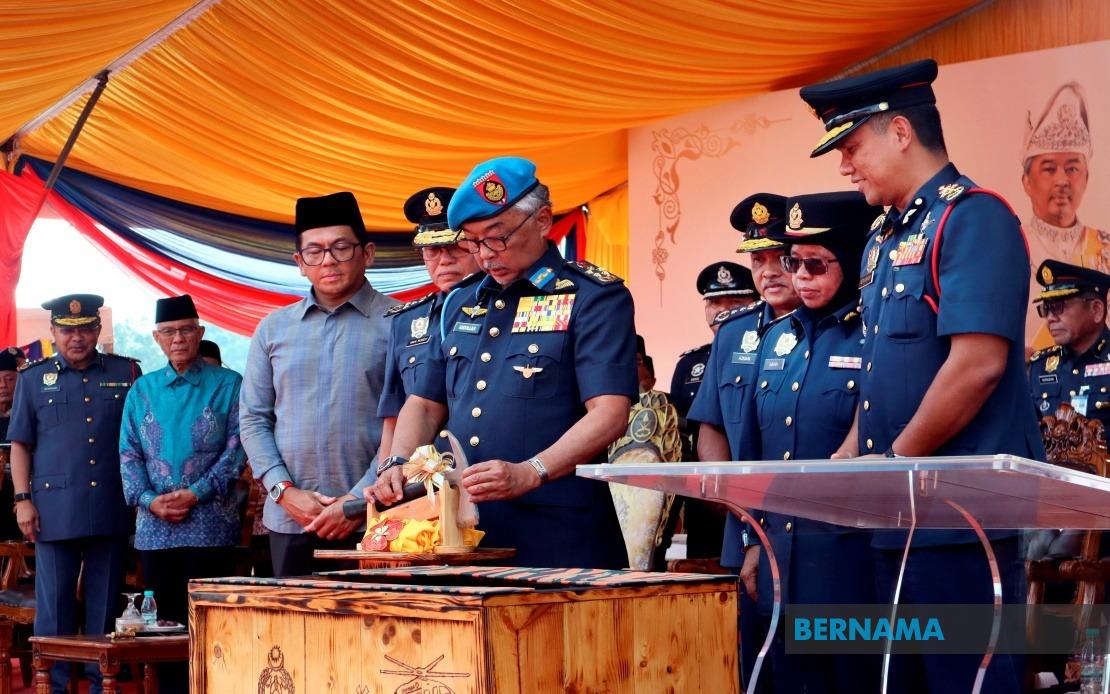
The Sultan of Pahang, Al-Sultan Abdullah Ri'ayatuddin Al-Mustafa Billah Shah, has publicly acknowledged the substantial financial commitments made by both federal and state authorities towards infrastructure development across the state, with particular emphasis on flood prevention and disaster management capabilities. Speaking during the official opening of the Sungai Lembing Fire and Rescue Station in Kuantan on July 2, the Sultan highlighted how these collaborative efforts directly benefit ordinary Malaysians through tangible improvements to their safety and living conditions.
Flood mitigation has emerged as a centrepiece of development priorities in Pahang, a state historically vulnerable to severe inundation during the northeast monsoon season. The Sultan specifically recognised Sungai Lembing's strategic importance, noting that this area frequently experiences flooding earlier than other parts of Kuantan and often serves as a natural indicator of broader flooding risks across the district. By investing in protective infrastructure in Sungai Lembing, authorities effectively establish an early warning system that helps communities prepare for potential disasters across wider regions.
The royal endorsement carries considerable weight in Malaysian governance, as the state ruler's public recognition of government expenditure reinforces accountability and demonstrates satisfaction with how public resources are being deployed. The Sultan's gratitude extended explicitly to both tiers of government, underscoring the collaborative nature of infrastructure projects that frequently require coordinated planning between Putrajaya and Ipoh. This unified approach has become increasingly important as climate-related challenges demand sustained, long-term investment rather than fragmented, short-term solutions.
Present at the ceremony were key stakeholders including Pahang Menteri Besar Datuk Seri Wan Rosdy Wan Ismail, Deputy Housing and Local Government Minister Datuk Aiman Athirah Sabu, and Deputy Economy Minister Datuk Mohd Shahar Abdullah, who represents Paya Besar as Member of Parliament. The gathering reflected the multidimensional nature of contemporary disaster management, spanning housing, local government, and economic portfolios, each contributing essential expertise and resources.
Beyond infrastructure, the Sultan articulated a direct instruction for river deepening near populated areas, a practical measure aimed at increasing channel capacity during heavy precipitation. This intervention demonstrates how royal prerogatives can complement bureaucratic processes by identifying specific, implementable solutions to recurring problems. River maintenance and dredging programmes require significant budgetary allocation and sustained effort, yet often lack the political visibility of more prominent projects.
The Sultan also commended Fire and Rescue personnel for their consistent dedication across diverse emergency situations, from structural fires to traffic accidents and natural disasters. His observation that daily news reports frequently feature examples of their work demonstrates both the frequency of emergencies in the state and the public visibility of these essential services. Such recognition matters considerably for frontline workers whose psychological wellbeing and motivation depend partly on institutional and societal appreciation.
The royal patron expressed commitment to maintaining active engagement with emergency responders and affected communities, pledging to visit disaster scenes whenever his schedule permits. This hands-on approach contrasts with purely ceremonial roles and signals serious engagement with grassroots realities. For Malaysian citizens, such direct access to senior leadership during crises fosters confidence in governmental responsiveness and demonstrates that institutional structures remain accountable to those they serve.
A significant proposal emerging from the discussion involved establishing a volunteer fire brigade in Kampung Bantal, Ulu Tembeling within Jerantut district, an acknowledgement that remote communities face particular vulnerabilities. Geographic isolation typically means longer emergency response times, creating life-or-death gaps when minutes matter. Community-based firefighting capacity represents a cost-effective solution that distributes disaster response capabilities closer to vulnerable populations. This initiative reflects growing recognition that professional services, however well-resourced, cannot adequately cover all territory without supplementation from trained local volunteers.
For Malaysian and Southeast Asian observers, the statement illustrates broader patterns of climate adaptation emerging across the region. As extreme weather events intensify, governments increasingly must allocate substantial resources to protective infrastructure rather than purely developmental projects. Pahang's experience with recurring floods mirrors challenges faced by low-lying areas throughout the region, from Bangladesh to parts of Thailand and Indonesia. The Malaysian approach—combining structural engineering solutions with disaster response capacity building—offers potential lessons for neighbours grappling with similar vulnerabilities.
The confluence of royal patronage, government investment, and emergency service expansion indicates recognition that flood risk has become a permanent feature of regional environmental conditions rather than episodic aberration. This paradigm shift carries profound implications for resource allocation, urban planning, and development priorities across Malaysia and Southeast Asia. Communities in vulnerable areas increasingly expect and demand protection measures that governments must somehow finance amid competing priorities, creating difficult political and fiscal calculations.
The Sultan's remarks also underscore tensions between development and conservation in resource-scarce contexts. Every dollar spent on flood mitigation necessarily represents resources unavailable for other purposes. Yet public safety considerations—protecting lives and livelihoods from natural disasters—typically command priority when choices must be made. Pahang's experience suggests that sophisticated governance requires sustained commitment to multiyear projects without guaranteed visible returns, distinguishing this approach from infrastructure investments generating more immediate economic activity or political credit.
Looking forward, the expansion of fire and rescue capacity and deepening of river channels in Pahang reflects incremental, pragmatic responses to identifiable problems. Neither solution is revolutionary, yet both represent meaningful improvements to public safety infrastructure. For Malaysian policymakers evaluating their own disaster management strategies, Pahang's systematic approach—combining structural engineering, institutional capacity, and community participation—provides a measured model emphasising steady improvement over transformative claims.

