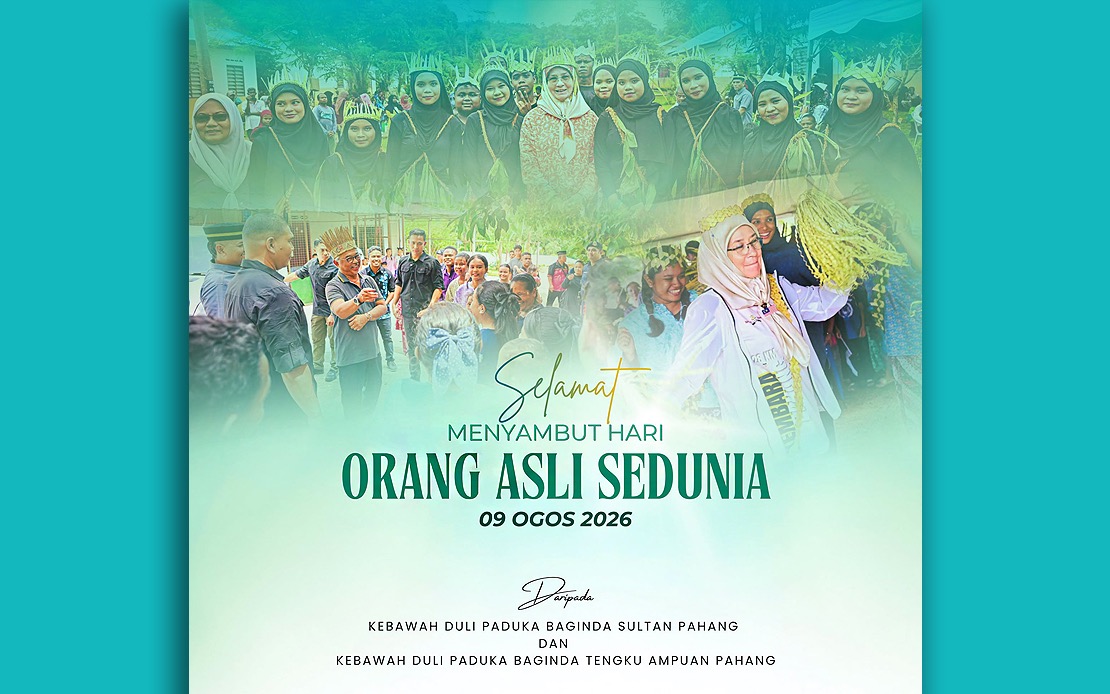
The Sultan of Pahang, Al-Sultan Abdullah Ri'ayatuddin Al-Mustafa Billah Shah, and Tengku Ampuan Pahang Tunku Azizah Aminah Maimunah Iskandariah have issued a formal statement recognizing the Orang Asli community's vital contributions to the state's cultural landscape. Released through the Kesultanan Pahang's official social media channels, the joint message celebrates the indigenous peoples' role in preserving Pahang's unique traditions and heritage, underscoring their significance to the broader Malaysian identity.
The royal acknowledgment carries particular weight in Malaysia's constitutional framework, where Malay rulers serve as custodians of cultural and religious heritage. By explicitly highlighting the Orang Asli's role in this context, the palace has elevated indigenous concerns to the state's highest level of governance, signalling that their interests merit serious policy attention alongside Malay-Muslim traditions.
Central to the rulers' statement is a commitment to expanding opportunities for the Orang Asli across multiple development sectors. Rather than treating indigenous advancement as charitable outreach, the message frames it as essential state responsibility encompassing education, economic participation, and skills training. This framing suggests the palace views Orang Asli development not as a peripheral concern but as integral to Pahang's overall prosperity and modernization agenda.
The emphasis on preserving indigenous identity while pursuing development addresses a longstanding tension in Malaysian policy. Historically, government initiatives targeting indigenous communities have sometimes prioritized assimilation over cultural preservation, potentially eroding the very traditions that define Orang Asli societies. By insisting these dual objectives must proceed simultaneously—economic uplift without cultural dilution—the royal statement charts a more nuanced developmental path.
The timing of this announcement, coinciding with preparations for the 2026 International Day of the World's Indigenous Peoples, reflects growing global recognition of indigenous rights. Malaysia's participation in international indigenous advocacy has historically been muted, with indigenous issues often overshadowed by other national priorities. This statement suggests Pahang's leadership may be positioning the state as more responsive to indigenous concerns than the federal level, potentially creating a template for other states to follow.
Educational access emerges as a particular focus in the rulers' remarks, addressing a persistent vulnerability for Orang Asli populations. School attendance and completion rates among indigenous children remain significantly below national averages, perpetuating cycles of limited economic opportunity. By specifically naming education as a priority area, the palace acknowledges that genuine development requires investing in human capital rather than relying solely on resource-based or infrastructural projects.
Economic development constitutes the second pillar of the proposed approach. Orang Asli communities historically have relied on forest-based livelihoods increasingly threatened by land conversion and environmental pressures. The rulers' call for economic opportunities suggests recognition that traditional subsistence cannot sustain growing populations, necessitating transitional support toward alternative income sources—whether through skills training, small business development, or integration into formal employment.
The stress on human capital development adds another dimension, encompassing vocational training, professional certification, and capacity-building initiatives. This approach acknowledges that employment gaps stem partly from skills mismatches between indigenous workforce capabilities and available opportunities, suggesting targeted interventions could yield significant returns for both individuals and state economies.
The palace's emphasis on unity, respect and cooperation carries broader implications for Pahang's governance. By urging all state residents to uphold these values in relation to indigenous communities, the rulers implicitly establish expectations for how government agencies, private sector actors, and civil society should engage with Orang Asli populations. Such royal guidance, though symbolic, carries practical weight in Malaysian governance contexts where deference to rulers influences policy implementation.
The statement also reflects evolving attitudes toward indigenous knowledge and heritage conservation. Rather than viewing Orang Asli cultural practices as historical curiosities, the message positions them as shared state assets deserving systematic protection and documentation. This reframing could justify increased institutional support for indigenous cultural initiatives, museums, language programs, and community-led heritage projects.
For Malaysian readers, this development signals that indigenous rights advocacy has achieved sufficient prominence to warrant royal attention, suggesting broader social shifts in how indigenous communities are perceived and valued. The statement provides rhetorical legitimacy to future policy initiatives benefiting Orang Asli populations, potentially facilitating government and civil society efforts in Pahang and beyond.
Implementation remains crucial, however. Royal statements establish expectations and moral authority but do not automatically translate into concrete policy changes or budgetary commitments. The actual impact will depend on whether Pahang's state government and federal authorities follow through with substantive programs addressing the identified priorities—education access, economic development, and skills training—while genuinely consulting indigenous communities about their own development visions and aspirations.

