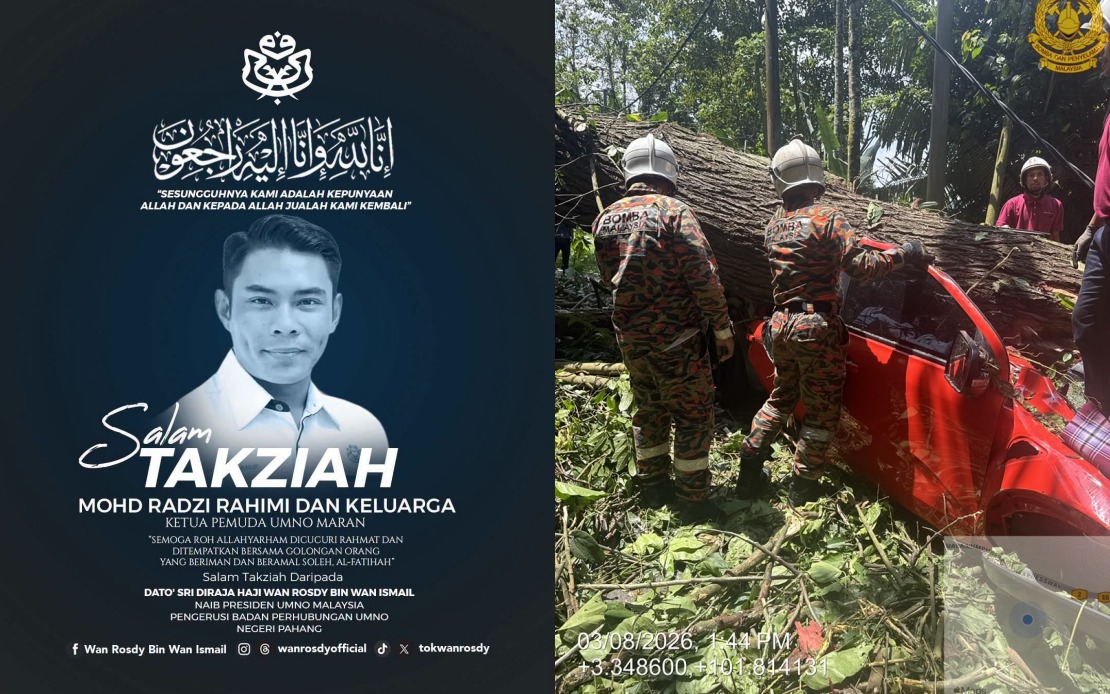
Datuk Seri Wan Rosdy Wan Ismail, the Pahang Menteri Besar and chairman of the Pahang UMNO Liaison Committee, has mourned the death of Maran UMNO Youth chief Mohd Radzi Rahimi, known widely as Edy Radzi, following a tragic accident in the Bentong district. The incident claimed the lives of four individuals on the afternoon of August 3 when a tree collapsed onto the vehicle they were travelling in along the old Kuala Lumpur-Bentong road near Janda Baik.
Wan Rosdy's tribute emphasised Radzi's character as a committed and people-focused leader who consistently placed community welfare at the heart of his work within the youth movement. The loss, according to the state leader, extends beyond the bereaved family to encompass wider circles within UMNO's organisational structure, particularly the Maran division, the Pahang UMNO Youth movement, and the broader Pahang UMNO Liaison Committee. The sudden nature of the tragedy has evidently struck deeply within party circles, with multiple senior figures acknowledging the gap his absence will create in youth leadership and grassroots mobilisation efforts.
Beyond Radzi, the fatal incident claimed three other lives: Nuriani Mohammad Jafri, her son Muhammad Rizz Hazim, and her younger brother Mohammad Nizam. The multi-generational loss within a single family underscores the devastating human cost of the accident and has resonated across the local community in the Bentong area. The vehicle occupants had no warning of the danger moments before the tree gave way, leaving authorities to investigate the structural conditions that led to the tree's collapse along what is a frequently travelled route linking Kuala Lumpur with the east coast.
Wan Rosdy conveyed his condolences publicly through a Facebook statement, expressing profound sadness over the news and extending heartfelt sympathies to the families of all deceased individuals. His message called for strength and patience for the grieving families facing what he characterised as an immensely difficult period. The formal expression of state-level condolences signals the significance of Radzi's role within Pahang's UMNO framework and the seriousness with which party leadership regards the loss.
The tragedy also prompted a response from UMNO Youth's national leadership. Datuk Dr Muhammad Akmal Saleh, the national UMNO Youth chief, extended his own condolences to Radzi's immediate family, invoking Islamic prayers for divine forgiveness of the deceased's sins, acceptance of his good deeds, and eternal rest. Such expressions reflect the centrality of Islamic values within UMNO's organisational culture and the way party members process grief through religious frameworks.
According to initial reports, the impact of the fallen tree was severe enough to crush the four-wheel-drive vehicle, leaving the occupants with little chance of survival. Beyond the four fatalities, a child travelling with the group sustained injuries, introducing another dimension of tragedy to the incident. Emergency responders would have faced a harrowing scene in extricating survivors and deceased individuals from the crushed vehicle along a roadway that, despite being classified as an old route, continues to carry traffic between major population centres.
The accident on the old Kuala Lumpur-Bentong road has raised questions about tree maintenance and road safety along rural corridors in Pahang. The state's forests and roadside vegetation management practices may come under scrutiny as authorities investigate the circumstances that allowed a tree to fall with such fatal consequences. For Malaysian road users, particularly those frequenting similar routes through forested areas, the incident serves as a sobering reminder of environmental hazards that exist beyond the immediate control of individual motorists.
Mohd Radzi's role as Maran UMNO Youth chief positioned him within a critical stratum of the party's organisational hierarchy. Youth leaders in UMNO serve as the primary interface between the party and younger constituents, executing grassroots programmes, mobilising youth votes during elections, and developing the next generation of party activists. The loss of someone actively engaged in these functions represents a personnel gap that the party will need to address through succession planning and restructuring.
For Pahang UMNO specifically, this incident compounds previous challenges the party has faced in maintaining cohesive leadership structures across its multiple divisions. The Maran division, which loses its youth chief, will need to undertake an internal process to identify a replacement capable of continuing Radzi's work and maintaining momentum in youth engagement. The timing of such a transition, regardless of when it occurs, will inevitably be overshadowed by the circumstances of his passing.
The broader implications for political leadership in Malaysia include recognition of the often-unheralded work performed by divisional and state-level youth leaders who operate far from national media attention. These individuals frequently spend considerable personal time and resources supporting party objectives, organising community activities, and nurturing political participation among young Malaysians. Radzi's death represents not merely the loss of an individual but the interruption of institutional knowledge and personal networks that such leaders cultivate over years of service.
From a safety perspective, the incident also highlights the vulnerability of road users in Malaysia's extensive network of rural highways and secondary roads. While major expressways receive regular maintenance and inspection, older routes like the Kuala Lumpur-Bentong road may experience less frequent safety audits. The presence of hazardous vegetation overhanging or positioned dangerously near travel lanes presents ongoing risks that require systematic identification and mitigation.
As investigations proceed into the precise causes of the tree's collapse, the broader community will process this tragedy through multiple lenses: as an individual loss felt by families and party colleagues, as a reminder of occupational and environmental hazards facing everyday road users, and as a moment for reflection on the contributions of grassroots political workers whose efforts remain largely invisible to the general public. The tributes from senior figures like Wan Rosdy and Akmal Saleh represent an acknowledgment of the importance of these roles within Malaysia's political infrastructure.

