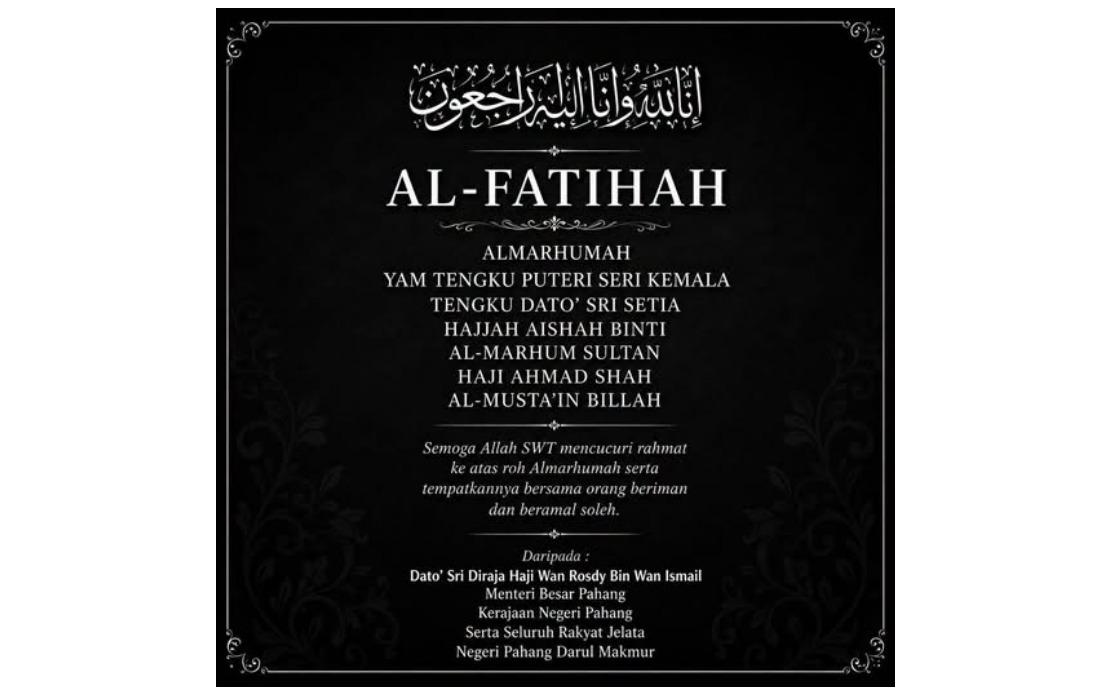
Pahang's leadership has mourned the loss of a member of the royal household, with Menteri Besar Datuk Seri Wan Rosdy Wan Ismail releasing a formal statement of condolence following the death of Tengku Puteri Seri Kemala Tengku Datuk Seri Aishah, the elder sister of the Sultan of Pahang. The prominent royal figure passed away at a Kuala Lumpur hospital on the evening of August 26, marking a significant moment in the state's political calendar as senior government officials paid their respects to the reigning monarch and his immediate family.
Wan Rosdy's carefully worded statement acknowledged the profound nature of the loss, particularly emphasizing the impact on Sultan Al-Sultan Abdullah Ri'ayatuddin Al-Mustafa Billah Shah and his consort, Tengku Ampuan Pahang Tunku Azizah Aminah Maimunah Iskandariah. The Menteri Besar's remarks, delivered through a Facebook post from his official residence in Kuantan, sought to unite the state government and broader Pahang populace in shared grief, a customary gesture that underscores the ceremonial role of state leadership in acknowledging loss within royal circles.
The timing of such condolences reflects broader Malaysian constitutional arrangements, where state governments maintain formal protocols for engaging with state rulers and their families. By articulating collective grief on behalf of both government machinery and ordinary residents, Wan Rosdy performed a dual function—honoring the deceased while simultaneously reaffirming the bonds of respect and loyalty that characterize relations between elected administrations and constitutional monarchies across the federation.
Tengku Puteri Seri Kemala's passing concluded at 9:15 pm, with funeral arrangements proceeding according to royal protocols. Her final resting place was designated as the Pahang Royal Mausoleum in Pekan, a site of historical significance where members of the Pahang royal lineage have been interred across generations. This choice of burial location underscores the continuity of dynastic tradition and the enduring connection between the ruling family and the state's territorial and cultural foundations.
The Menteri Besar's invocation of Islamic prayers and religious sentiments—specifically requesting divine mercy, forgiveness of transgressions, and eternal reward—reflected Malaysia's constitutional position as an Islamic state, where official expressions of mourning typically incorporate religious frameworks. Such language resonates across Pahang's Muslim-majority population and demonstrates the interweaving of governance, religious practice, and social convention that characterizes Malaysian political culture.
For Malaysian observers, this incident highlights the ceremonial dimensions of state-level politics, where Menteri Besar figures serve not merely as administrative heads but as symbolic intermediaries between government institutions and royal authority. Wan Rosdy's intervention into the mourning process, despite his executive role being primarily concerned with state development and administration, demonstrates how Malaysian federalism assigns cultural and diplomatic responsibilities to elected leaders. The Pahang MB effectively became a voice for institutional grief, channeling formal condolences through modern communications platforms while respecting centuries-old traditions of royal mourning.
The death of a close relative of the reigning sultan carries implications beyond personal loss, as it touches upon questions of royal succession, family legacy, and the public image of the institution itself. In Malaysian constitutional monarchies, where rulers exercise significant ceremonial influence and derive legitimacy from historical lineage and popular esteem, the passing of prominent family members occasions public reflection on dynastic continuity and institutional stability. By promptly and respectfully acknowledging these deaths, elected officials like Wan Rosdy reinforce the collaborative relationship between democratic governance and constitutional monarchy.
Regionally, such moments of royal bereavement demonstrate how Southeast Asian monarchies maintain their institutional prominence despite the presence of modern, democratic governance structures. Malaysia's sultan system represents a unique constitutional arrangement where hereditary rulers retain defined powers alongside elected parliaments and prime ministers. The formal observance of royal family losses through state government statements reflects this intricate balance, showing how contemporary political systems accommodate both democratic accountability and monarchical tradition.
The broader context includes Pahang's particular significance within Malaysia's federal framework, given its substantial land area, natural resources, and strategic geographic position. As the state's chief elected administrator, Wan Rosdy occupies a position requiring constant negotiation between state sovereignty and federal authority, between popular mandate and royal prerogative. His condolence statement exemplifies how such negotiations extend even into matters of grief and commemoration, where protocol, sentiment, and political symbolism converge.
Pahang residents and observers of Malaysian politics would recognize in such statements the ongoing performance of statecraft, where words carry weight beyond their literal meaning. Wan Rosdy's explicit positioning of his remarks as originating from both government and people—rather than from himself alone—illustrates a hierarchical understanding of authority and representation that remains deeply embedded in Malaysian political culture. The statement serves simultaneously as personal respect, institutional acknowledgment, and affirmation of the constitutional framework underpinning state governance.

