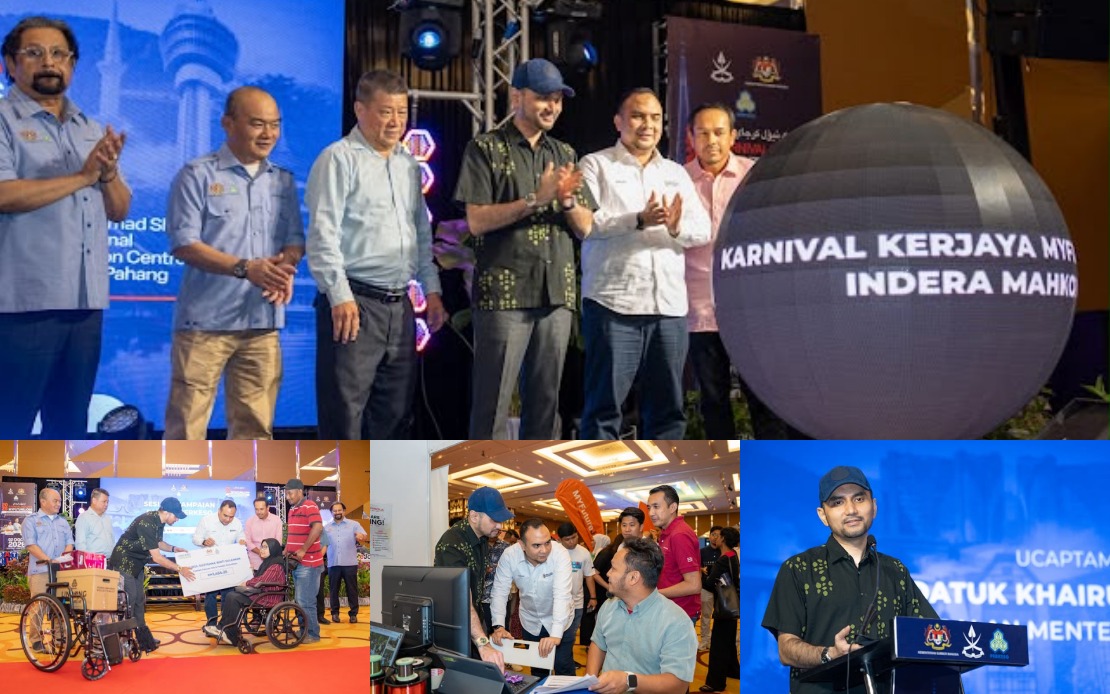
Pahang has emerged as the East Coast's employment leader, recording a labour force participation rate of 65.3 per cent in the first quarter of 2026 while maintaining an impressively low unemployment rate of 1.9 per cent. The figures underscore the effectiveness of coordinated government employment initiatives in the state, signalling that strategic job placement and skills development programmes can produce measurable economic outcomes across Malaysia's regions.
The achievement comes as Deputy Human Resources Minister Datuk Khairul Firdaus Akbar Khan highlighted the role of various government-backed employment schemes in facilitating workforce participation. Speaking at the opening of the Indera Mahkota MyFutureJobs Career Carnival 2026, he pointed to the platform's central role in connecting jobseekers with opportunities across diverse sectors. The minister emphasised that reducing the nation's unemployment rate remains an ongoing priority, with particular attention to engaging young Malaysians in the employment landscape during a period of economic transition.
The MYFutureJobs programme, administered by the Social Security Organisation (PERKESO), has become the primary conduit for this employment agenda in Pahang. From 2023 through July 24, 2026, the platform facilitated employment for 26,877 jobseekers across the state. This substantial throughput reflects sustained institutional effort to match labour supply with employer demand. The performance gains ground themselves in intensive intervention: PERKESO organised 1,277 interview programmes and career carnivals throughout Pahang during the same period, creating repeated touchpoints between candidates and recruiters while advertising over 10,000 vacancies through the digital portal.
The Indera Mahkota Career Carnival itself demonstrates the scale of these recruitment drives, offering 6,000 job vacancies sourced from 30 employers spanning multiple industries. Such events serve multiple functions within Malaysia's employment ecosystem: they reduce friction in job matching, expose jobseekers to diverse career paths, and allow employers to access talent pools beyond traditional recruitment channels. The carnival's presence in Pahang's capital reflects the government's commitment to bringing employment services to population centres across the peninsula.
Youthful jobseekers have begun responding to these platforms with increasing engagement. Registrations through MYFutureJobs reached 11,857 in 2026 alone, suggesting that awareness and uptake are accelerating as the portal becomes better established. This generational participation carries strategic importance: Malaysia's demographic window depends on moving young people into productive employment while they remain early in their career trajectories. Channelling this cohort effectively into the formal economy determines long-term productivity and fiscal sustainability.
Beyond placement, Datuk Khairul Firdaus underscored the ministry's emphasis on skills development and worker adaptation to evolving industry requirements. Employment platforms alone cannot resolve mismatches between jobseeker capabilities and employer expectations. The ministry has therefore complemented placement services with training programmes designed to prepare workers for sectoral transitions and technical skill demands. This holistic approach—combining job access with capacity building—addresses structural employment challenges rather than merely treating symptoms through temporary placement activities.
The government's strategy extends beyond conventional employment services through the parallel Sahabat MADANI initiative, launched at state level during the Pahang carnival. This community-based volunteer movement operates as a grassroots complement to formal employment and skills programmes. Datuk Ahmad Farhan Fauzi, the Prime Minister's political secretary, positioned the initiative as bridging government institutions and local communities, particularly in rural and underserved areas where conventional job networks may not reach. The framing emphasises volunteerism and social responsibility while simultaneously deploying volunteers as information channels between bureaucracy and grassroots populations.
The Pahang-level Sahabat MADANI launch targeted recruitment of 2,000 members, a goal the organisers have reportedly achieved. However, Ahmad Farhan indicated that scaling the volunteer force remains a priority, with appeals for continued recruitment among young Pahang residents. The emphasis on creating a larger cadre of community volunteers suggests recognition that employment barriers often combine formal obstacles (skill gaps, information asymmetries) with informal challenges (social isolation, community disconnection) that volunteer networks might address. This two-track approach—formal employment services plus community engagement—reflects sophisticated understanding of joblessness as partly structural and partly social.
For Malaysian policymakers, Pahang's performance metrics offer instructive lessons about regional employment dynamics. East Coast states often lag peninsular averages in labour force participation, reflecting geographic dispersion, sectoral concentration, and lesser integration into high-productivity corridors. Pahang's achievement suggests that intensive, persistent application of employment infrastructure—platforms, carnivals, training, volunteer networks—can narrow participation gaps even in peripheral regions. The 65.3 per cent rate approaches participation levels in more developed states, indicating potential for convergence if initiatives receive sustained funding and institutional commitment.
The concentration of employment gains in a single state raises questions about replicability and equitable distribution across Malaysia's regions. While Pahang's figures are encouraging, they must be contextualised within the broader Southeast Asian labour market, where cross-border competition for talent and investment increasingly shapes domestic employment prospects. The region's younger workers can increasingly access opportunities across national boundaries, whether through formal expatriate pathways or informal migration networks. Malaysian employment initiatives must therefore compete not merely against domestic unemployment but against the attraction of alternative regional opportunities.
Looking ahead, maintaining Pahang's 1.9 per cent unemployment rate while continuing to deepen labour force participation depends on sustaining institutional investment in platforms like MYFutureJobs and maintaining employer engagement through repeated carnival events. Cyclical downturns or sectoral disruptions could quickly erode these gains if viewed as temporary rather than structural achievements. The emphasis on skills training and volunteer community engagement offers some resilience: workers with broader capabilities and stronger community connections may weather economic transitions more effectively than those dependent solely on platform-mediated placements.
For Southeast Asian observers, Pahang's employment narrative reflects broader regional trends toward digital-mediated job matching, skills-focused workforce development, and volunteer-based community engagement as policy instruments. Malaysia's approach combines market-oriented platforms (MYFutureJobs) with state coordination (PERKESO oversight) and social participation (Sahabat MADANI), creating a hybrid model that harnesses multiple mechanisms simultaneously. Whether this model proves sustainable and transferable to other Malaysian states and neighbouring economies will shape regional employment policy for years to come.

