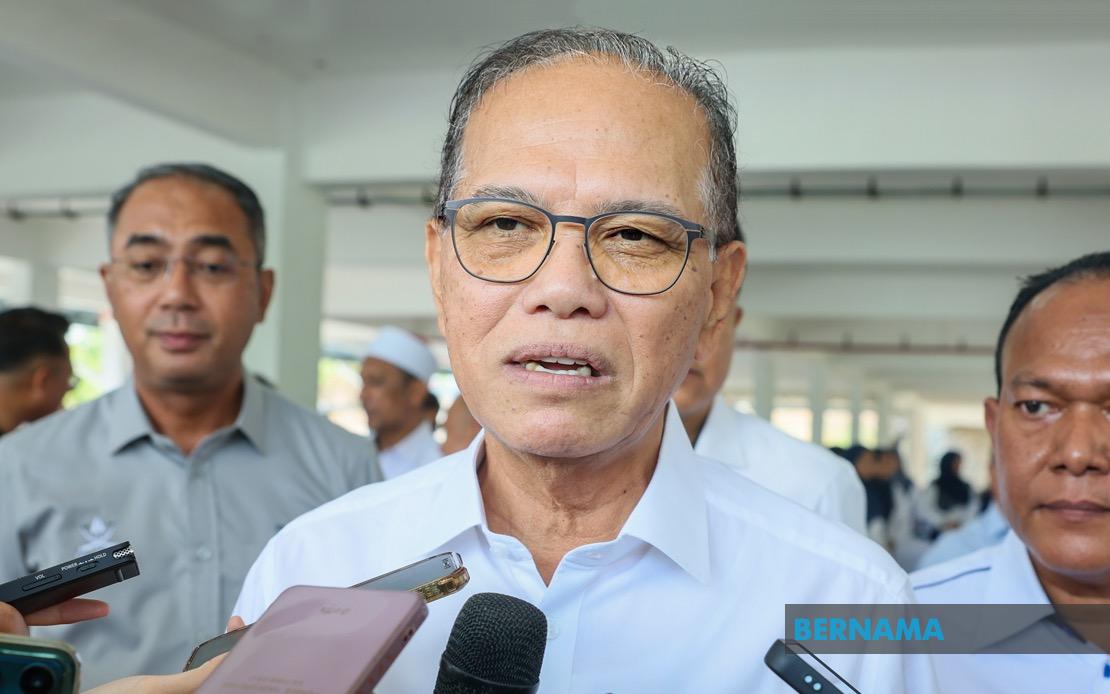
Pahang is rolling out an ambitious sports investment programme worth RM3.5 million designed to strengthen the competitive capacity of three key disciplines and position the state as a serious contender in Malaysia's national sports landscape. The financial commitment, announced during the closing ceremony of the Pahang 1st Netball League Championship at the Pahang Sports Complex here, reflects state leadership's determination to move beyond incremental progress and establish systemic excellence across multiple sporting domains.
Menteri Besar Datuk Seri Wan Rosdy Wan Ismail framed the initiative as a comprehensive response to Pahang's historical underperformance relative to more established sporting states. The allocation strategy divides resources strategically: RM2 million flows towards football development, RM1 million supports netball, and RM500,000 backs sepak takraw—a traditional Malaysian sport with significant cultural resonance. This distribution reflects both the infrastructure demands of football and the growing momentum behind netball, a sport increasingly competitive at regional levels.
The underlying philosophy extends beyond elite athlete recruitment. State officials emphasise that sustainable sporting success requires investment at grassroots entry points, where talent identification and early-stage nurturing determine long-term productivity. By targeting community-level participation, Pahang seeks to create pipeline systems that feed emerging talent into increasingly competitive developmental streams. This approach acknowledges that occasional stellar performances mean little without institutional capacity to replicate success systematically.
Netball represents a particular strategic focus, with the state government committing to increase its annual allocation by RM500,000 from next year onwards, bringing total annual funding to RM1.5 million. This escalation suggests confidence in the sport's trajectory and recognition of its accessibility as an entry point for female athletes in particular. The sport's relatively lower infrastructure costs compared to football make accelerated investment immediately actionable, potentially yielding visible competitive gains within shorter timeframes.
Football's RM2 million share reflects the sport's entrenched position within Malaysian sporting culture and its demanding infrastructure requirements—training facilities, coaching personnel, competition structures and equipment represent substantial ongoing costs. Pahang's football ambitions place it in competition with states possessing longer institutional traditions and established talent networks. The financial commitment signals determination to overcome these structural disadvantages through concentrated resource deployment.
Sepak takraw, allocated RM500,000, occupies a distinct position as both a culturally significant traditional sport and one with regional tournament prestige through Southeast Asian Games participation. Investment here may yield disproportionate symbolic returns for state pride while developing athletes capable of defending Malaysia's regional dominance in a discipline where Southeast Asian competitors remain formidable.
Wan Rosdy's emphasis on implementation seriousness—explicitly warning against half-hearted execution—signals that financial allocation alone proves insufficient. State machinery must translate budgets into coherent programme architecture, competent coaching recruitment, transparent selection processes and sustained monitoring. The warning implicitly acknowledges that previous initiatives may have suffered from implementation gaps, where funds existed but coordination or follow-through faltered.
The netball championship itself demonstrated gathering momentum, drawing 42 teams for its inaugural league iteration. Semambu's championship victory and RM10,000 prize allocation indicate that competitive structures now reward success sufficiently to motivate participation across broader geographical areas. Building on such foundational competitions to develop talent pathways represents the practical mechanics through which abstract budget commitments become athlete development realities.
Beyond athletic competition, state officials articulated a social cohesion narrative, positioning sports development as a unifying force transcending community divides. This framing connects sporting investment to broader state governance objectives around social stability and community engagement—a rationale that justifies sports funding within competitive budget environments where education, healthcare and infrastructure claims compete for resources.
For Southeast Asian observers, Pahang's initiative exemplifies how Malaysian states increasingly pursue competitive differentiation through targeted sectoral investment. The approach mirrors strategies deployed across the region, where subnational administrations recognise sports success as relatively cost-effective vehicles for building public legitimacy and state identity. Unlike massive infrastructure megaprojects, sports funding generates tangible results within election cycles, making it politically attractive.
The timing of this announcement reflects broader Malaysian sports policy discussions around preparation for regional and international tournaments. As Southeast Asian Games approach and Commonwealth Games scheduling becomes relevant for Malaysian athletes, state-level competitive pressure intensifies. Pahang's investment signals that state governments now view sports development as integral to comparative standings against peers, not merely as peripheral community activity.
Implementation success will depend on whether administrative structures can execute coherently. Recruitment of quality coaching staff, establishment of transparent talent identification systems, and maintenance of consistent programme delivery across multiple sports simultaneously present operational challenges that financial allocation alone cannot resolve. Pahang's stated seriousness will face immediate testing as the state government translates RM3.5 million into measurable competitive improvements within realistic timeframes.

