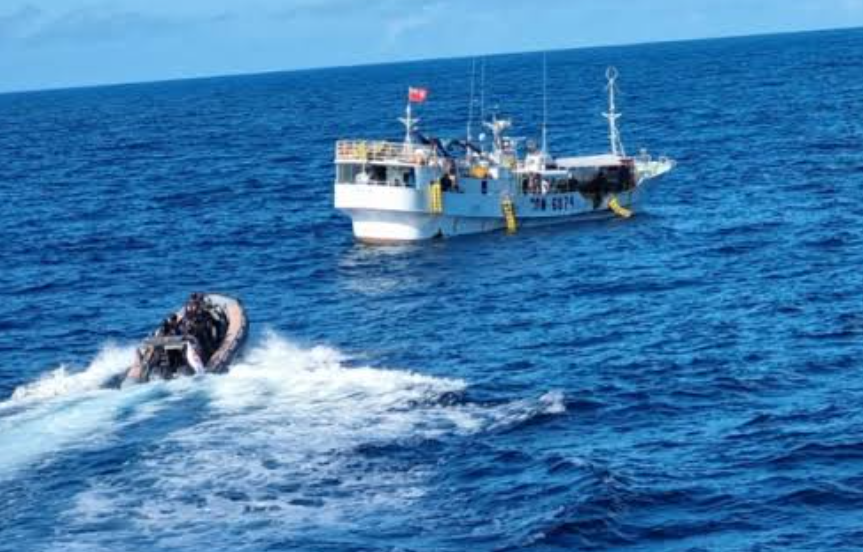
Authorities across the Pacific region have intensified enforcement action against foreign fishing vessels, with at least four boats from China and Indonesia seized or brought to port during August for violations ranging from unlicensed fishing to breaches of licensing conditions. The Pacific Islands Forum Fisheries Agency announced the enforcement actions following a major coordinated operation, highlighting the ongoing struggle by small island nations to maintain control over their maritime resources and combat the substantial illegal fishing problem plaguing the region.
The enforcement drive, branded Operation Island Chief, represents one of the most comprehensive patrols undertaken by Pacific authorities in recent years. Between August 3 and 14, a coalition of 11 island nations deployed combined maritime and aerial resources to monitor and inspect vessels transiting through exclusive economic zones. The operation covered a vast expanse of ocean spanning 28 million square kilometres, with coordinated boarding teams inspecting in excess of 100 individual vessels. In addition to the four vessels detained across Kiribati, Palau and Papua New Guinea, the FFA identified a further 16 boats classified as "of interest" requiring additional investigation, though authorities have declined to release specific details regarding these cases.
The geographic scope of the operation underscores the immense challenge faced by Pacific island nations in policing their waters. Australian military aircraft provided aerial reconnaissance support, while a United States Coast Guard vessel and regional maritime patrol units conducted on-water inspections. Despite these substantial resources, the sheer volume of fishing activity across the zone necessitates continuous vigilance. Officials from Palau and Papua New Guinea declined to comment on specific enforcement actions, while Kiribati's maritime police similarly refrained from providing operational details, suggesting a degree of diplomatic sensitivity surrounding the detentions.
The economic stakes underlying these enforcement efforts are substantial. The Pacific region accounts for approximately half of the world's tuna catch, yet only 15 per cent of the harvested fish undergoes processing within Pacific island territories themselves. This disparity reflects the dominance of foreign long-distance fleets that obtain fishing rights through annual licence agreements with island governments. These access arrangements generate approximately US$500 million annually in direct licensing fees, alongside an additional US$1.2 billion in export revenues. Beyond these headline figures, commercial fishing operations sustain the livelihoods of roughly one-third of all Pacific island households, making fisheries management a matter of profound economic and social importance.
The reliance on foreign vessels operating under licence creates a complex regulatory environment. Most tuna caught in the region is immediately transported to Asian markets by distant-water fleets that maintain their own refrigeration and processing capabilities. Island authorities must therefore balance the need to generate essential government revenue against the imperative to maintain stock sustainability and prevent exploitation of their maritime resources. The licensing system, while lucrative, has also created incentives for some operators to circumvent regulations or falsify documentation to reduce compliance costs.
Chinese fishing interests feature prominently in the region's commercial fishing landscape, operating numerous long-distance vessels and maintaining joint venture arrangements with several island governments. The detention of Chinese vessels consequently carries diplomatic dimensions that authorities handle with evident caution. Publicly naming Chinese operators suspected of illegal activity remains a sensitive undertaking given the economic interdependencies involved. However, this diplomatic consideration does not prevent enforcement actions when violations are substantiated. Last month, Tuvaluan authorities apprehended a Chinese fishing vessel engaged in unlawful harvesting while simultaneously transmitting false location data to authorities. The vessel remained in detention for 24 days before being released following payment of fines, according to Peter Hammarstedt, captain of the conservation vessel Sea Shepherd that assisted with the enforcement patrol.
The Tuvalu incident illustrates the sophisticated evasion tactics employed by some operators. Transmitting false positional information represents a deliberate attempt to conceal fishing activities from maritime surveillance systems, indicating premeditated violation rather than inadvertent breach. Tuvalu's enforcement action proves particularly noteworthy given that the island nation maintains diplomatic recognition of Taiwan rather than the People's Republic of China, a distinction that may complicate relations with Chinese fishing interests operating in the region. This diplomatic dimension adds additional complexity to fisheries governance across the Pacific.
Historical enforcement data reveal the scale of compliance challenges facing regional fisheries regulators. Between 2008 and 2026, inspectors from the Western and Central Pacific Fisheries Commission, the principal regional fisheries management organization, issued 278 penalty notices to Chinese fishing vessels for various violations. This tally ranks second only to Taiwan, which accumulated 319 infringement notices during the same period. The substantial number of violations from Chinese operators suggests either a larger proportion of illegal activity within that fleet or greater detection and enforcement scrutiny. Regardless, the data indicates that illegal fishing constitutes a chronic rather than episodic problem requiring sustained intervention.
Pacific island leaders are preparing to address these governance challenges at a forthcoming summit. An annual meeting convening 18 Pacific Island leaders commences August 30 in Palau, with fisheries policy forming a central agenda item. Discussions are expected to crystallize around developing enhanced strategies for protecting sovereign fishing rights, strengthening revenue streams, and adapting management frameworks to address climate change impacts on fish stocks. Rising ocean temperatures threaten to displace tuna populations, potentially creating additional management complications and economic pressures for island economies heavily dependent on fisheries revenues. The timing of this leadership gathering reflects recognition that current regulatory structures require evolution to meet emerging challenges.
For Malaysia and other Southeast Asian nations, the Pacific fisheries enforcement developments carry important implications. The region's fishing practices, vessel compliance standards, and regulatory frameworks influence global fisheries markets where Malaysian operators also participate. The commitment demonstrated by Pacific authorities to combat illegal and unlicensed fishing establishes precedents for regional enforcement cooperation. Furthermore, the dominance of Asian markets in consuming Pacific-caught tuna creates commercial links that Malaysian importers and traders must navigate. As Pacific island nations intensify enforcement of their fishing rights, Southeast Asian operators require awareness of evolving compliance requirements and enforcement risk. The Operation Island Chief initiative demonstrates that Pacific authorities possess both the resolve and capacity to detain vessels and impose sanctions, suggesting that compliance with licensing conditions and fishing regulations remains economically prudent for all parties operating in the region.

