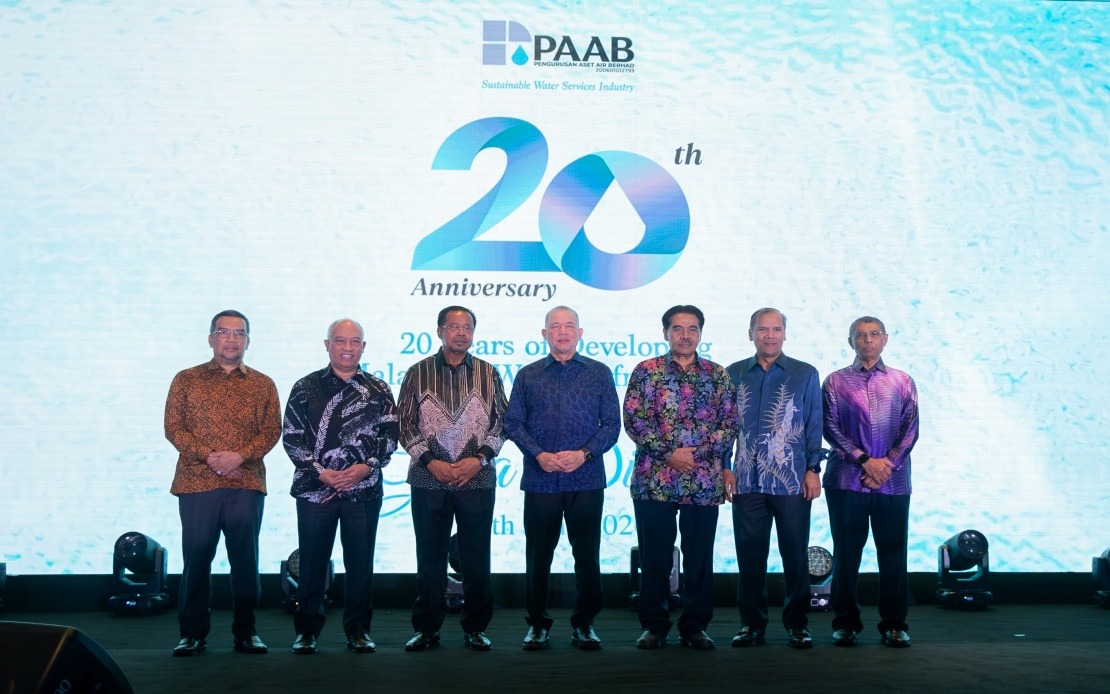
Pengurusan Aset Air Berhad (PAAB), the wholly owned subsidiary of the Minister of Finance Incorporated, marked its 20th anniversary on June 26 with recognition of its transformative role in overhauling Malaysia's water services landscape and bolstering the nation's water supply resilience. Since its inception on May 5, 2006, the entity has channelled RM23.04 billion to finance the acquisition of water industry loans while simultaneously deploying RM23.84 billion toward critical infrastructure development, collectively representing RM46.88 billion in total commitment that positions PAAB as a cornerstone of Malaysia's public infrastructure advancement.
The milestone anniversary dinner, held at the Banquet Hall of Menara Felda Platinum Park, was officiated by Deputy Prime Minister Datuk Seri Fadillah Yusof, who simultaneously holds the Energy Transition and Water Transformation Minister portfolio. The presence of senior officials including Deputy Minister Datuk Seri Abdul Rahman Mohamad, National Water Services Commission (SPAN) chairman Datuk Abdul Kadir Mohd Din, and PAAB leadership underscored the strategic significance of the institution within Malaysia's infrastructure governance framework.
As of December 2025, ten states have formalised agreements under the National Water Services Industry Restructuring Plan, catalysing substantial physical transformation across the country. The completed portfolio encompasses 21 water treatment plants with combined daily capacity exceeding 2,085 million litres, 42 storage facilities holding 783 million litres, and an extensive 3,263-kilometre network of pipeline upgrades and extensions. These tangible assets represent the backbone of improved water distribution across urban and regional areas, though their implementation underscores the scale of infrastructure modernisation still required.
Despite impressive investment figures, Malaysia confronts a persistent challenge that threatens both household and industrial water security. Non-revenue water, defined as water lost through leakage, theft, and metering inaccuracies, persists at approximately 40 per cent nationwide—a rate Fadillah characterised as demanding urgent intervention beyond conventional long-term planning horizons. This loss rate is substantially higher than regional and international benchmarks, representing both economic leakage and strategic vulnerability as Malaysia positions itself to attract capital-intensive sectors requiring uninterrupted water and energy supplies.
The Deputy Prime Minister's emphasis on immediate action rather than protracted timelines reflects mounting recognition that Malaysia's water infrastructure challenges require acceleration beyond the phased approach traditionally employed. While PAAB's roadmap extends to 2050, encompassing migration, stabilisation, consolidation, and full cost recovery phases, the urgency of water security for both household consumers and foreign investors in data centre development and advanced manufacturing necessitates more aggressive near-term intervention. The 2021-2030 stabilisation phase represents a critical window for demonstrating tangible progress.
The RM23.84 billion capital expenditure mobilised through December 2025 reflects strategic resource allocation across project lifecycles. Of this amount, RM8.33 billion supports projects already handed to operators, RM1.84 billion funds construction-phase initiatives, and RM13.67 billion remains committed to design and planning activities. This portfolio distribution indicates that substantial capacity expansion remains in pipeline, with engineering and procurement phases still underway for nearly 60 per cent of allocated capital. The timeframe for completing these design-phase projects will significantly influence Malaysia's ability to address non-revenue water within the current decade.
PAAB chairman Datuk Seri Jaseni Maidinsa articulated the organisation's mission as implementing the restructuring plan through a Full Cost Recovery Roadmap spanning four sequential phases. The Migration phase (2008-2020) established foundational governance and asset consolidation. The ongoing Stabilisation phase (2021-2030) seeks to enhance system reliability and operational efficiency while progressively shifting cost structures toward sustainability. Consolidation (2031-2040) and Full Cost Recovery (2041-2050) phases target mature system performance and financially sustainable tariff structures, though the trajectory depends on accelerating progress in the current decade.
The water sector's transformation carries profound implications for Malaysia's economic trajectory and regional competitiveness. Data centres and advanced manufacturing facilities, increasingly prioritised by the government for foreign direct investment, demand secure, consistent water availability alongside reliable electricity. Countries like Singapore and Thailand have achieved water loss rates below 5 per cent through aggressive infrastructure modernisation and demand management, demonstrating that Malaysia's 40 per cent loss represents both a competitive disadvantage and an untapped efficiency opportunity. Reducing non-revenue water by even 10 percentage points would free substantial volume for industrial expansion without requiring equivalent infrastructure investment.
The coordination challenge extends beyond PAAB's mandate, requiring synchronised action across federal agencies and state governments. Water services operate across multiple jurisdictional boundaries, with some states maintaining greater operational capacity than others. The ten states currently implementing the restructuring plan represent approximately 70 per cent of Malaysia's population, yet the remaining states and federal territories require equivalent commitment to achieve national improvement targets. Federal-state coordination mechanisms and resource allocation formulas will determine whether the 2030 stabilisation phase targets become achievable.
From a public finance perspective, PAAB's RM46.88 billion commitment represents a substantial portion of Malaysia's annual federal capital expenditure, reflecting water infrastructure's prioritisation within government spending strategies. However, the financial sustainability question looms: tariff structures must eventually reflect full cost recovery without creating affordability barriers for lower-income households. The transition to cost-reflective pricing, already contentious in several states, will require careful management as utilities move through the stabilisation and consolidation phases. Cross-subsidisation mechanisms and targeted assistance programs will become increasingly important as tariff adjustments progress.
The measurement framework for success extends beyond financial metrics and completed assets. Fadillah's observation that impact should centre on citizen outcomes—more stable, cleaner, higher-quality water supply—reflects the political reality that water services directly affect population welfare and satisfaction with government services. Water supply disruptions, particularly in urban areas during dry seasons, remain persistent public grievances that infrastructure investment is meant to remedy. The visible reduction in disruptions and improvement in water quality should accompany infrastructure expansion; otherwise, public confidence in the restructuring agenda will erode regardless of investment levels.
Looking forward, PAAB's next decade will be defining for Malaysia's water sector trajectory. The convergence of infrastructure modernisation imperatives, non-revenue water urgency, economic competitiveness requirements, and tariff sustainability pressures creates a complex operating environment. Success will require not merely deploying capital but achieving operational excellence in completed systems, accelerating pipeline project completions, and generating measurable improvements in water loss reduction. The 20th anniversary milestone appropriately focuses attention on whether the next chapter will deliver the transformative outcomes that Malaysia's water security and economic aspirations demand.

