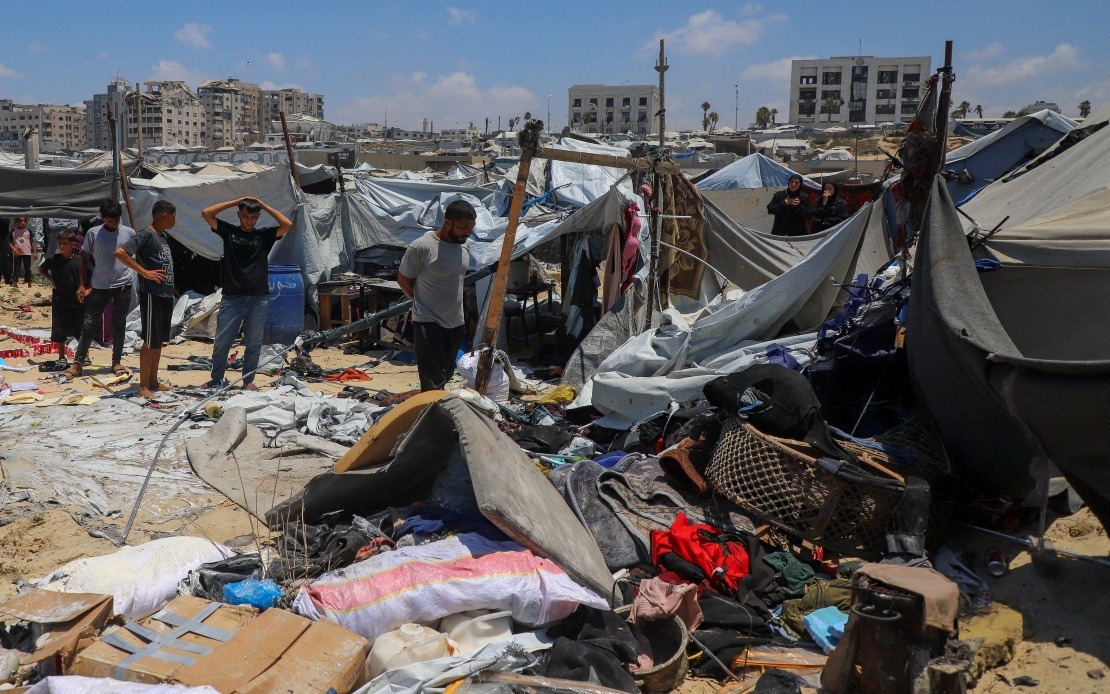
The scale of destruction across the Gaza Strip has reached alarming proportions, with a Palestinian government weekly situation report estimating that Israeli military operations have demolished more than 90 per cent of the enclave's built environment. According to the Palestinian Government Communication Centre at the Prime Minister's Office, Israeli occupation forces now exercise control over approximately 80 per cent of the territory, reflecting the extent of military consolidation following months of intensive operations. The findings, released on Monday based on data compiled through local sources and field assessments, paint a sobering picture of the humanitarian and infrastructural devastation facing the Palestinian population in Gaza.
Intensified military operations during the final week of June and opening days of July have concentrated on three major population centres: Khan Younis, Rafah, and Gaza City. During this seven-day period alone, eight Palestinians were killed according to local medical sources, with the report documenting systematic destruction of residential infrastructure. The Palestinian Government Communication Centre noted that Israeli occupation forces conducted coordinated shelling campaigns targeting civilian neighbourhoods whilst simultaneously demolishing homes, a pattern that has created fresh waves of displacement among already vulnerable Palestinian families struggling to find shelter in an increasingly devastated landscape.
The scope of military activities extends far beyond Gaza's borders into the occupied West Bank, where the Palestinian Government Communication Centre reported widespread raids carried out by Israeli occupation forces throughout the week under review. These operations involved forced entries into private residences, arbitrary detentions, severe restrictions on Palestinian movement, and strategic road closures affecting multiple Palestinian cities and towns. The affected areas included Ramallah, Nablus, Hebron, Bethlehem, Jenin, Qalqilya, Tulkarem, and occupied Jerusalem, suggesting a coordinated security approach spanning the entire occupied Palestinian territory.
Beyond uniformed military operations, the report documents a troubling escalation in attacks perpetrated by Israeli colonial settler militias against Palestinian communities and their property throughout the West Bank. These incidents reveal a pattern of systematic harassment and economic sabotage targeting Palestinian civilian life. During the reporting period, settler groups deliberately set fire to a cafeteria facility in the village of al-Lubban ash-Sharqiya, physically assaulted Palestinian shepherds grazing livestock east of Bethlehem, and attempted to steal animals from Palestinian herds. In another incident, settlers blocked the main entrance to the village of Burqa, effectively restricting Palestinian access to essential services and resources.
The ramifications for Palestinian agriculture and rural livelihoods represent a distinct but equally devastating dimension of the ongoing conflict. The Palestinian Ministry of Agriculture has documented a significant and accelerating campaign targeting the agricultural sector across the West Bank, with particular intensity in regions dependent on farming as a primary economic activity. During the week covered by the situation report, a total of 2,559 olive trees were uprooted, burned, or damaged, predominantly across the Salfit, Jenin, and Nablus governorates. These three regions have historically been agricultural heartlands, and the systematic destruction of olive groves represents both an immediate economic loss and a long-term threat to Palestinian food security and rural employment.
The human cost of agricultural destruction extends beyond immediate financial losses. At least 125 Palestinian farmers were directly affected by the documented incidents, losing not merely crops but also productive assets essential to their survival and their families' welfare. The Ministry of Agriculture calculated documented direct economic losses at approximately US$11.78 million during this single week, a staggering figure that underscores the economic dimension of the conflict. For a Palestinian population already experiencing severe economic hardship and unemployment, the targeted destruction of agricultural infrastructure represents a systematic assault on civilian livelihoods and economic resilience.
For Malaysian observers and policymakers, these reports carry significant implications regarding the humanitarian crisis unfolding in the Middle East. As a Muslim-majority nation with long-standing diplomatic relationships throughout the region, Malaysia has consistently advocated for Palestinian rights within international forums. The scale of destruction documented in the Palestinian Government Communication Centre's report — exceeding 90 per cent of Gaza's built environment — positions the territory among the most severely damaged conflict zones globally in recent decades, with comparisons to post-conflict reconstruction efforts in Syria, Iraq, and Ukraine.
The simultaneous expansion of Israeli military control to 80 per cent of Gaza's territory suggests a shift toward permanent occupation rather than temporary military operations, a development with profound implications for regional stability and humanitarian access. The targeting of agricultural infrastructure and rural communities indicates a strategy extending beyond immediate military objectives to encompass long-term demographic and economic transformation of Palestinian territories. For Southeast Asian nations monitoring Middle Eastern developments, such patterns raise concerns about the sustainability of any future political settlement and the humanitarian obligations of the international community.
The documentation of settler militia violence alongside formal military operations reveals a complex security environment where civilian Palestinian populations face threats from multiple armed actors without consistent international oversight or protection mechanisms. The blocking of village entrances, livestock theft, and deliberate destruction of community facilities represent tactics designed to coerce Palestinian communities to abandon their lands and properties. These incidents, whilst perhaps less dramatic than large-scale military bombardments, contribute substantially to the cumulative pressure upon Palestinian civilian populations and the erosion of economic viability across rural West Bank communities.
The economic damage quantified by the Palestinian Ministry of Agriculture provides a concrete metric for assessing the conflict's toll on civilian populations. The loss of 2,559 olive trees in a single week, affecting 125 farming families with combined losses exceeding US$11.78 million, demonstrates how agricultural destruction compounds humanitarian suffering. Olive cultivation represents not merely an economic activity but a cultural and historical anchor for Palestinian communities, with olive trees often serving as multigenerational family assets passed through inheritance. Their systematic destruction carries psychological and cultural dimensions beyond economic calculation.
Looking forward, the trajectory documented in the Palestinian Government Communication Centre's report suggests that reconstruction and humanitarian recovery will require unprecedented international engagement and resource commitment. The destruction of more than 90 per cent of Gaza's infrastructure implies that rebuilding will require not merely repair but comprehensive reconstruction of housing, water systems, electrical infrastructure, and agricultural capacity. For Malaysia and other nations committed to supporting Palestinian humanitarian needs, understanding the full scope of this destruction becomes essential for formulating appropriate development assistance and reconstruction support strategies.

