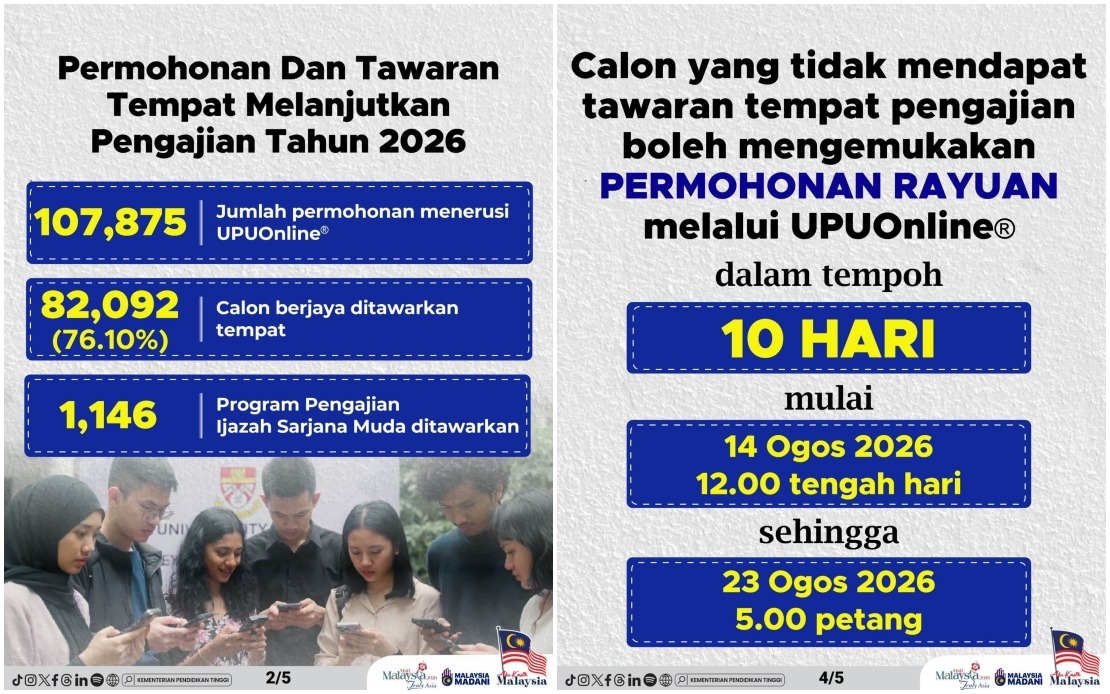
The Ministry of Higher Education (KPT) announced today that 82,092 prospective students have received offers to pursue bachelor's degrees across Malaysia's 20 public universities in the current academic year. This figure encompasses roughly three-quarters of the 107,875 applications deemed eligible for undergraduate study through the UPUOnline system, reflecting a competitive admissions landscape in the nation's tertiary sector.
The selection process underlying these placements operates strictly on meritocratic principles, with the ministry ranking all qualifying candidates according to their academic achievement scores, advancing those with the highest marks through the allocation system. Across this cohort, institutions are offering a combined 1,146 distinct bachelor's degree programmes, spanning disciplines from engineering and science to humanities and social sciences, providing prospective undergraduates with substantial variety in their academic pathways.
This year's admissions cycle represents a continuation of Malaysia's longstanding commitment to expanding higher education access, though the acceptance rate of 76.10 percent underscores the sustained demand that outpaces available capacity within the public university system. The gap between applications and offers highlights persistent constraints on institutional resources and infrastructure, issues that have prompted ongoing discussions among policymakers regarding the need for additional funding and campus development.
For thousands of aspiring students who did not receive initial placement offers, the ministry has established a structured appeal mechanism to provide a secondary opportunity for admission. Beginning at noon on August 14 and continuing until 5pm on August 23, 2026, unsuccessful candidates may lodge appeals through UPUOnline, a window that extends across approximately ten days. This appeals process recognises that merit-based systems, while equitable in principle, may occasionally disadvantage candidates whose circumstances prevented optimal examination performance or whose preferred programme combinations proved numerically oversubscribed.
The ministry's statement accompanying the announcement expressed optimism regarding the cohort entering Malaysia's public university system, urging successful candidates to maximise the educational opportunities now available to them. Officials framed undergraduate admission as a significant milestone in students' academic trajectories, emphasising the transformative potential of higher education in shaping career prospects and contributing to national development objectives.
For Malaysian students and families, these admissions outcomes carry substantial implications. Access to public university places determines not only immediate educational pathways but also long-term economic prospects, particularly given the credential inflation increasingly evident across professional labour markets in Malaysia and the broader Southeast Asian region. The 24 percent of eligible applicants who failed to secure placements face difficult decisions regarding alternative educational routes, including applications to private institutions, overseas study, or pursuit of vocational and technical qualifications through other channels.
The scale of applications—exceeding 107,000 eligible submissions—demonstrates undiminished public appetite for university-level qualifications in Malaysia despite concerns about graduate unemployment and oversupply in certain fields. This pattern reflects both the genuine aspirations of school-leavers and their families, who regard university degrees as essential credential markers, and possibly structural features of Malaysia's education system that have channelled students predominantly toward academic rather than vocational pathways.
The 1,146 programmes made available this year represent an expansion of curricular offerings, suggesting efforts by the ministry and university administrations to diversify programme portfolios and align them with evolving labour market demands. However, the continued disparity between application volume and available places raises questions about whether this expansion sufficiently addresses underlying capacity constraints or whether systemic reform remains necessary to accommodate Malaysia's growing cohort of school-leavers seeking higher education.
Regionally, Malaysia's public university system continues to occupy a significant position within Southeast Asia's higher education landscape, attracting not only domestic students but also substantial numbers of international applicants. The selective nature of admissions through merit-based systems maintains quality standards and comparative rankings, although it also generates equity concerns regarding whether capability assessment adequately captures potential among students from disadvantaged socioeconomic backgrounds or non-mainstream educational trajectories.
Looking forward, the appeals process will likely determine final enrolment figures, as some unsuccessful candidates transition into alternative pathways while others secure placements through the secondary round. This phased approach to admissions provides administrative flexibility while maintaining the integrity of merit-based selection principles that have become institutionalised within Malaysia's tertiary education framework.

