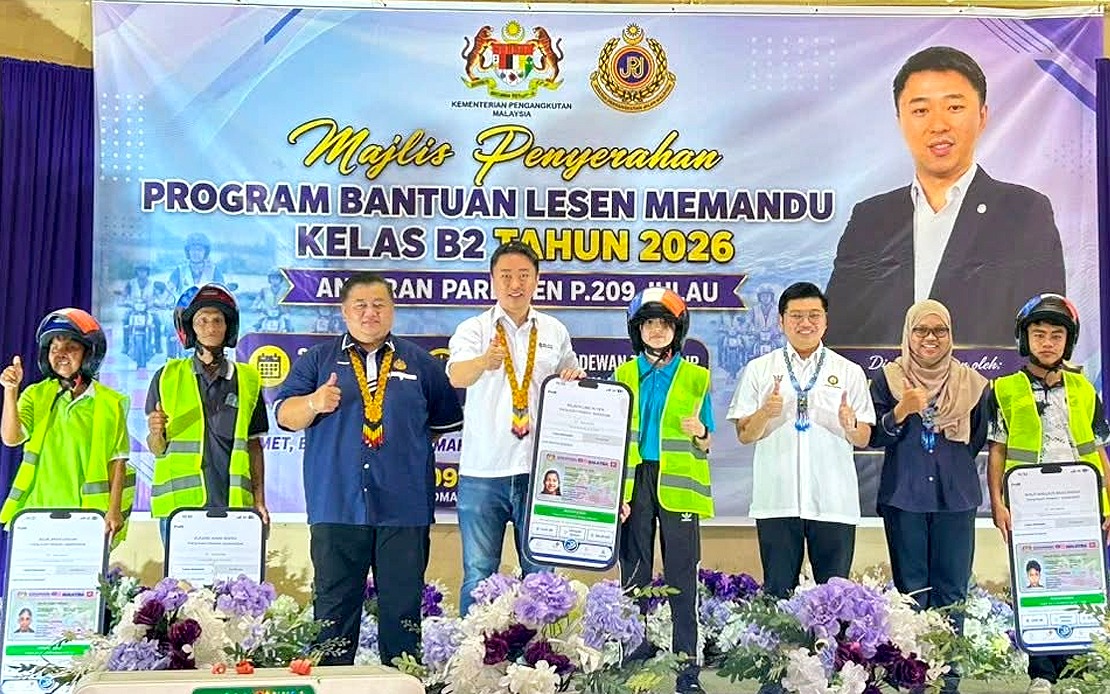
The Driving Licence Assistance Programme in Julau concluded its 2026 intake with 885 participants receiving their Class B2 Probationary Driving Licences, marking a significant milestone for rural communities in Sarawak's interior. The programme, which wrapped up at Julau Closed Stadium in Sarikei, not only provided essential documentation to residents but opened doors to subsidised petrol benefits—a development that carries profound implications for the daily livelihood of smallholders, agricultural workers, and mobile entrepreneurs across the constituency.
Julau MP Datuk Larry Sng Wei Shien, who also chairs the Malaysian Timber Industry Board, officiated the closing ceremony alongside Sarawak Road Transport Department director Norizan Jili. The initiative reflects growing recognition that licensing barriers in remote constituencies impose tangible economic burdens on residents who depend on motorcycles for essential work. For many participants, the inability to hold a valid licence had previously locked them out of government fuel subsidies, forcing them to purchase fuel at full commercial rates—a cost that compounds over months of daily commuting to plantations, orchards, and smallholdings.
Bajik Undum, a 57-year-old smallholder from Rumah Ajau in Ulu Kuntau, Pakan, exemplifies the beneficiaries. She operates a motorcycle-dependent livelihood transporting produce from her orchard to markets, a journey she had previously undertaken without a valid licence and consequently without access to subsidised petrol. The financial gap between commercial and subsidised fuel rates, though seemingly modest per litre, accumulates into substantial monthly savings for rural workers who operate motorcycles as their primary transport infrastructure. Her participation as the oldest female recipient underscores how the programme reaches across demographic boundaries, addressing long-standing licensing gaps that affect older residents who may never have obtained formal documentation.
Kudang Jenggi, a 64-year-old bird's nest house caretaker in Bayong, Sarikei, similarly represents the programme's reach into vulnerable populations. Beyond the immediate fuel subsidy benefit, Kudang highlighted a dimension often overlooked in discussions of rural licensing: the psychological and practical security of holding valid documentation. Travelling through roadblocks and police checkpoints without proper credentials carries perpetual anxiety, particularly for older residents whose limited familiarity with bureaucratic processes compounds their apprehension. His remarks reveal how compliance with road regulations remains aspirational rather than automatic in communities where documentation barriers have historically been accepted as inevitable.
The fuel subsidy angle deserves particular scrutiny for Malaysian policymakers. Rural economies depend disproportionately on subsidised fuel allocation, which effectively cross-subsidises the productivity of smallholders and agricultural workers. Recent petrol price volatility has rendered transport costs unpredictable for operators with tight margins. Daniel Padong, a 45-year-old oil palm smallholder from Rumah Pom in Ulu Amot, Pakan, framed this clearly: rising fuel prices directly erode his operational viability unless he accesses subsidised rates. The programme thus functions as an informal productivity support mechanism, enabling rural workers to maintain competitive smallholding operations.
The choice of the Driving Licence Assistance Programme as a policy instrument reflects broader strategies to reduce friction in rural service delivery. Licensing itself—acquiring documentation, attending training, passing examinations, navigating paperwork—involves transaction costs that rural residents struggle to absorb. Dedicated assistance programmes lower these barriers by bringing licensing infrastructure to remote communities rather than requiring long journeys to urban licensing centres. The concentration of 885 participants in a single closure event suggests significant accumulated demand, indicating that previous licensing gaps were substantial and persistent.
For Southeast Asian context, rural licensing and fuel subsidy access patterns reveal how resource allocation mechanisms intersect with development outcomes. Malaysia's subsidised fuel system, while debated among economists, functions as a de facto support structure for rural livelihoods. Individuals locked out of subsidy schemes—whether through licensing gaps, documentation hurdles, or administrative exclusion—experience steeper effective costs than their urban and documented counterparts. The Julau programme addresses this disparity directly.
The programme also carries implications for road safety and enforcement. Rural areas frequently experience lower compliance with licensing requirements, partly because rural residents perceive limited enforcement risk and partly because access barriers legitimate their informal status. By reducing access barriers through assistance programmes, authorities can shift dynamics from stigmatised non-compliance toward normalised participation, supporting both road safety objectives and fuel subsidy programme integrity.
Moving forward, the visibility and apparent success of the Julau closure suggest potential for replication across other rural Malaysian constituencies, particularly in Sarawak and Sabah where geographic dispersion and limited urban concentration create similar licensing challenges. Scaling the programme would require sustained investment in mobile or decentralised licensing infrastructure, trained personnel deployment, and coordination between road transport authorities and rural administration systems. The enthusiasm expressed by beneficiaries indicates strong demand for such expansion.
The Julau programme ultimately illustrates how targeted, locally-delivered support can unlock participation in formal systems and subsidy schemes for marginalised populations. The 885 residents who now hold valid licences gain not merely documentation but economic relief, psychological security, and enhanced operational capacity for their rural livelihoods. For a constituency where many residents depend on informal transport and agricultural work, legitimising their mobility through accessible licensing represents concrete advancement in rural development.

