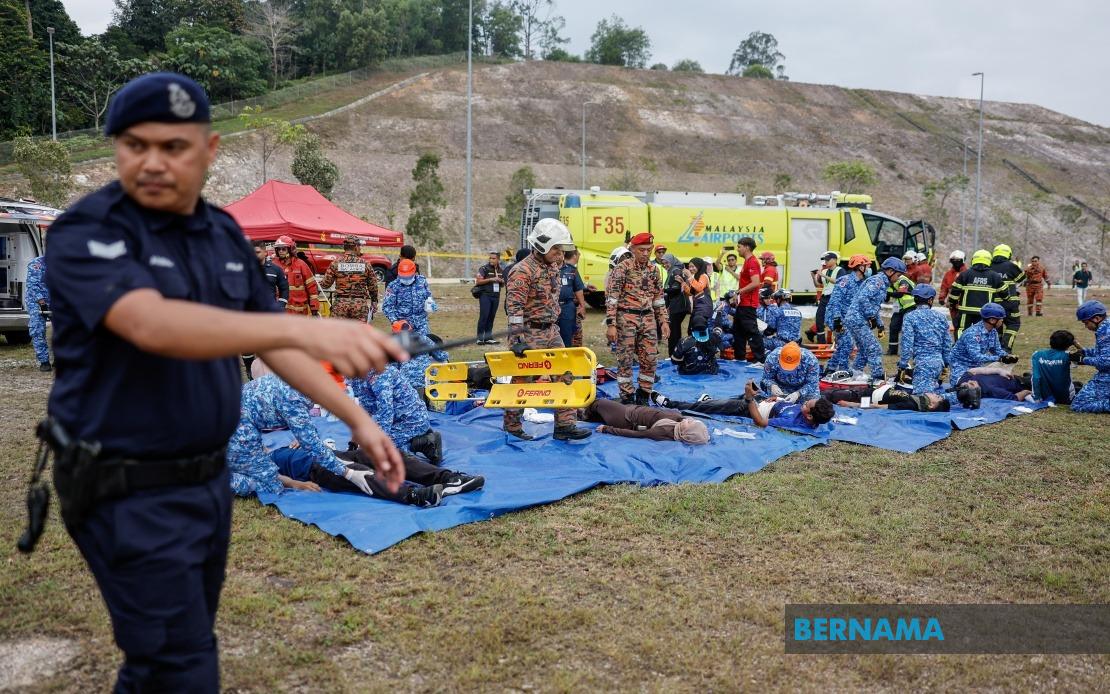
Malaysia's aviation safety framework faced a significant test on July 16 when over 20 enforcement and emergency response agencies participated in Ex Urban Falcon 2026, a comprehensive simulation of an aircraft disaster occurring well beyond airport boundaries. Held at the Denai Alam Rest and Service Area along the Damansara-Shah Alam Elevated Expressway, the drill marked a notable evolution in the country's disaster preparedness protocols, moving beyond traditional exercises conducted within or immediately adjacent to airport perimeters.
The simulation centred on a scenario involving an ATR72 aircraft touching down approximately six kilometres from Sultan Abdul Aziz Shah Airport in Subang. This distance falls within the National Aeronautical Search and Rescue Manual (NAMSA) framework, which designates the Airport Fire and Rescue Services (AFRS) area of responsibility as extending up to eight kilometres from the airport's midpoint. According to Muhammad Hidayat Ismail, general manager of AFRS, the exercise aimed to evaluate whether Malaysia Airports Holdings Berhad (MAHB) and allied response agencies could effectively coordinate emergency operations under the aerodrome emergency plan when the incident location lay outside traditional airport operational zones.
The geographical and logistical challenges inherent in off-airport scenarios distinguish them fundamentally from exercises conducted at or near airport facilities. Response teams must navigate residential areas, navigate complex road networks, and contend with toll plaza crossings—factors that complicate rapid deployment and extend response times. Muhammad Hidayat highlighted these operational complexities as the primary challenge facing rescue personnel, noting that swift arrival at a remote crash site requires coordination across multiple jurisdictions and transportation infrastructure typically absent from airport emergency protocols.
One critical distinction between off-airport and airport-based aircraft disasters involves victim survival prospects. Terrain irregularities at locations distant from airports substantially reduce survival rates compared to incidents occurring on standardised airport grounds. This reality demands fundamentally different casualty management approaches, particularly concerning mass fatality scenarios. The exercise specifically modelled a situation where casualties would likely exceed survivors, creating a more austere operational environment that tested the coordination capabilities of participating agencies in ways that conventional simulations could not replicate.
Disaster Victim Identification (DVI) operations, coordinated by the Royal Malaysia Police, emerged as a critical component requiring enhanced inter-agency synchronisation. The realistic casualty scenario presented during Ex Urban Falcon 2026 underscored the complexity of managing mass casualty events in unprepared environments, forcing response teams to establish protocols and coordinate resources under conditions far more challenging than airport-based alternatives. Muhammad Hidayat observed that participating agencies executed their assigned duties in accordance with established procedures, with firefighting and rescue operations demonstrating adequate operational competence.
Technological preparedness constitutes an important foundation for Malaysia's aviation disaster response capability. AFRS operates aircraft firefighting vehicles constructed to specifications and standards established by the International Civil Aviation Organisation (ICAO) and the Civil Aviation Authority of Malaysia (CAAM), ensuring equipment compatibility with international best practices. However, equipment alone proves insufficient without comprehensive inter-agency coordination frameworks tested through realistic scenario drills. The Ex Urban Falcon 2026 exercise provided an opportunity to validate both technological capabilities and procedural integration across 450 participants drawn from critical public and private sector organisations involved in aviation disaster response.
This exercise represented a methodological departure from previous Malaysian aviation safety drills, marking the first occasion in which response agencies confronted a scenario extending substantially beyond airport boundaries. Previous exercises, while valuable for establishing baseline procedures, had primarily focused on incidents occurring within or immediately adjacent to airport facilities. Muhammad Hidayat acknowledged this historical limitation, noting that such off-airport scenarios remain rarely tested despite their realistic possibility and distinct operational requirements. The willingness to conduct this more challenging simulation reflects a maturing approach to disaster preparedness planning in Malaysia.
The collaborative framework underpinning Ex Urban Falcon 2026 demonstrates the institutional structures necessary for comprehensive emergency response. MAHB, the National Disaster Management Agency (NADMA), the Selangor state government, and PROLINTAS-DASH—the expressway operator—contributed strategic partnership that integrated transportation, disaster management, and aviation authorities. This multi-sector coordination reflects the reality that off-airport aviation disasters transcend traditional aviation industry boundaries and necessitate engagement from local government, highway management, and state-level disaster coordination capabilities.
Lessons derived from the exercise will inform future preparedness improvements through a structured post-exercise analysis process. A dedicated workshop scheduled for July 26 and 27 will examine findings and identified challenges, with the objective of developing enhancement measures and reinforcing coordinated disaster response protocols. This systematic approach to integrating exercise outcomes into operational improvements represents a deliberate commitment to continuous enhancement of Malaysia's aviation safety infrastructure.
Muhammad Hidayat emphasised that sustained agency commitment demonstrated during the drill reflects Malaysia's institutional readiness to respond effectively to potential aviation disasters and subsequently enhances public confidence in the nation's aviation safety frameworks. For Malaysian and Southeast Asian observers, the exercise signals a sophisticated understanding that genuine preparedness requires regular testing of realistic, challenging scenarios rather than routine validation of established airport-proximate procedures. The willingness to expose operational gaps and coordination deficiencies in a controlled exercise environment positions Malaysia favourably within regional aviation safety standards and reflects the professional maturity expected of countries maintaining significant aviation infrastructure and passenger traffic.

