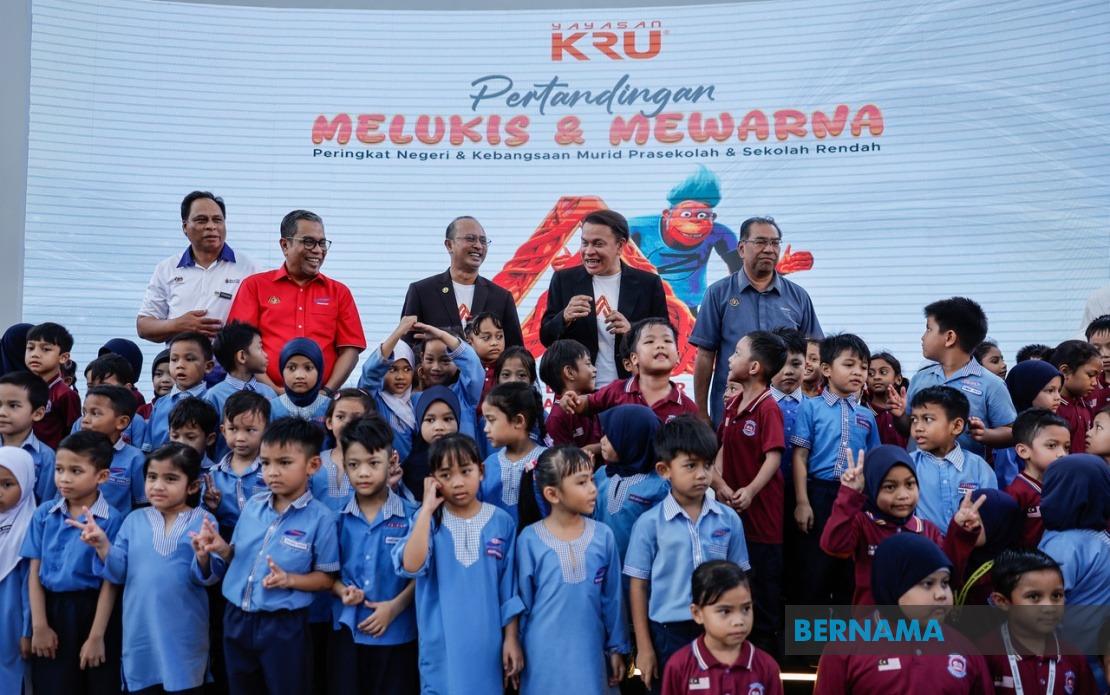
The 2026 Kreatif Aspirasi Reka (AKAR) Awards has entered the Malaysia Book of Records after mobilising the country's largest-ever participation of preschool children in a unified colouring competition. Coordinated simultaneously across the nation, the initiative brought together more than 153,000 pupils from KEMAS and Unity kindergartens, marking a remarkable demonstration of the reach and engagement capacity of Malaysia's early childhood education sector.
The competition represents a collaborative effort spanning multiple government entities and statutory bodies. The National Higher Education Fund Corporation (PTPTN) provided financial support, while the Education Ministry (MOE), Community Development Department (KEMAS), and the Department of National Unity and National Integration (JPNIN) worked alongside Yayasan KRU to execute the nationwide event. This multi-agency coordination underscores the government's investment in nurturing creative capabilities from the earliest educational stages.
Beyond the artistic engagement, the AKAR 2026 programme embedded a purposeful environmental message through its "I Love Orangutans" campaign. The initiative thus served a dual function: channelling children's creative expression while simultaneously cultivating awareness about conservation issues among Malaysia's youngest learners. This integration of artistic development with environmental stewardship reflects a growing recognition that early childhood programmes can meaningfully contribute to shaping attitudes toward sustainability.
Yayasan KRU Board of Trustees president Datuk Norman Abdul Halim characterised the achievement as historic, emphasising that the scale of participation would not have been possible without coordinated backing from multiple stakeholders. He highlighted the organisation's commitment to fostering children's creative interests whilst advancing conservation messaging, positioning the awards as part of a broader national effort to develop well-rounded young citizens equipped with both artistic sensibilities and environmental consciousness.
The financial incentive structure rewards excellence at both regional and national tiers. Winners at state level share approximately RM100,000 in prize money, with winning entries credited directly to the National Education Savings Scheme (SSPN) accounts belonging to participating children. This approach provides immediate recognition while contributing to long-term educational savings, aligning short-term achievement with families' medium-term financial planning for their children's schooling.
Competition culminates at the national finals scheduled for 29 August in Putrajaya, where state-level victors advance to contend for the highest prizes. The top national winner receives RM3,000, establishing a meaningful incentive that acknowledges exceptional creativity at the national level. The tiered competition structure encourages broad participation while reserving premium recognition for standout achievements.
Mohd Hanafiah Man, the director-general of KEMAS, positioned creativity as a foundational competency for developing a generation capable of competing in an increasingly complex economic landscape. His remarks acknowledge the strategic importance of nurturing creative thinking from early childhood, a perspective aligned with global education trends emphasising non-routine cognitive skills alongside traditional academic learning. KEMAS preschool staff across the country coordinated the simultaneous execution of the competition, demonstrating organisational capacity at the grassroots level.
The presence of senior officials from JPNIN and PTPTN at the launch reflects the political and institutional weight attached to the initiative. Datuk Zulkifli Hashim of JPNIN and Ahmad Dasuki Abdul Majid of PTPTN both attended, signalling sustained government commitment to programmes linking national unity building with youth development. This alignment suggests the AKAR awards are understood as contributing to broader nation-building objectives beyond narrow artistic competition.
For Malaysian parents and educators, the AKAR 2026 result demonstrates the capacity of well-coordinated national campaigns to achieve substantial reach within the preschool sector. The scale of participation—exceeding 153,000 children—indicates that coordinated efforts across KEMAS and private kindergartens can successfully mobilise large cohorts around specific developmental objectives. The programme's success may encourage similar multi-agency initiatives targeting early childhood development in subsequent years.
The Malaysia Book of Records recognition carries symbolic significance for Yayasan KRU as validation of their organisational achievement. For the broader early childhood education sector, the milestone signals that preschool children represent an engaged, mobilisable demographic capable of large-scale participation in structured national programmes. The integration of creative, environmental, and savings-focused elements within a single competition framework offers a model that other organisations might adapt.
Looking forward, the August nationals in Putrajaya will showcase winning works while providing a capstone event highlighting exceptional preschool creativity across Malaysia's states. The occasion will likely receive media coverage that further amplifies the environmental messaging and celebrates outstanding young artists, reinforcing cultural narratives about the importance of nurturing creativity during foundational educational years.

