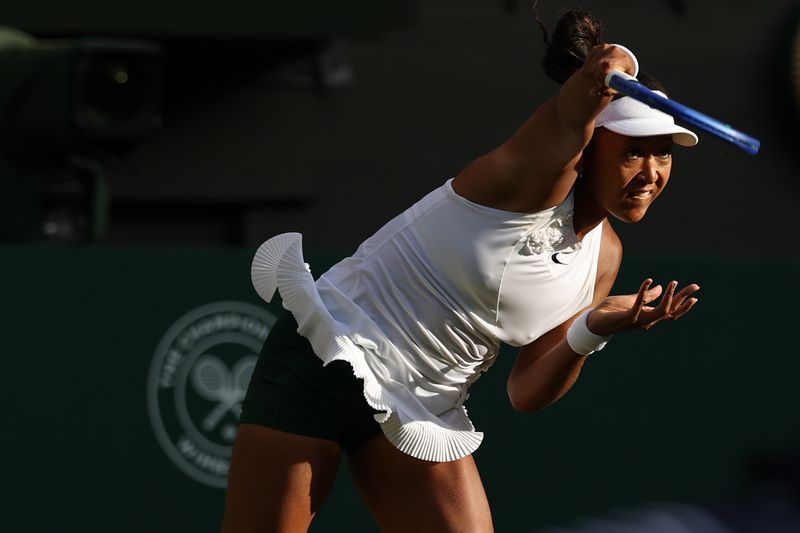
Naomi Osaka reached the Wimbledon quarter-finals for the first time by dismantling top seed Aryna Sabalenka in a display of relentless power and precision, claiming a 6-2 7-6(2) victory that underscores her return to elite form following maternity leave. The Japanese 14th seed, who opened her week in a striking Kill Bill-inspired kimono-style ensemble, channelled the championship prowess that has earned her four Grand Slam titles to overwhelm the world's leading player, leaving Sabalenka visibly frustrated on Centre Court.
Oska's scintillating performance adds significant weight to an already depleted women's draw at the All England Club. The elimination of defending champion Iga Swiatek and 2022 winner Elena Rybakina in the third round, coupled with Sabalenka's departure and Barbora Krejcikova's fourth-round loss, has vacated the top three seeding positions entirely. This cascade of upsets has locked in a remarkable milestone: a ninth consecutive Wimbledon women's champion will be crowned who has never previously won the tournament, a statistical anomaly that reflects both the competitive depth of contemporary women's tennis and the unpredictable nature of grass-court play.
The quality gap between the rivals proved minimal on paper yet vast in execution. Both women had accumulated four Grand Slam titles apiece and shared identical age at 28 years old, with all of Sabalenka's major victories arriving on hard courts where she traditionally dominates. Their history suggested competitive balance, with Sabalenka having won their three most recent encounters this season alone. Yet on this occasion, Osaka's superior court positioning and rhythm-setting groundstrokes proved devastating, transforming their long-awaited reunion into a masterclass that validated her investment in returning to professional tennis.
Oska herself appeared surprised by the thoroughness of her dominance, reflecting afterwards on the extended absence from competing at elite level. She described the victory as her most significant since her comeback, particularly satisfying given the recent pattern of losses to Sabalenka that had accumulated psychological weight. The Japanese player acknowledged the unusual nature of having "so much fun on the court" at Wimbledon, where grass presents distinct technical challenges markedly different from the hard-court conditions where she built her reputation as a Grand Slam champion.
Meanwhile, Novak Djokovic progressed through his fourth-round encounter with Russian qualifier Roman Safiullin in a laboured 7-6(6) 6-3 3-6 6-3 victory that moved him forward despite providing him limited satisfaction. The 39-year-old Serbian champion, pursuing a record-equalling eighth Wimbledon title, acknowledged feeling physically and mentally uncomfortable throughout the match, describing his performance as scrappy and uninspiring. Yet he succeeded in claiming his 106th Wimbledon match victory, surpassing Roger Federer's previous men's record and cementing his position as the tournament's most prolific competitor across history.
Djokovic's advancement represents a strategic achievement despite the aesthetic shortcomings. His progression to a 17th quarter-final appearance at SW19 positions him one victory away from a potential semi-final confrontation with defending champion Jannik Sinner, though he must first negotiate third seed Felix Auger-Aliassime, the Canadian who has already battled through an exhausting four hour 26 minute encounter against Spain's final remaining player, Alejandro Davidovich Fokina, in a 6-7(4) 7-6(6) 6-3 6-7(2) 6-1 marathon that ended in pointed exchanges at the net.
The men's draw witnessed another dramatic exit when Polish prospect Hubert Hurkacz was forced to retire during the fifth set against Jan-Lennard Struff, the German veteran who at 36 years old has unexpectedly found himself competing in his first Grand Slam quarter-final. Struff's late-career breakthrough adds another element of unpredictability to a tournament that has already defied seeding and past form on multiple occasions across both competitions.
Oska's next assignment pits her against tenth seed Karolina Muchova, who secured passage by defeating 2024 champion Krejcikova in a tightly contested 7-5 5-7 6-3 affair. The Czech player's elimination of the defending champion further attests to the magnitude of the disruption coursing through this year's Wimbledon field, where consistency has been scarce and upset victories continue accumulating. For Southeast Asian tennis enthusiasts monitoring Osaka's progress, her resurgence carries particular significance given the profile she commands across the region and her demonstration that elite status can be reclaimed following extended absence from competition.
The women's draw has generated unexpected American strength, with five players from the United States reaching the fourth round, achieving their strongest representation at this stage since 2002. Among these, fourth seed Jessica Pegula showcased her experience advantage against 18-year-old Iva Jovic, delivering a clinical lesson in match management through a 4-6 6-3 6-1 victory. Pegula's advance has matched her best previous Wimbledon achievement, positioning her potentially to face fellow American Coco Gauff if the latter succeeds against Switzerland's Belinda Bencic, a scenario that would concentrate American hopes increasingly among players capable of delivering consistent high-level performance across contrasting surface conditions.
The broader implications of these results reverberate across professional tennis scheduling and tournament narratives heading into the latter stages of the English summer season. Osaka's performance particularly resonates with global audiences who had watched her navigate the complexities of returning to professional sport following motherhood, transforming her comeback narrative from uncertain experiment into demonstrable competitive reality. Her dispatching of Sabalenka, a player of formidable reputation and recent form, supplies tangible evidence that elite players retain their championship capacity regardless of career interruptions, provided the physical and mental preparation underpins their return.

