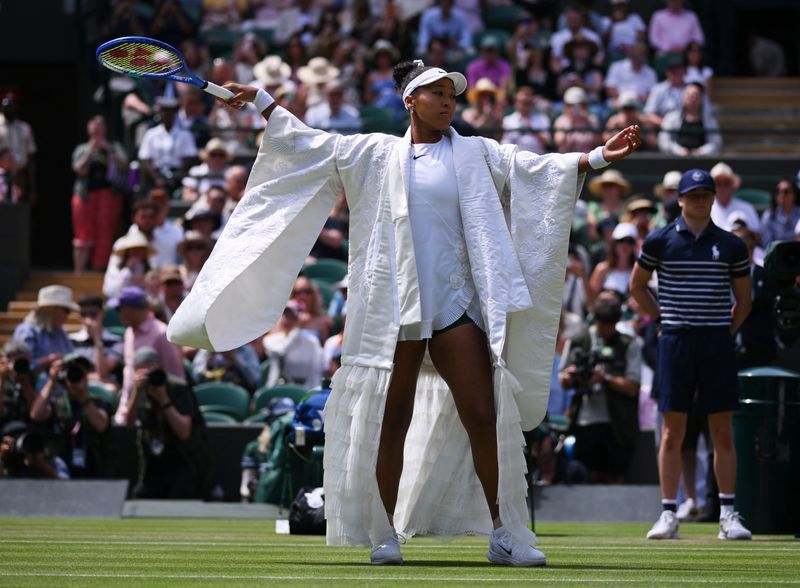
Naomi Osaka extended her impressive run at Wimbledon on Friday, overcoming Russian-born Australian Daria Kasatkina in commanding fashion to secure her maiden appearance in the last 16 at the All England Club. The 14th-seeded Japanese champion claimed a straightforward 6-1 6-3 victory on Court One, mixing aggressive ball-striking with tactical precision to dismantle an unseeded opponent who struggled to find rhythm throughout the encounter. The emphatic scoreline underscores Osaka's growing credentials on grass, a surface where she had previously made limited impact in her career before this fortnight.
While Osaka has garnered considerable attention throughout the opening week for her striking courtside fashion statements—most recently walking out in a flower-patterned "Kill Bill" inspired kimono—the four-times Grand Slam winner is increasingly demonstrating that her tennis prowess can command equal billing. Known within the sport as a pioneering style icon who consistently challenges conventional dress codes at major tournaments, Osaka has successfully channelled her off-court confidence into her on-court performance, creating a compelling narrative that transcends traditional tennis coverage. This dual dimension of her presence has captivated crowds at what remains one of sport's most tradition-bound venues.
Osaka established her dominance from the opening moments, breaking Kasatkina's serve in the second game through a precisely executed backhand winner that set the tone for what would follow. She consolidated this early advantage by forcing another immediate break with a penetrating forehand stroke, racing through the first set with the kind of clinical efficiency that suggests genuine title aspirations. The 28-year-old's aggressive approach exploited Kasatkina's relative unfamiliarity with grass-court nuances, limiting her opponent's ability to construct rallies or deploy the tactical variety that characterises her usual play style.
The second set proved more contested, with Kasatkina briefly threatening to recover ground after Osaka squandered an early advantage. However, the Japanese champion displayed the mental resilience necessary at this stage of grand slam competition, clawing back to establish two match points before ultimately closing out the affair in assured fashion. This capacity to maintain focus and execute when opportunities arise represents a critical element of Osaka's recent revival, particularly given her extended absence from competitive tennis through mental health prioritisation and physical injury complications.
Addressing the home crowd following her victory, Osaka expressed genuine pleasure at achieving what represents a breakthrough moment at Wimbledon. "I've actually never won on this court, so I'm really glad to have made a really good memory here," she told assembled spectators, her remarks touching on both the personal significance of the achievement and gratitude for supporter engagement. Her comments highlighted how previous visits to the venue had ended in disappointment, making this progression particularly meaningful from an emotional perspective beyond merely advancing another round.
Osaka's grass-court preparation in preceding weeks proved instrumental in developing the confidence evident during her Kasatkina encounter. The Japanese champion contested a tour-level final at Bad Homburg prior to Wimbledon, though an injury forced her withdrawal from that competition and raised questions about her readiness for this championship. Yet her performance against Kasatkina dispels any lingering fitness concerns, demonstrating movement quality and explosive power that suggest she has fully recovered. The Bad Homburg experience, despite its disappointing conclusion, clearly provided valuable exposure to grass-court tennis that she has successfully translated into productive results.
Looking ahead to her last-16 engagement, Osaka faces a fascinating collision course with either world number one Aryna Sabalenka or former French Open champion Jelena Ostapenko, each representing distinctive challenges. Should Sabalenka advance, Osaka would encounter the circuit's most dominant hard-court specialist attempting to extend her influence across different surfaces—a potential matchup that carries considerable intrigue given their contrasting playing styles and career trajectories. Alternatively, Ostapenko brings the unpredictability and creative shot-making that grass courts historically favour, presenting an opponent capable of generating winning opportunities from unconventional positions.
Osaka's progression represents a broader narrative about her career reconstruction following the well-documented mental health challenges that prompted her withdrawal from professional competition previously. Her return to elite-level competition has been methodical rather than immediate, with the 28-year-old carefully rebuilding her ranking and confidence through selective tournament participation. The Wimbledon showing suggests this measured approach is yielding tangible dividends, as evidenced not merely by match victories but by the evident comfort she displays within competitive environments—a psychological component that extends beyond statistical output.
From a regional perspective, Osaka's continuing prominence at major championships carries significance for the broader Asian tennis narrative. While Asian players have made incremental progress across the tennis hierarchy, the presence of a multiple Grand Slam champion competing at Wimbledon's latter stages elevates the sport's profile throughout East Asia and reinforces tennis as an aspirational career path. Her intersection of technical excellence with cultural influence—manifested through fashion-forward presentation—creates a template that transcends traditional sporting achievement and speaks to younger demographics who increasingly view athletic excellence through multi-dimensional lenses.
Osaka acknowledged the mounting demands of the tournament while maintaining measured optimism about her prospects. "I'm just trying to take it one day at a time, one point at a time," she stated, demonstrating the philosophical approach that increasingly characterises her public commentary. This point-by-point mentality represents a departure from earlier career phases where she occasionally seemed overwhelmed by championship expectations, suggesting genuine personal development alongside athletic improvement. The Japanese champion's willingness to compartmentalise her focus—addressing immediate tasks without projecting excessively into potential future matchups—reflects the mental frameworks that separate sustained success from brief flourishes in elite competition.
As the championship progresses into its second week, Osaka's continued advancement would validate her status among genuine contenders rather than interesting storylines. The combination of improved grass-court credentials, mental resilience, and demonstrated capacity to maintain concentration through pressure situations positions her as a legitimate threat to tournament favourites. Whether she ultimately challenges for the title or exits in subsequent rounds, Osaka's Wimbledon trajectory has already established this fortnight as a watershed moment in her ongoing career renaissance, confirming that her influence extends meaningfully beyond the fashion commentary that initially dominated early-round coverage.

