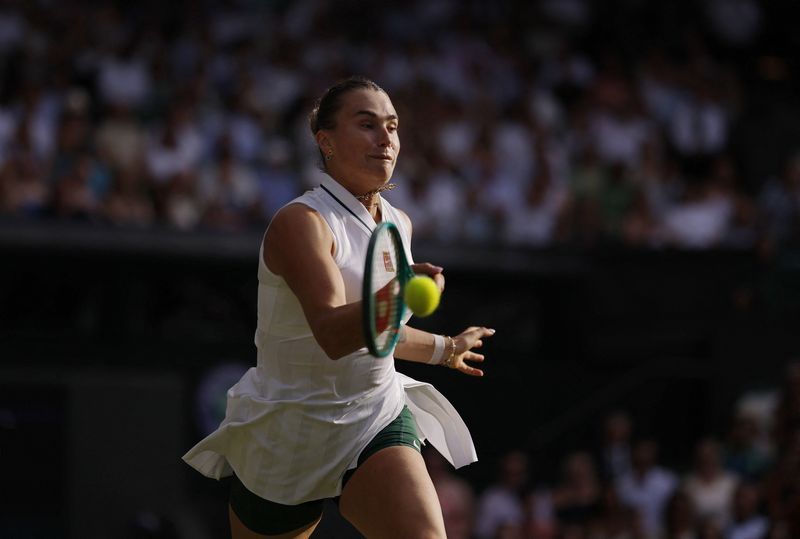
Naomi Osaka delivered one of the tournament's most significant upsets on Sunday, dismantling world top seed Aryna Sabalenka 6-2 7-6(2) on Centre Court to reach the Wimbledon quarter-finals for the first time and fundamentally alter the complexion of the women's draw. The 14th-seeded Japanese star's clinical performance left the heavily favored Sabalenka visibly frustrated, transforming what promised to be a compelling battle between two Grand Slam champions into a lopsided demonstration of precision and composure under pressure.
The implications of Osaka's breakthrough extend well beyond her own resurgence. With defending champion Iga Swiatek and second seed Elena Rybakina already eliminated in the third round, and now Sabalenka's departure in the fourth, the traditionally protective seeding structure that typically keeps top players clustered deep into any Grand Slam has completely unraveled. For Southeast Asian tennis followers accustomed to watching established hierarchies dominate major tournaments, this represents an unusual opening in a competition where the path to the title has rarely appeared so contested and unpredictable.
Osaka's dominance during the opening set proved particularly striking given Sabalenka's formidable reputation as a power hitter. During the 32-minute first set, the world No. 1 found her aggressive baseline game repeatedly neutralized by Osaka's superior service return positioning and court awareness. The Japanese player broke Sabalenka's serve twice in succession, establishing control she would never relinquish and leaving her opponent increasingly visibly agitated as the set wore on. Sabalenka's frustration boiled over repeatedly, her usual confidence replaced by a mounting desperation that manifested in loud exclamations and physical displays of irritation.
The second set promised to offer the spectacle that the Centre Court crowd had anticipated, with Sabalenka mounting a genuine competitive response and keeping pace throughout. However, Osaka's mental resilience proved equally formidable, maintaining her characteristic composure even as the match tightened. When the set progressed to a tiebreak, Osaka executed flawlessly, not merely winning the decisive points but doing so with a serene confidence that visibly deflated her opponent. In breaking Sabalenka's remarkable streak of 21 consecutive Grand Slam tiebreak victories, Osaka achieved a symbolic victory that extended far beyond the match itself—a statement that the previously invincible top seed had vulnerabilities that could be exploited by a prepared opponent.
For Osaka, the achievement carries particular significance given her trajectory over recent years. The four-time Grand Slam champion had stepped away from professional tennis following the birth of her daughter Shai in 2023, returning to competition only in 2024. Sunday's victory represents her biggest win since that comeback and validates the physical and mental preparation she has undertaken to reclaim her place among tennis's elite. The fact that it came on Centre Court, where she had never previously secured a victory, adds a poignant personal dimension to an already momentous achievement.
The peculiar dynamics between these two competitors merit deeper examination for those following women's tennis globally. Both Osaka and Sabalenka have built their careers primarily on hardcourt surfaces, where their power and athleticism find ideal conditions. Each holds four Grand Slam titles won exclusively on hard courts—Sabalenka's most recent victories coming at the Australian Open. Their contrasting career arcs, despite being born merely seven months apart, highlight how differently talent develops across professional tennis. Osaka captured all four of her major titles before Sabalenka recorded her first, yet the Belarusian has since accumulated multiple Australian Open crowns and established herself as the world's dominant player. This head-to-head clash at Wimbledon represented their first direct encounter at a Grand Slam since Osaka's U.S. Open triumph eight years prior, making Sunday's result all the more consequential.
Osaka's tactical excellence throughout the match reflected meticulous preparation, particularly in her approach to service return. From the opening game, she positioned herself aggressively to disrupt Sabalenka's rhythm on serve, consistently forcing the top seed into uncomfortable positions and preventing her from establishing the commanding presence she typically imposes. This aggressive return strategy, usually risky against players of Sabalenka's caliber, proved devastatingly effective because Osaka executed it with precision rather than desperation. The quality of her groundstrokes and her willingness to take calculated risks on crucial points created an environment where Sabalenka's defensive options became progressively more limited.
Sabalenka's post-match demeanor revealed the magnitude of her disappointment. After watching a match point disappear into the arena's upper reaches, she departed the court visibly drained, later remarking that she intended to consume alcohol specifically to attempt forgetting the experience. The 28-year-old's comment reflected both the psychological intensity of competing at the sport's highest level and the particular sting of losing to an opponent she had previously dominated. Having reached three consecutive Grand Slam semi-finals entering Wimbledon, Sabalenka had positioned herself to finally claim an All England Club title, yet Osaka's performance removed that opportunity entirely.
Osaka's continued presence at Wimbledon now extends to a quarter-final meeting with 10th seed Karolina Muchova of Czech Republic, a match that carries genuine intrigue given Muchova's demonstrated ability against top-ranked opponents on grass surfaces. Beyond the immediate matchup, Osaka's advancement has created genuine uncertainty about the women's Wimbledon destination for the first time in recent memory. Her combination of power, precision, mental fortitude, and proven Grand Slam experience now positions her as a legitimate contender for the title, even if seeding and public perception might not yet fully reflect that assessment.
For Malaysian and regional tennis followers, Osaka's breakthrough carries additional resonance given her position as Asia's most accomplished current player in the sport's major championships. Her successful return from maternity leave and sustained performance improvement demonstrate that elite athletes can navigate career interruptions and emerge successfully at the highest competitive levels. This narrative particularly resonates in Southeast Asia, where professional tennis participation remains limited and the region's top players have historically struggled to establish themselves on the Grand Slam stage. Osaka's continued success serves as an inspiration for aspiring players throughout the region who seek to establish themselves among tennis's global elite.

