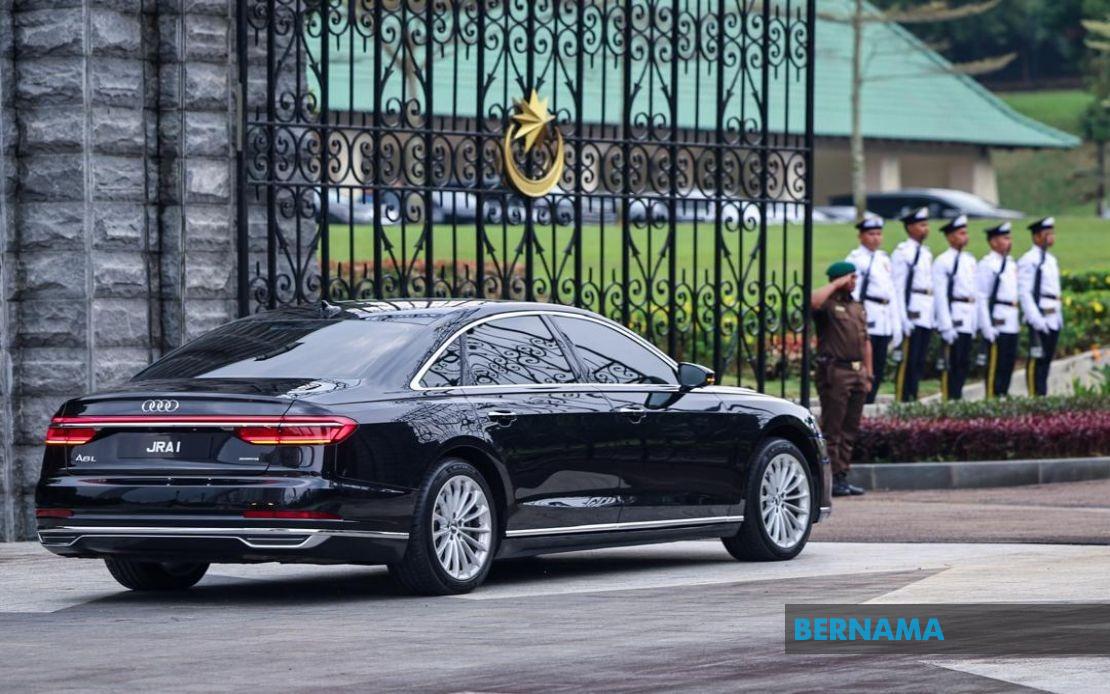
Datuk Onn Hafiz Ghazi, the Machap state assemblyman and chairman of the Johor Barisan Nasional faction, arrived at Istana Bukit Serene on the afternoon of July 12 to be sworn in as the new Johor Menteri Besar, marking a decisive shift in the state's political leadership following a resounding electoral mandate delivered to the ruling coalition.
The motorcade carrying Onn Hafiz was spotted pulling through the palace gates at approximately 3.40 pm, completing a brief journey from the Menteri Besar's official quarters in Saujana, which he had vacated fifteen minutes earlier. News media personnel, who had assembled at the palace grounds since midday, positioned themselves to capture the historic moment as security details and government officials cordoned off the ceremonial spaces to ensure the proceedings unfolded without disruption.
The palace administration had circulated media guidelines earlier in the day, stipulating that journalists covering the swearing-in would be confined to designated areas around the Mahkota gate entrance of Istana Bukit Serene, a restriction aimed at maintaining ceremonial decorum while still permitting public documentation of the formal transfer of executive power. The heightened security presence and administrative preparations reflected the significance of the transition, with government representatives from various departments stationed throughout the premises to facilitate an orderly handover process.
Onn Hafiz's elevation to the menteri besar position follows Barisan Nasional's extraordinary performance in the sixteenth Johor State Election held on July 11, where the coalition secured forty-eight seats out of the fifty-six contested, delivering one of the most commanding victories in recent state electoral contests. This supermajority represents not merely a routine reaffirmation of electoral support but a substantial endorsement of the incumbent coalition's governance record and policy direction, providing the new administration with considerable political flexibility to implement its legislative agenda without navigating the complex dynamics of fractious coalition management.
The comprehensive nature of Barisan Nasional's victory underscores the resilience of the party machinery in Johor, a state that has traditionally served as a stronghold for the ruling coalition despite broader turbulence in Malaysian politics over the past decade. The electoral outcome signals voter confidence in the BN's capacity to deliver development and stability within the peninsula's southern economic powerhouse, a state whose prosperity is intertwined with regional industrial corridors, port infrastructure, and manufacturing sectors that benefit from political predictability.
Onn Hafiz's appointment as menteri besar represents a consolidation of power within the Johor BN faction, affirming the leadership hierarchy that has guided the state's administrative machinery through this electoral cycle. His background as a Machap representative and party chairman positioned him as the natural successor to oversee the implementation of the coalition's election commitments and navigate the complex governance challenges that characterize a state with substantial urbanization, diverse economic interests, and competing developmental priorities.
The swearing-in ceremony itself, conducted within the palatial surroundings of Istana Bukit Serene, carries ceremonial weight beyond mere procedural formality. The setting underscores the constitutional role of the Sultan of Johor as the head of state whose authority legitimizes executive governance, a formal reminder that state power operates within institutional frameworks anchored in constitutional monarchy principles that remain central to Malaysia's political architecture.
For Malaysian political observers and Southeast Asian commentators tracking governance dynamics in the region, the Johor election result and its immediate aftermath offer instructive insights into voter preferences during periods of national political volatility. While Malaysian politics at the federal level has experienced significant institutional turbulence and coalition realignments, the Johor electorate's decisive backing for the established order suggests that state-level governance performance, development track records, and administrative competence continue to influence electoral behavior, particularly in economically significant regions where voters weigh prosperity considerations against broader national political currents.
The smooth transition of power, facilitated by the palace apparatus and proceeding without the procedural complications that have occasionally attended previous transitions, indicates a functional institutional framework capable of managing orderly changes in state administration. This efficiency carries implications for investor confidence and business continuity within Johor's commercial ecosystem, sectors that benefit from predictable administrative transitions and clear lines of political authority.
Onn Hafiz's tenure will test the new administration's capacity to translate electoral momentum into substantive governance improvements across infrastructure development, education provision, healthcare delivery, and economic diversification—challenges that transcend partisan politics and confront every state government regardless of electoral mandate. His performance metrics will be measured not by the scale of his election victory but by tangible outcomes in service delivery and development outcomes visible to ordinary Johor residents navigating daily life in an increasingly urbanized state.
The menteri besar's first weeks in office will prove crucial for establishing administrative priorities and signaling policy directions, decisions that will reverberate across the state's bureaucracy and shape government resource allocation during the five-year assembly term. The electoral supermajority, while politically advantageous, carries corresponding expectations from constituents who delivered such a decisive mandate, creating accountability pressures that extend beyond routine partisan performance metrics.

