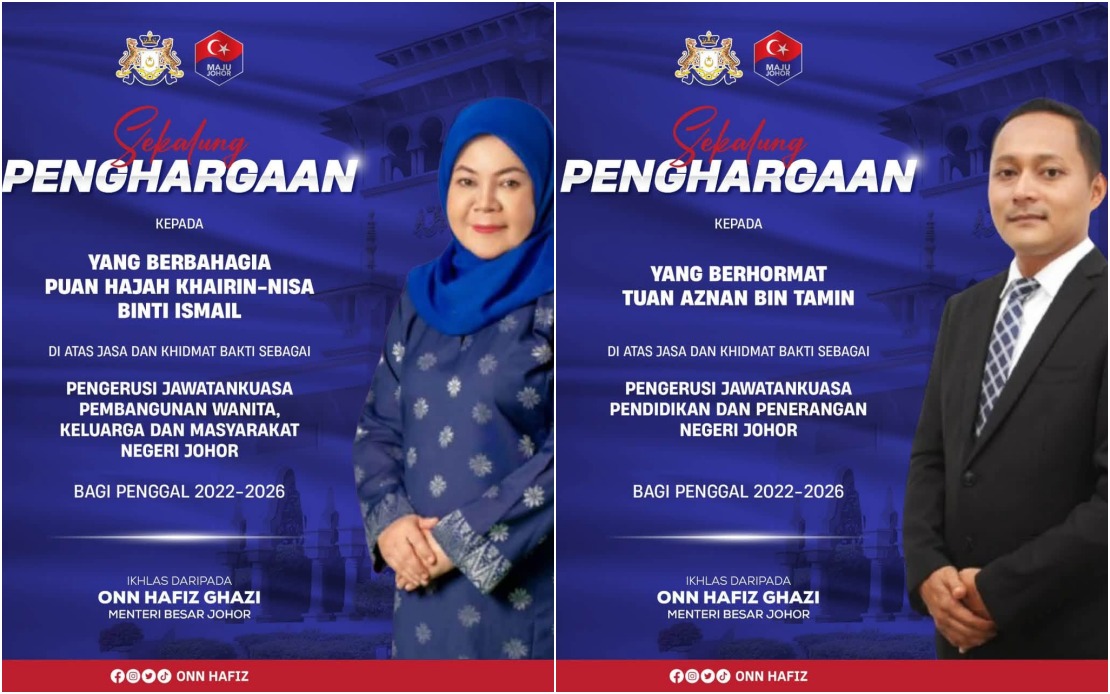
Johor's leadership restructuring represents a deliberate recalibration of the state administration rather than a departure from established governance, according to Menteri Besar Datuk Onn Hafiz Ghazi. The reshuffle of the State Executive Council, which saw four members exit and a further four new appointees join, reflects what state leadership characterises as a renewal process designed to sustain momentum while infusing fresh perspectives into the machinery of government.
Onn Hafiz framed the executive changes not as a rejection of previous work but as an evolution of the administration's capacity. In a statement posted on social media, he acknowledged that administrative transitions of this nature constitute standard practice in the pursuit of broader development objectives benefiting the state and its people. The distinction he drew—between positional change and the depreciation of past efforts—carries particular significance in Malaysian political culture, where such reshuffles often generate speculation about individual ministerial standing and party dynamics.
The four departing executive councillors—Datuk Zahari Sarip, K. Raven Kumar, Aznan Tamin and Khairin-Nisa Ismail—represented the second term serving from 2022 to 2026. Onn Hafiz extended formal recognition of their contributions, characterising their involvement as foundational to achievements registered during their tenure. This acknowledgment reflects a conventional approach to managing political transitions, wherein departing office-holders receive public commendation to preserve institutional harmony and their personal political standing within party structures.
The substance of Onn Hafiz's remarks centred on continuity as an organising principle. He suggested that the responsibility of advancing Johor's interests transcends individual positions, and that accumulated experience, accumulated wisdom, and commitment to public service remain transferable assets beyond formal cabinet roles. This framing carries implications for Malaysian state governance more broadly, where questions of administrative capacity and institutional memory frequently resurface during leadership transitions.
Six assemblymen retained their executive council portfolios in the reshuffle, providing a degree of administrative stability amid the broader changes. This partial continuity reflects a deliberate balancing act—introducing new personnel and ideas while preserving existing relationships and established policy frameworks. In Malaysian state politics, such mixed reshuffles often signal an attempt to maintain policy coherence while addressing internal political pressures or generational renewal imperatives.
Four new assemblymen entered the executive council for the first time, representing an infusion of fresh talent into state administration. The scale of new appointments—representing four of ten positions—suggests meaningful structural change rather than cosmetic adjustment. For Malaysian political observers, such personnel transitions frequently foreshadow shifts in policy priorities or emerging power dynamics within the ruling coalition at state level.
All ten executive council members underwent formal swearing-in ceremonies before Tunku Mahkota Ismail, the Regent of Johor, at Istana Bukit Serene. This ceremonial dimension reinforces institutional legitimacy and the constitutional foundations of Johor's governance arrangements. The involvement of the royal household in formal appointment procedures underscores the continued importance of constitutional monarchy in Malaysian state administration, distinguishing it from purely executive transitions observed in other Westminster-derived systems.
For Malaysian and Southeast Asian readers, the Johor reshuffle illustrates broader patterns in regional governance. State-level administrative transitions in Malaysia frequently operate as testing grounds for national political trends, and Johor—as the region's most populous state and economic powerhouse—commands disproportionate attention from federal observers. The manner in which Onn Hafiz managed the announcement and framed the changes may influence how other state administrations approach similar transitions, establishing precedents for balancing institutional continuity with renewal imperatives.
The emphasis on welfare, development priorities, and collective effort in Onn Hafiz's statement reflects broader themes within contemporary Malaysian political discourse. State administrations increasingly position themselves as development-focused entities committed to inclusive prosperity rather than narrowly factional concerns. This rhetorical shift, evident across Malaysian state governments regardless of ruling coalition composition, responds to evolving voter expectations around performance metrics and tangible service delivery.
The timing and composition of Johor's reshuffle may also carry implications for federal politics and intercommunal balance within state coalitions. In Malaysian context, state executive councils typically reflect careful attention to ethnic representation and coalition partner allocation of portfolios. The specific identity and backgrounds of the four departing and four incoming members would merit scrutiny from political analysts tracking intra-coalition dynamics and resource distribution mechanisms at state level.
Onn Hafiz's measured approach to the reshuffle—emphasising continuity, appreciation for past service, and collective commitment to state advancement—represents a textbook application of political communication best practices within Malaysian governance frameworks. By reframing administrative change as professional renewal rather than political conflict, the Menteri Besar attempted to minimise factional grievances while maintaining forward momentum on state development agendas. Whether this narrative succeeds in deflecting internal or external political criticism will become apparent through subsequent policy implementation and coalition stability dynamics in Johor over coming months.

