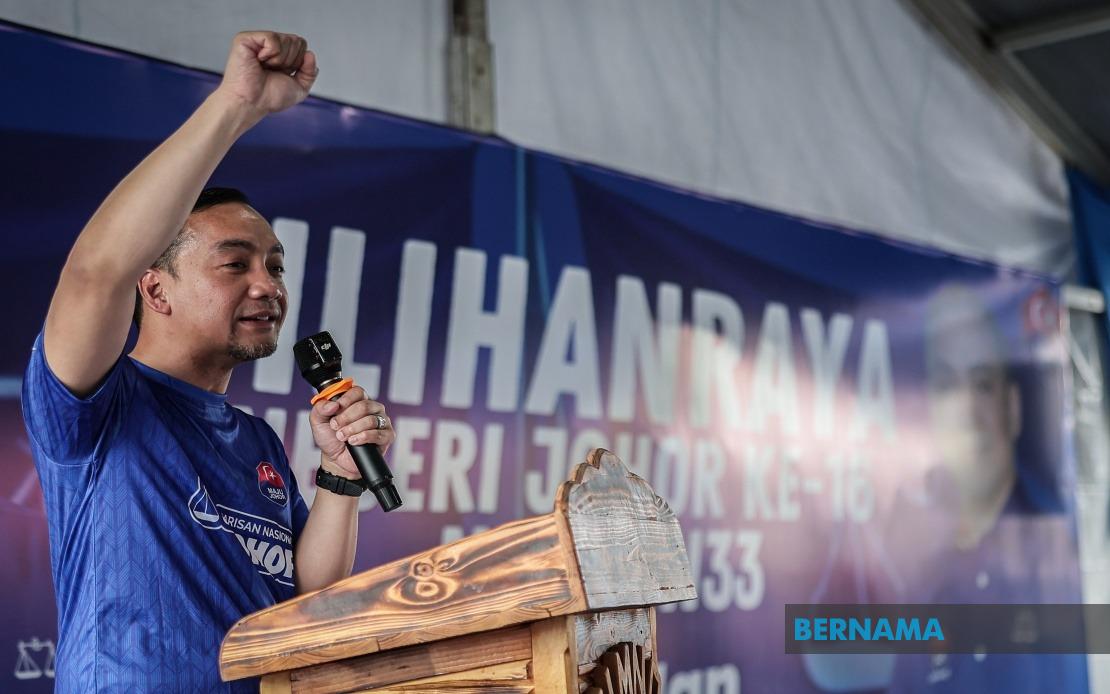
Barisan Nasional (BN) is banking on sustained momentum in the Johor state election as it heads toward polling day on July 11, with coalition officials citing encouraging grassroots reception for the Endau seat candidate, Alwiyah Talib. The positive engagement from voters in the constituency has become a focal point for BN's campaign strategy across the state, particularly given the broader significance of the election in determining political direction in one of Malaysia's most strategically important states.
Datak Onn Hafiz Ghazi, the BN chairman and Johor Menteri Besar, underscored the value of community responses to Alwiyah during campaign activities. He characterised the local reception as "highly encouraging" and framed her candidacy as emblematic of the broader coalition strategy. The buoyancy evident in Endau reflects an effort to translate localised electoral success into statewide advantage, a critical component of BN's calculation ahead of early voting on July 7 and the main polling on July 11.
Alwiyah's presence on the BN ticket carries particular symbolic weight within the coalition's renewed positioning. The candidate, popularly known as "Kak Awi," previously held the Endau seat under Perikatan Nasional in the 2022 state election, when she secured victory with a 3,041-vote majority in a five-way contest. Before that alignment, she had won the same constituency representing BN during the 14th General Election. Her return to the coalition thus represents a significant consolidation of BN's voter base in a seat it once held and seeks to recover.
Onn Hafiz deliberately connected Alwiyah's candidacy to UMNO president Datuk Seri Dr Ahmad Zahid Hamidi's "Rumah Bangsa" concept, which emphasises unity and pragmatic coalition-building across diverse political backgrounds. By framing her movement back into BN as consistent with this overarching philosophy, party leadership sought to normalise the transition and underscore that ideological flexibility serves the broader goal of political cohesion. This framing is intended to signal to voters that personal political histories matter less than present commitment to shared governance objectives.
The Johor Menteri Besar's public endorsement of Alwiyah's capability as a leader represents a calculated move to reinforce confidence among BN supporters and wavering voters. Rather than dwelling on her previous affiliation with PN, Onn Hafiz emphasised her track record of serving constituents regardless of party badge. This approach attempts to neutralise potential criticism that BN is opportunistically recruiting candidates from rival coalitions, instead presenting it as a recognition of merit and dedication to public service.
Party machinery readiness in both the Endau and Tenggaroh constituencies has also emerged as a talking point for BN leadership. The reference to full preparation and commitment from the party apparatus suggests a coordinated, well-resourced campaign operation across multiple fronts within Johor. The presence of Tenggaroh BN candidate Mohd Youzaimi Yusof at campaign events alongside senior leadership indicates an integrated strategy aimed at capturing multiple seats rather than relying on isolated victories.
The campaign environment itself has reportedly remained orderly. Onn Hafiz noted that the Johor state election campaign has proceeded without significant disturbances or controversies, a point of implicit contrast to electoral cycles marked by public acrimony or procedural complications. This assertion of smooth operations serves a dual purpose: it reassures stakeholders of BN's organisational competence while subtly suggesting that alternative coalitions may lack similar discipline or focus.
From a regional perspective, the Johor state election carries ramifications beyond its immediate boundaries. As Malaysia's second-largest state by population and a major economic centre, Johor's political complexion influences broader federal dynamics and coalition calculations. BN's performance here will test whether its renewed emphasis on unity politics and inclusive messaging resonates with voters fatigued by political volatility. The contest also offers insights into whether swing voters and former opposition supporters can be reliably integrated into BN's coalition framework.
The historical context of Alwiyah's electoral journey underscores how fluid voter allegiances have become in contemporary Malaysian politics. Her shift from BN to PN and back to BN demonstrates that seat-holders are no longer rigidly bound to single parties, a phenomenon that complicates traditional notions of party loyalty while creating opportunities for coalition recalibration. For BN, each such return signals capacity to recover lost ground and consolidate previously fragmented support bases.
Looking toward the polling period, BN's confidence in electoral momentum must contend with several variables. Voter sentiment can shift rapidly in the final campaign stretch, and organisational discipline alone does not guarantee electoral outcomes. The early voting scheduled for July 7 will provide an initial gauge of actual turnout and voter enthusiasm, offering early signals that could either vindicate or complicate BN's optimistic projections.
For Malaysian observers and regional analysts monitoring Johor's trajectory, the election represents a critical juncture in assessing whether BN's coalition-building approach and emphasis on unity politics can successfully restore its electoral dominance in a state it has long considered a political stronghold. The reception accorded to Alwiyah and similar returnees to the coalition will substantially influence whether such bridges to displaced voters prove durable or remain temporary electoral conveniences.

