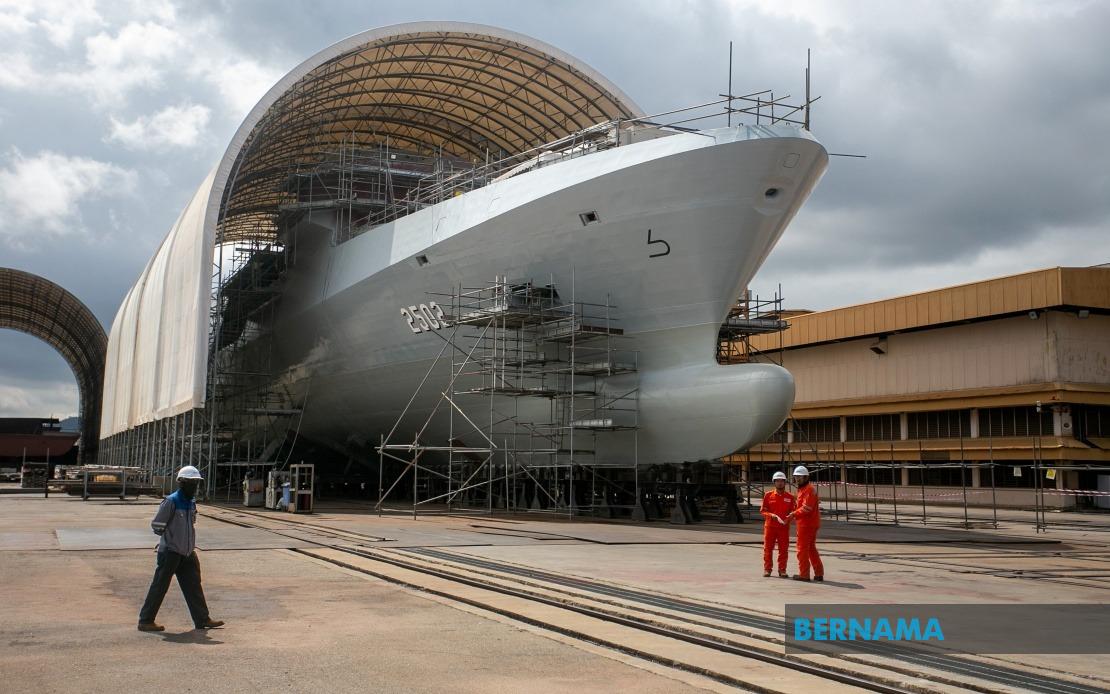
The Ministry of Defence has moved to defend its handling of a RM571.9 million payment to a Norwegian defence contractor for Naval Strike Missile systems destined for the Royal Malaysian Navy's Littoral Combat Ships, asserting that the funds were disbursed only when contractual milestones had been achieved rather than in advance of work completion.
In a parliamentary response addressing concerns raised by members from both government and opposition benches, MINDEF rejected allegations that the government had released payment prematurely or that the procurement agreement lacked adequate protective clauses for Malaysia's financial interests. The clarification comes amid ongoing scrutiny of the LCS project, which has been subject to multiple controversies since its inception, and reflects growing parliamentary attention to defence procurement practices and accountability.
According to MINDEF's statement, the Norwegian supplier had manufactured all NSM systems in full before payment was transferred. Critically, each system had also undergone rigorous testing protocols established by the Royal Malaysian Navy and achieved successful validation before Malaysia accepted delivery. This sequencing—manufacture, testing, acceptance, then payment—differs fundamentally from advance payment arrangements where contractors receive funds without physical progress or demonstrated readiness, a practice that carries substantially higher financial risk to the purchasing government.
The defence ministry emphasised that its contractual arrangement with the Norwegian supplier contained explicit safeguarding provisions that enable Malaysia to pursue remedies should the contractor fail to perform or breach its obligations. These protections become particularly relevant given the subsequent revocation of the export licence by the Norwegian government, an action that MINDEF characterised as beyond the control of either Malaysia or the supplier. Such licence revocations by source governments can fundamentally alter defence procurement landscapes across Southeast Asia, where many nations rely on advanced systems from Western suppliers whose export controls are subject to shifting geopolitical considerations.
The export licence cancellation, while creating significant complications for the LCS programme, has not immediately compromised the operational readiness of Malaysia's maritime forces, according to MINDEF. The Royal Malaysian Navy retains existing weapons systems and assets that continue to serve the nation's maritime defence requirements, providing a operational buffer during the period when alternative solutions are being identified. This distinction between contractual disruption and operational capability is crucial for regional security assessments, as it demonstrates that supply chain interruptions need not translate immediately into capability gaps.
Crucially, MINDEF has disclosed that the Royal Malaysian Navy is actively evaluating and assessing alternative missile systems that could potentially substitute for the Norwegian system. This forward-looking approach suggests that rather than abandoning the LCS upgrade pathway, the Navy is exploring options that might include systems from other suppliers, potentially including those from the United States, European Union members, or regional partners. The missile replacement exercise will likely inform Malaysia's broader defence procurement strategy and could have implications for how other Southeast Asian navies approach similar capability acquisitions from suppliers whose governments maintain restrictive export controls.
The parliamentary inquiries originating from both government and opposition lawmakers reflect legitimate concerns about transparency in major defence spending, particularly given the LCS project's chequered history. Hassan Abdul Karim from Pasir Gudang raised questions about payment timing and contractual protections, while Mohd Kurniawan Naim Moktar from Kinabatangan focused on operational implications and readiness timelines. These questions represent healthy democratic oversight mechanisms, even as MINDEF's responses suggest that the ministry believes it acted appropriately within available contractual frameworks.
The broader context matters considerably for Malaysian stakeholders. The LCS programme represents one of the Malaysian Armed Forces' largest capital acquisitions, and scrutiny of its execution reflects justified public interest in how taxpayer resources are allocated to defence capabilities. Over recent years, the project has encountered multiple delays, cost escalations, and technical challenges that have prompted periodic reassessments of programme viability and value for money. The NSM contract complication adds another layer to this lengthy implementation journey.
From a regional security perspective, Malaysia's experience with export licence revocations highlights vulnerabilities inherent in defence procurement relationships with distant suppliers whose governments may prioritise diplomatic and geopolitical considerations over long-term contractual commitments to individual customers. Other Southeast Asian nations watching the LCS programme's evolution will draw their own lessons about diversifying supplier bases, negotiating technology transfer arrangements, and building regional defence industrial cooperation to reduce future exposure to external constraints on military capability development.
MINDEF's invocation of contractual remedies and its pursuit of claims for payment recovery and damages represent practical responses to an unfavourable external development. The outcome of these legal and diplomatic efforts may influence how future Malaysian defence procurement agreements are structured, particularly regarding liability provisions and dispute resolution mechanisms. The ministry's emphasis on maintaining operational readiness despite the procurement disruption also signals that defence policy flexibility and contingency planning remain essential elements of responsible military stewardship.
The clarification provided to Parliament indicates that MINDEF views the Norwegian export licence revocation as a specific event disconnected from the earlier payment decision. Whether Malaysian courts or international arbitration mechanisms ultimately concur with the ministry's interpretation of contractual obligations and government liability will have lasting implications not only for this particular transaction but also for the framework governing Malaysia's future engagement with international defence suppliers. The resolution of this matter will likely inform procurement policies across the broader Southeast Asian region, where many nations navigate similar challenges in acquiring advanced military systems from suppliers whose export decisions rest with foreign governments.

