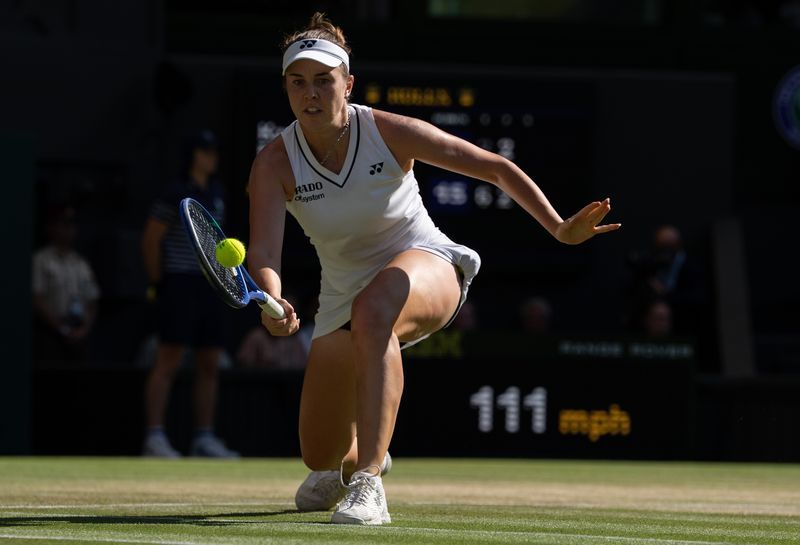
Linda Noskova's maiden Grand Slam victory at Wimbledon offers a masterclass in mental resilience for any young athlete learning to navigate the crushing weight of professional sport. The 21-year-old ninth seed overcame her fellow Czech and friend Karolina Muchova 6-2 5-7 6-3 on Centre Court, but the path to lifting the Venus Rosewater Dish was far more tumultuous than the scoreline suggests. Most players at such a tender age would have crumbled when positioned to deliver the knockout blow, yet Noskova demonstrated the psychological fortitude of a seasoned competitor, regrouping after one of sport's most brutal stretches of missed opportunities.
The turning point came when Noskova held a commanding 5-2 advantage in the second set, with the championship seemingly within arm's reach. Three match points evaporated as Muchova served from 2-5 down. Another dissolved when a double fault on serve at 5-3 punctuated Noskova's mounting anxiety. The fifth and final chance slipped away in the ninth game as the pressure mounted visibly on both players. By the time Muchova staged her extraordinary recovery, reeling off five consecutive games to level the match, Noskova appeared mentally defeated, covering her ears as she walked to her chair to block out the crowd's roar.
The psychological damage of such a collapse could easily have proven fatal to her tournament hopes. Yet what transpired during her bathroom break proved decisive—and more importantly, revelatory about her character. As Noskova walked down the corridor, she noticed the trophies displayed for the finalists. In that moment, seeing the Venus Rosewater Dish alongside the smaller runners-up trophy, a flash of determination struck her. She later recounted the pivotal moment with striking candour: she resolved that she would not be leaving Wimbledon with the small trophy. She splashed cold water on her face, drew a deep breath, and mentally reset, treating the remainder of the match as a fresh contest beginning from the first game of the third set.
This mental recalibration proved instrumental in what unfolded. Remarkably, Noskova held serve in the opening game of the deciding set—a moment she herself recognised as crucial. Had she lost that game, the psychological momentum might have swung definitively toward Muchova. Instead, something shifted almost imperceptibly. Her groundstroke timing returned. Her footwork sharpened. Her confidence solidified. When she again reached match point at 5-3, more than an hour after her first opportunity, Noskova seized it decisively, refusing to be denied a second time.
Noskova's triumph places her among a distinguished but select group. She becomes the third Czech woman to claim the Wimbledon singles title in just four years, a remarkable concentration of excellence from a tennis nation with a rich history at this major. More significantly, at 21 years old, she is the youngest women's champion since her fellow Czech Petra Kvitova claimed the first of her two titles in 2011. The achievement underscores the competitive depth emerging from Central European tennis, particularly the Czech Republic's continued production of elite female talent.
Yet Noskova's character extends well beyond her serve-and-volley prowess on grass courts. She carries a nose ring and possesses a worldview that transcends the insular bubble of professional tennis. Two years before her Wimbledon triumph, she lost her mother Ivana to cancer—a grief that shapes her perspective profoundly. Rather than allowing such personal tragedy to derail her ambitions, she has channelled her pain into a more expansive consciousness about life's meaning and purpose.
This maturity was evident in her decision last year to spend part of her off-season volunteering in Zanzibar, working at a local school through a charitable organisation. Upon returning to the professional circuit, she spoke openly about becoming more appreciative of her privileges and the opportunities afforded to her. Such experiences reveal a player with emotional intelligence and social awareness unusual in someone her age, particularly in a sport often dominated by single-minded pursuit of rankings and titles.
Noskova's environmental consciousness further distinguishes her from the typical Grand Slam champion. Having grown up in a village nestled within a Czech forest, she has developed a deep connection to the natural world and has already begun mapping a post-tennis career centred on environmental conservation and nature volunteering. During this year's tournament, she spoke enthusiastically about her intentions to dedicate significant time to environmental activism once her playing days conclude. This forward-thinking approach to life beyond tennis suggests a person determined to construct meaning and purpose beyond competitive sport.
Her semi-final victory over Ukrainian player Marta Kostyuk on Thursday provided a glimpse of this broader perspective. When discussing her environmental commitments and volunteer work, Noskova emphasised her consistent activism throughout various crises, suggesting a young woman acutely aware of global challenges and determined to contribute meaningfully to solutions. This contextualisation of her own success within a larger framework of human responsibility speaks to a maturity and wisdom that plainly influenced her capacity to recover from Wimbledon's near-disaster.
The practical mechanics of her comeback—the cold water splash, the glimpse of the trophies, the conscious mental reset—constitute merely the visible manifestation of deeper psychological strength. Her ability to reframe devastating failure as opportunity, to convert five lost match points into motivation rather than mortification, ultimately reflects the outlook of someone who has confronted genuine tragedy and emerged with prioritised values. Cancer claimed her mother; a tennis match, by comparison, becomes recoverable.
Noskova's handling of the post-match interviews revealed genuine emotion and gratitude. She recognised that survival through the Muchova match felt almost miraculous in its reversals. The fortnight had demanded everything emotionally and physically, yet she expressed determination to allow the magnitude of her achievement to crystallise gradually. Her commitment to leaving nothing on court in that final set—to departing her soul across the white lines of Centre Court—manifested in the only outcome that truly mattered.
For Malaysian and Southeast Asian sports enthusiasts, Noskova's breakthrough carries instructive lessons about resilience under extreme pressure. Professional sport at this level exposes athletes to conditions that most people never experience—the collision of supreme pressure, international scrutiny, and the devastating proximity to triumph followed by near-certain collapse. That a 21-year-old not only survived such an ordeal but emerged victorious speaks to possibilities that transcend mere athletic talent. Character, wisdom, perspective, and mental fortitude ultimately determined Wimbledon's women's champion this year, qualities that Noskova's broader life philosophy had cultivated long before she stepped onto Centre Court.

